
April 13, 2026 - PBS News Hour full episode
4/13/2026 | 57m 46sVideo has Closed Captions
April 13, 2026 - PBS News Hour full episode
April 13, 2026 - PBS News Hour full episode
Problems playing video? | Closed Captioning Feedback
Problems playing video? | Closed Captioning Feedback
Major corporate funding for the PBS News Hour is provided by BDO, BNSF, Consumer Cellular, American Cruise Lines, and Raymond James. Funding for the PBS NewsHour Weekend is provided by...
April 13, 2026 - PBS News Hour full episode
4/13/2026 | 57m 46sVideo has Closed Captions
April 13, 2026 - PBS News Hour full episode
Problems playing video? | Closed Captioning Feedback
How to Watch PBS News Hour
PBS News Hour is available to stream on pbs.org and the free PBS App, available on iPhone, Apple TV, Android TV, Android smartphones, Amazon Fire TV, Amazon Fire Tablet, Roku, Samsung Smart TV, LG TV, and Vizio.
Providing Support for PBS.org
Learn Moreabout PBS online sponsorshipAMNA NAWAZ: Good evening.
I'm Amna Nawaz.
Geoff Bennett is away.
On the "NewsHour" tonight: The United States blockades Iran's ports after the first round of peace talks fail.
How the move is likely to affect negotiations and gas prices.
Hungary's longtime leader and Trump ally Viktor Orban is defeated in a landslide election.
KIM LANE SCHEPPELE, Princeton University: Everyone could see that the system was cracking under the strain, and Peter Magyar jumped out ahead.
AMNA NAWAZ: And President Trump picks a fight with the pope, who says he won't back down from speaking out against war.
(BREAK) Welcome to the "News Hour."
The U.S.
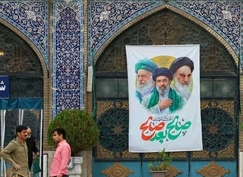
began a blockade of Iranian ports today, less than two days after a first effort at peace talks between the Americans and Iran failed in Pakistan.
White House correspondent Liz Landers begins our coverage.
LIZ LANDERS: Today, in the Strait of Hormuz, it was the U.S.
Navy that said it will enforce a blockade, a choke point for roughly 20 percent of the world's oil now a bargaining chip caught in the middle of an impossible negotiation.
The U.S.
said it would block all ships entering or leaving Iranian ports.
President Trump issued a direct threat, warning that if any Iranian vessel comes close to the U.S.
blockade, it will be -- quote -- "immediately eliminated" and today said there will be no deal until Iran gives up its highly enriched uranium.
DONALD TRUMP, President of the United States: If they don't agree, there's no deal.
There'll never be a deal.
Iran will not have a nuclear weapon, and we're going to get the dust back.
We'll get it back.
Either we'll get it back from them, or we'll take it.
LIZ LANDERS: The escalation follows the failure of 21 hours of marathon talks in Islamabad this weekend.
The negotiations were meant to turn a fragile cease-fire into a broader agreement.
Instead, both sides walked away, blaming each other.
J.D.
VANCE, Vice President of the United States: The bad news is that we have not reached an agreement.
And I think that's bad news for Iran much more than it's bad news for the United States of America.
LIZ LANDERS: Vice President J.D.
Vance said the ball is now in Iran's court.
J.D.
VANCE: We go back to the United States having not come to an agreement.
We have made very clear what our red lines are.
And we leave here with a very simple proposal, a method of understanding that is our final and best offer.
We will see if the Iranians accept it.
LIZ LANDERS: But Iranian Foreign Minister Abbas Araghchi said Iran negotiated -- quote -- "in good faith," but when the sides were just inches away from a deal, the U.S.
turned to what he called maximalist demands and imposed a blockade instead.
Iran's speaker of Parliament reacted to the U.S.
blockade by trolling the president, showing a map of gas prices near the White House in Washington, adding -- quote -- "Soon, you will be nostalgic for $4 to $5 gas."
IAN RALBY, President, Auxilium Worldwide: Unfortunately, this is an escalation by the United States by invoking the doctrine of blockade, which is a law of naval warfare construct.
So this is going to be perceived as aggression against Iran amid this cease-fire.
And so there will be some form of retaliation.
LIZ LANDERS: Ian Ralby is a founder and CEO of Auxilium Worldwide and focuses on maritime security.
He said the blockade could become an open-ended military commitment with global economic consequences.
IAN RALBY: If the American blockade actually does function and it does suspend any movement through the Strait of Hormuz, as it is likely to do, we're actually going to see a further increase in price, because what is happening is that the limited trickle of oil that was coming out, roughly $3.5 billion since the start of this conflict, to largely the Asian markets will become zero.
LIZ LANDERS: Ralby cautioned that the scope of the blockade and how it will be imposed is still unknown, but said it may not hurt Iran as much as the U.S.
hopes.
IAN RALBY: The Iranians are probably going to find ways not only to adapt economically, but also adapt militarily and try to create concomitant harm for everybody else.
So they're likely to push back in different ways.
And that could mean attacking neutral vessels.
LIZ LANDERS: Today, China also came out against the blockade.
Chinese Foreign Minister Wang Yi said it is not in the common interests of the international community and urged for a comprehensive and lasting cease-fire.
The United States' partner in this war, Israel, was not part of recent negotiations, as Pakistan doesn't recognize the state of Israel.
But Israeli Prime Minister Benjamin Netanyahu said the U.S.
and Iran failed to reach a deal because Iran did not open this strait and refused to give up its right to enrich uranium.
BENJAMIN NETANYAHU, Israeli Prime Minister (through translator): Yesterday, I spoke with Vice President J.D.
Vance.
He reported to me in detail, as officials of this administration do on a daily basis.
The central issue on the table from the perspective of President Trump and the United States is the removal of all of enriched material and ensuring that there will be no enrichment in the years ahead, which could be decades of no enrichment inside Iran.
That is their focus.
And, of course, it is also important to us.
LIZ LANDERS: Iran said it will not open this strait until there's also a cease-fire in Lebanon, which it says was part of the cease-fire agreement.
But since the cease-fire in Iran, Israel has intensified its attacks on Lebanon, attacking 100 sites in 10 minutes last week, killing nearly 400 people.
And the search for remains continues.
Hezbollah has also been firing rockets into Northern Israel.
And, yesterday, Netanyahu met Israeli troops in Lebanon and vowed to continue the war.
In Tyre in Southern Lebanon, this family's incomprehensible grief.
They lost their baby girl, Talin (ph), killed in an Israeli strike during her father's funeral.
Talin's elder sister, 7-year-old Aleen (ph), survived, but with severe burns.
And while world powers debate escalation, here, the war's reality is measured not in strategy, but in lives lost.
For the "PBS News Hour," I'm Liz Landers.
AMNA NAWAZ: For perspective now on the situation with Iran, we get two views.
Alan Eyre is now at the Middle East Institute after serving in the U.S.
government for four decades.
He was part of the Obama administration's negotiating team for the Iran nuclear deal, which President Trump pulled out of in 2018.
And Miad Maleki was born and raised in Iran, and until last year he was associate director for sanction targeting with a focus on Iran in the U.S.
Treasury Department.
He's now a senior fellow at the Foundation for the Defense of Democracies.
Welcome to you both.
Thanks for being here.
ALAN EYRE, Middle East Institute: Thanks for having us.
AMNA NAWAZ: Miad, I will begin with you.
Will this U.S.
Naval blockade, will it force the Iranians to change course?
MIAD MALEKI, The Foundation for Defense of Democracies: I think so.
I think it's -- really, with the blockade, the regime now has two options.
Come to its term -- come to back to the negotiations table and accept some kind of a, if not a full deal, but some agreement to continue to negotiate, buy some time, or just accept the fact that the economy is going to collapse.
I think domestically the Iranian regime knows that they're more vulnerable than they are on the battlefield.
I mean, as a matter of fact, they shot down the Internet for over 40 days.
That's about $50 million a day in economic damages that they're taking on, only because they're worried about uprising in country.
So they're taking that hit just to avoid any kind of domestic pressure.
They're going to face that domestic pressure soon if the blockade is effective.
AMNA NAWAZ: Alan, what do you make of that?
You think the U.S.
blockade will have that impact on the regime?
ALAN EYRE: Unfortunately, I'm a little less optimistic than Miad is.
I think, even if the blockade is perfectly done and effective, it will take too long to have the requisite effect on Iran, because there's two dynamics here.
One is, the global economy suffering because the strait is closed.
And the other is whatever pain we can inflict on Iran by a fully effective blockade.
But they have land borders.
There's other ways of getting things in and out of Iran.
So it might be effective over time, but too long a time frame for it to matter.
Secondly, it's escalatory, not just giving Iran more targets to shoot at, but I find it hard to believe the United States is going to try to board, for example, a Chinese vessel or a Pakistani cargo and interdict that and stop that trade.
So I think it's partially performative.
It helps put some additional pressure on Iran, but it won't get Iran to accept current U.S.
terms.
AMNA NAWAZ: What about that, Miad?
I mean, the point is here too, does it incentivize them to come back to the table and negotiate or to see through the threats that they made, which is saying no port in the region will be safe if the blockade... (CROSSTALK) MIAD MALEKI: I disagree with Alan on the point that there are alternative ways for Iran to continue its trade.
You can't truck in $160 million a day in import.
There's no alternative to Persian Gulf and Strait of Hormuz for Iran's trade.
I mean, you're looking at 90 percent of its economy really relying on the trade that goes through the Strait of Hormuz.
They can't continue to take -- they can't sustain running an economy that, can't import anything, can't export anything.
And then eventually they're going to have to drop their oil extraction.
And when you drop your oil extraction because you're running out of oil storage, then you're going to have to shut down your wells, and then you're going to have strikes.
You're going to have labor strikes.
You won't be able to pay salaries.
They have issues with taxation.
They can't collect taxes right now because they have shut down the Internet, because they can't produce metals and they can't produce petrochemicals.
So state of the economy is so vulnerable domestically that I don't think anything can replace the export and trade that we rely on through the Persian Gulf.
ALAN EYRE: Well, I think -- again, I think Miad is right, but I think the time frame is wrong.
In the long run, you're right.
A fully effective blockade brings Iran to its knees.
But like Keynes said, in the long run, we're all dead.
And by the time it's effective, the world economy has gone over a cliff because the Strait of Hormuz is closed.
We saw during COVID that Iran can get by, it can eke by with drastically decreased economic activity, drastically decreased exports of oil.
So, yes, he's quite right that it's an effective tool, but not in the time frame we need to put pressure on Iran.
AMNA NAWAZ: What do you see Alan -- let met stick with you for a moment.
What do you see as enough pressure, sufficient pressure to bring Iran back to the negotiating table and also that might get it to accept some of the U.S.
demands so far?
Do you see anything?
ALAN EYRE: I don't think that's in our bag of tricks.
I think pressure works best in complement with negotiations.
We have enough pressure to bring Iran to the table.
Iran wants to come to the table.
But once they're at the table, for Iran, this is an existential battle.
And so there are certain red lines, just like the U.S.
has red lines.
If what's most important for the U.S.
is the nuclear issue, there's a deal to be had.
Unfortunately for President Trump, it's a lot like the JCPOA.
And that's one of the reasons why he doesn't want to do it.
But what's more important than any possible nuclear deal is, again, largely for time reasons, the strait has to be opened as fully as possible, as quickly as possible.
AMNA NAWAZ: Do you see Iran accepting any of those demands, or does the U.S.
need to rethink them, when we're talking about giving up the right to enrichment, opening up the Strait of Hormuz?
MIAD MALEKI: You know, I think if Iran accepts those 10 demands that President Trump put before them, then, on that day, I would say that there was a regime change.
I think the 10 demands that we put before them, if they accept all 10, then I would say the regime changed, because they really changed what the principles of these regimes, not supporting these terrorist proxies, the enrichment of uranium that they have been, really they have invested close to three -- hundreds of billions of dollars in the nuclear enrichment program.
If the Iranians accept all 10 points, then it would be a really different regime that it is we're dealing with.
That's why I don't think they're going to accept the 10.
I think, with this regime, you can't get a deal that would serve our national security interests.
And I think, with blockade, we have an opportunity to either really see a regime that will change its behavior, which I would say regime change, or really a collapse in Iran's economy, which is going to lead to an opposition movement.
AMNA NAWAZ: Alan, do you see -- where do you see the U.S.
line that might exist for the resumption of military operations here?
ALAN EYRE: I think it's all -- I mean, President Trump has already said that he might do limited strikes.
I think, for domestic political reasons, he's loath to do that because it will spook the markets and lead to further economic price rises.
But he's clearly exasperated.
He's only got one gear.
And that's increased pressure.
And that's not working.
So I don't know what the next step is.
I mean, unfortunately, this administration, U.S.
administration, is both unwilling and unable to do serious, sustained negotiations.
So a diplomatic solution is even harder for that reason.
So, yes, I -- it's hard for me to find a way out of this mess.
AMNA NAWAZ: Miad, we should point out, as we speak here, Vice President Vance has been on FOX and he's repeatedly saying that the ball is in the Iranians' court.
What do you see the Iranians doing in this moment?
MIAD MALEKI: You know, I think we just -- I think, at this point, they're just trying to think how they can cause some increased costs on the blockade, whether it's going to be some asymmetric operations against tankers that are in the Persian Gulf, going after some of the oil refinery or oil facilities in the Gulf.
They're probably in the planning phase, because they understand this blockade is going to lead to economic collapse internally.
It'll be really the end of the way that their economy is set up right now.
And back to Alan's point, I think the diplomatic approach with this regime is just not going to work at this point.
I think there's nothing but pressure that you can really focus on to bring this regime to either accept some of the terms you're putting before them or really just let the Iranians take the government back.
The regime that killed 40,000 -- I think the numbers are much higher, 40,000 innocent Iranians in 48 hours, it's not a type of regime that you can make a peaceful deal with.
They shut down the Internet for 47 days.
Who would do that?
I mean, you cut the entire population out of the international communication systems.
I don't think anything other than pressure would work with this regime at this point.
AMNA NAWAZ: Alan, I will give you the last word here.
Miad says no chance of any diplomatic deal to get out of this.
You say?
ALAN EYRE: I think that's very unlikely too.
Again, it's a peculiarly American misconception to think that every problem has a solution.
We shouldn't have entered this war.
There was no need to.
It was unnecessary.
And, at this point, I think we should be looking not for the ideal solution, but just the least bad solution.
AMNA NAWAZ: Alan Eyre, Miad Maleki, very good to see you both.
Thank you so much.
ALAN EYRE: Thank you.
MIAD MALEKI: Thanks for having us.
AMNA NAWAZ: In the day's other headlines: A federal judge has dismissed President Trump's $10 billion defamation lawsuit against the publisher of The Wall Street Journal for a story on the president's ties to the late convicted sex offender Jeffrey Epstein.
That article from last summer centered on a sexually suggestive letter written for Epstein's 50th birthday that appears to bear Trump's signature.
The president denies writing it.
The ruling marks the latest setback to the president in his efforts to manage fallout from the Epstein files.
Mr.
Trump's legal team said they would refile the suit.
The Trump administration says it will allow the Stonewall National Monument in New York to fly a Rainbow Pride Flag once again.
That reverses an administration directive to remove it back in February, which drew fierce backlash.
It also settles a high-profile lawsuit from LGBTQ+ groups and historic preservationists.
The site is the first ever national monument commemorating LGBTQ+ history.
Pending a judge's approval, the Pride Flag will return to a federal flagpole raised between an American flag and the Park Service flag.
A new study found that deadly antisemitic attacks around the world last year were the highest seen in more than three decades.
In all, 20 people were killed across three continents; 15 of those people were killed in the mass shooting at a Hanukkah celebration on Sydney, Australia's Bondi Beach.
Other deadly attacks were recorded in the U.S.
and the U.K.
The annual report from Tel Aviv University said the violence is part of a spike following Hamas' October 7 attack on Israel and Israel's war in Gaza that followed.
Swimmers from both Russia and Belarus will be allowed to compete on the world stage again without restrictions and with their respective flags and national anthems.
That marks a major shift in a key sport ahead of the 2028 Los Angeles Olympics.
World Aquatics, the sport's governing body, had required Russians and Belarusians to compete as neutral athletes since 2023 after Russia's invasion of Ukraine.
In a statement, World Aquatics said it would - - quote -- "ensure that pools and open water remain places where athletes from all nations can come together in peaceful competition."
And, on Wall Street, stocks staged a big comeback today despite the stalemate and peace talks between the U.S.
and Iran.
The Dow Jones industrial average added 300 points for a modest gain, while the Nasdaq shot up by more than 1 percent.
With a 1 percent gain of its own today, the S&P 500 has rallied to erase nearly all its losses from the Iran war.
Still to come on the "News Hour": Democrat Eric Swalwell resigns from Congress amid sexual assault allegations; Tamara Keith and Jasmine Wright break down the latest political headlines; and media expert Evan Shapiro joins our podcast to discuss the future of the industry.
The incoming prime minister of Hungary struck a hopeful tune today, and for the first time since 2010, it was not Viktor Orban.
Peter Magyar has called for a swift transition of power.
And, as Stephanie Sy tells us, he began to chart an ambitious course to reverse central pillars of Orban's rule.
STEPHANIE SY: In Hungary today, a Budapest street musician sounds notes of jubilance and hope.
He's one of the millions of Hungarians celebrating the weekend's election defeat of Viktor Orban and his 16-year grip on power in this parliamentary republic.
With nearly 80 percent voter participation, 5.9 million Hungarians delivered a clear verdict, overwhelmingly choosing the opposition party Tisza led by Peter Magyar.
Tens of thousands celebrated the results on the torchlit streets of Budapest last night.
The incoming prime minister promises to lead Hungary back to its European alliances.
PETER MAGYAR, Hungarian Prime Minister-Elect (through translator): Yesterday, the Hungarian people made many decisions, perhaps one of the most important being that Hungary's place in Europe was, is and will be a country that is a member of the two most important and largest alliance systems, the European Union and NATO.
STEPHANIE SY: A former Orban loyalist, he ran on an anti-corruption platform.
PETER MAGYAR (through translator): Hungary is in trouble in every respect.
It's been plundered, looted, betrayed, saddled with debt and ruined.
It's been turned into the poorest and most corrupt country in the European Union.
A systemic change is needed, since ours has been effectively controlled by an organized criminal group.
STEPHANIE SY: Prime Minister Orban's hard-line nationalist government eroded democratic norms and institutions, helping him stay in power, from stifling and co-opting independent media to weakening the judiciary's independence.
The nation slid toward what the European Union labeled electoral autocracy.
Magyar's Tisza Party, which won an astounding two-thirds majority in Parliament over the weekend, has vowed to undo Orban's institutional overhaul.
PETER MAGYAR (through translator): We have everything in our power to ensure that this truly marks the beginning of a new era, because the Hungarian people did not vote for a simple change of government, but for a complete transformation of the system.
STEPHANIE SY: Magyar's win was praised by European leaders, including Germany's Friedrich Merz.
FRIEDRICH MERZ, German Chancellor (through translator): As for Hungary and Ukraine, yes, things will be easier now.
This shows that our democratic societies are evidently much more resilient against Russian propaganda.
STEPHANIE SY: Orban was sympathetic to Russian President Vladimir Putin and just last month blocked a $103 billion E.U.
loan package to Ukraine.
At a news conference following his win, Magyar described what he would say to President Putin.
PETER MAGYAR (through translator): If Vladimir Putin calls, I will pick up the phone.
I don't believe that will happen and I won't call him myself.
But if we were to speak, I would tell him, please, after four years, end the killing and stop that war.
STEPHANIE SY: Kremlin spokesperson Dmitry Peskov downplayed the impact of Orban's loss.
DMITRY PESKOV, Spokesman for Vladimir Putin (through translator): We expect to continue our very pragmatic contacts with the new Hungarian leadership.
We have heard statements about a willingness to conduct a dialogue.
I don't think this has anything to do with the future of the Russian-Ukrainian conflict.
STEPHANIE SY: But Hungary's return to the European fold and further from Russia fueled hopes today.
IMRE VEGH, Budapest, Hungary, Resident: I feel very happy.
I have been waiting for 16 years this morning to beat Mr.
Orban.
He had an illiberal system which was against our fundamentals.
We are Europeans and we want to stay in Europe.
STEPHANIE SY: For more now on the Hungarian election and how the results could reverberate around the globe, we turn to Kim Lane Scheppele, a professor of international affairs at Princeton University who lived and worked extensively in Hungary.
Just a few years ago, Magyar was an Orban supporter.
How did his positions win the people during this campaign, Kim, and lead to such a seismic victory?
KIM LANE SCHEPPELE, Princeton University: Yes.
Well, Peter Magyar sprung out of the Orban machine.
He had spent about 20 years being part of the Fidesz Party as a loyalist, as someone who came up through the ranks, as someone who benefited a lot from actually his association with Orban.
And so there were a couple of events that I think caused him to pop out of the woodwork, so to speak, and take on Orban as a challenger.
One was that his ex-wife, Judit Varga, had just been fired as prime minister in a scandal that was probably Orban's fault, but that he blamed on her, and he kind of came to her defense very publicly.
But the second thing was that the European Union, having gotten really fed up with Orban, had cut most of the funds that the E.U.
gave to Hungary, putting Hungary in a financially precarious position.
And so everyone could see that the system was cracking under the strain, and Peter Magyar jumped out ahead.
So he came out of the woodwork.
He didn't really have much of a prior profile.
And he came out as a critic of Orban, and particularly as a critic of Orban's corruption, because he knew where all the bodies were buried, and he was a very credible source on exactly what that corruption was.
And he took that corruption beam right up through his victory this week.
STEPHANIE SY: So now there's this expected turn back toward Europe.
But when it comes to Ukraine, Orban has been blocking billions of dollars of aid that the E.U.
wants delivered to Ukraine.
What should we expect moving forward on Hungary's role in the war?
KIM LANE SCHEPPELE: Well, I think that Peter Magyar will stop being an irritant to the E.U., and my guess is that he will probably not exercise the Hungarian veto on this giant loan to Ukraine.
That said, I don't think he is going to sort of cuddle up to Ukraine very much, because over the years Orban has really whipped up a kind of anti-Ukrainian sentiment in Hungary.
And I think this whole foreign policy issue about the war next door is not really where Magyar wants to spend his time.
So I think he will get out of the way of Europe.
He won't block it, but he's not going to be there as a giant supporter cheering on Ukrainian - - on the Ukrainian fight against Russia.
He has promised quite starkly, I think, to cut the Russian ties that Orban had cultivated.
And so I think the -- insofar as the Ukrainian veto on Ukraine was part of Orban's making nice with Russia, that reason will be gone.
STEPHANIE SY: Orban's 16-year-old hold on power helped write a playbook that populist leaders, including critics say, our own President Trump have used.
What does Orban's loss mean for this type of strongman leadership in other Western democracies?
KIM LANE SCHEPPELE: A lot of Orban's machinery that has supported the far right across Europe, and, for that matter, has helped the far right in the United States, a lot of that machinery is going to remain intact, because the funding that holds up this huge operation called the Mathias Corvinus Collegium and its various think tanks like the Danube Institute, has been buffered from change by an incoming government.
And it's going to go on operating even without having a state behind it.
So it's a mixed story on all that.
And I might say that this Danube Institute, which is Viktor Orban's English-language think tank, was a partner with The Heritage Foundation in drafting Project 2025.
And the way that you can see that is that Trump's opening salvo months exactly duplicated what Viktor Orban had done when he came to power in 2010.
So, I think the Trump administration has lost a friend and an ally.
STEPHANIE SY: And yet, even with this playbook, Orban lost with almost 80 percent of the populists turning out.
Does Magyar's rapid ascent potentially offer a playbook for Trump's political opponents?
KIM LANE SCHEPPELE: Yes, so the way that Magyar won I think is very instructive to other oppositions trying to fight back against autocracy.
The first thing is that autocrats do try to rig the rules in their favor.
So when a pro-democratic candidate runs, he's got to figure out how to get around the rigged rules in the system.
And Peter Magyar had figured out that the way Orban's system was set up was that a rural voter would have roughly three times the weight in the parliamentary elections as an urban voter.
All of the oppositions had previously cultivated the cities, more cosmopolitan, more anti-authoritarian, you might say.
Peter Magyar went out to every single village in person to persuade Orban's base, actually, that Orban was not acting in their interests.
He also built this huge big tent so that people who voted for him probably agree on very little else than that Orban has to go and that democratic institutions have to be rebuilt.
So -- and that the corruption all has to stop.
So, very cleverly, Magyar played the issues that appealed to the broadest group.
And he ignored all of the pleas to deal with issues that only dealt with part of his base.
So, big tent, figuring out the election rules, figuring out a path to victory, all of that matters.
STEPHANIE SY: And the world is watching.
Kim Lane Scheppele of Princeton University, thank you.
KIM LANE SCHEPPELE: Thank you.
AMNA NAWAZ: President Trump is openly condemning the head of the Roman Catholic Church after Pope Leo XIV criticized the U.S.
and Israeli war with Iran.
William Brangham reports on the rare public battle between the president of the United States and the first U.S.-born pope.
WILLIAM BRANGHAM: After his attacks on Pope Leo earned him global condemnation, the president this afternoon refused to relent.
DONALD TRUMP, President of the United States: We believe strongly in law and order, and he seemed to have a problem with that, so there's nothing to apologize for.
He's wrong.
WILLIAM BRANGHAM: The president's remarks today doubled down on his lengthy tirade online and on the tarmac last night.
DONALD TRUMP: He's a very liberal person, and he's a man that doesn't believe in stopping crime.
He's a man that doesn't think that we should be going with a country that wants a nuclear weapon so they can blow up the world.
I'm not a fan of Pope Leo.
WILLIAM BRANGHAM: The president spoke yesterday after returning to Washington from Florida.
Echoing his post on social media, where he took issue with Pope Leo's criticism of American actions in Venezuela and Iran, he wrote -- quote -- "I don't want a pope who criticizes the president of the United States, because I'm doing exactly what I was elected in a landslide to do."
The president also implied that the first ever American pope owed his job to Trump, writing: "If I wasn't in the White House, Leo wouldn't be in the Vatican."
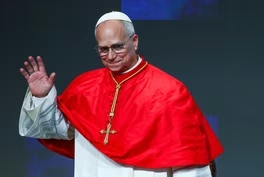
Today, en route to Algeria, Pope Leo responded.
POPE LEO XIV, Leader of Catholic Church: I have no fear neither of the Trump administration, nor speaking out loudly about the message of the Gospel.
And that's what I believe I am called to do.
WILLIAM BRANGHAM: The pontiff defended his earlier comments about the evils of war.
POPE LEO XIV: I basically said that the message of the church, my message, the message of the Gospel, blessed are the peacemakers.
I do not look at my role as being political, a politician.
I don't want to get into a debate with him.
I don't think that the message of the Gospel is meant to be abused in the way that some people are doing.
And I will continue to speak about this, against war, looking to promote peace, promoting dialogue and multilateral relationships among the states to look for just solutions to the problems.
WILLIAM BRANGHAM: It was Pope Leo's comments two days ago that apparently sparked the president's anger.
At a special prayer vigil Saturday night at St.
Peter's Basilica, Leo denounced the -- quote -- "delusion of omnipotence" that he argued was fueling the war in Iran and other global conflicts.
POPE LEO XIV (through translator): May the madness of war cease and the Earth be cared for and cultivated by those who still know how to create, safeguard and love life.
WILLIAM BRANGHAM: Today, the president's comments about the pope drew widespread criticism.
Catholic Bishop Robert Barron, who leads the Diocese of Winona-Rochester in Minnesota and serves on the White House's Religious Liberty Commission, wrote: "The statements made by President Trump on TRUTH Social regarding the pope were entirely inappropriate and disrespectful.
I think the president owes the pope an apology."
The head of the U.S.
Conference of Catholic Bishops, Archbishop Paul Coakley, also issued a statement -- quote -- "I am disheartened that the president chose to write such disparaging words about the Holy Father.
Pope Leo is not his rival, nor is the pope a politician.
He is the vicar of Christ, who speaks from the truth of the Gospel and for the care of souls."
President Trump stoked more outrage when he posted this Christlike image of himself, hands glowing and healing a sick man.
When even some allies condemned the image as blasphemy, the president took it down, saying it had been misconstrued.
DONALD TRUMP: It was me.
I did post it.
And I thought it was me as a doctor and had to do with Red Cross.
There's a Red Cross worker there, which we support.
And only the fake news could come up with that one.
WILLIAM BRANGHAM: President Trump's relationship was also tense with Pope Leo's predecessor, Pope Francis.
They clashed at times over immigration and climate change.
After Francis died, the president posted another A.I.-generated image, this one of himself wearing papal robes.
Meanwhile, after landing in Algeria today... POPE LEO XIV: In this place, let us remember that God desires peace for every nation.
WILLIAM BRANGHAM: ... Pope Leo laid a wreath at the monument honoring those who died in that nation's war for independence and said a prayer for peace.
For the "PBS News Hour," I'm William Brangham.
AMNA NAWAZ: Democrat Eric Swalwell of California announced today he will resign his seat in Congress after reports from multiple women accusing him of sexual misconduct, including in one case rape.
In a statement this afternoon, Swalwell wrote -- quote -- "I will fight the serious false allegations made against me.
However, I must take responsibility and ownership for the mistakes I did make."
Earlier today, the House Ethics Committee had launched an investigation, as some of his Democratic colleagues called for his expulsion from the chamber.
And, over the weekend, he also ended his campaign to be governor of California.
Our congressional correspondent, Lisa Desjardins, is here now with the latest.
So, Lisa, just remind us, what exactly were the allegations brought against Eric Swalwell?
LISA DESJARDINS: Rumors first rose over social media for the past few days, but starting on Friday and over the weekend, we saw reporting first from The San Francisco Chronicle and then CNN,bombshell, specific accusations against Congressman Swalwell.
CNN said that four women accused Swalwell of misconduct.
Most were anonymous.
One was named.
Now, those charges range from unsolicited explicit messages or nude photos, to unwanted touching, to one accusation of rape.
Now, we have not independently verified those charges.
The rape accusation in both stories is similar.
It's made anonymously by a woman who says, when she worked for Swalwell, he took her out for drinks and then she passed out, and she believes she was raped while she was passed out by Swalwell.
She says, years later, after she stopped working for him, she again was alone with Swalwell.
And she says, that time, that she was raped after she said no to intercourse with him.
Now, Swalwell says none of that happened.
He has maintained his innocence about that sexual misconduct.
But he did say he made some mistakes against his wife.
Now, the question then is, why did he resign today?
Let's look at more of his statement that he came out with.
He wrote: "I am aware of efforts to bring an immediate expulsion vote against me and other members.
Expelling anyone in Congress without due process within days of an allegation being made is wrong.
But it is also wrong for my constituents to have me distracted from my duties."
Essentially, two things there.
He's saying he doesn't want the precedent of due process being rolled over.
And he's also saying it seems he feels the votes might have been there to expel him.
Now, of course, all of this came after he was in a major election battle, as you said.
I reached out to Swalwell personally.
I have covered him for years.
I have not heard back.
AMNA NAWAZ: You have as part of your reporting been talking to staff and others.
And it's -- you have learned that staff saw red flags for years?
Is that right?
LISA DESJARDINS: That's correct.
This is something you often think of as a whisper campaign.
This is unfortunately one of the major systems of protection for some Hill staffers.
Now, I learned from two different staffers who I have known for a while, have covered and worked with in the past.
One told me that multiple times they knew of Swalwell reaching out to interns, in one case Swalwell asking an intern for their Snapchat address to communicate that way, which it's not easy to understand why a member of Congress would want to Snapchat with a young intern.
The other staff telling me that Swalwell -- he saw that -- Swalwell on the floor of Congress, taking young women there after hours, and that the idea was that was sort of something he did repeatedly.
Now, both of them saying that there was a whisper campaign to tell some interns and other young women especially to stay away from him.
But that's the problem with a whisper campaign.
It depends on being in the right place, having the right person looking out for you.
AMNA NAWAZ: Now that he's resigned, there's no need to expel him.
But where does all of this leave some of the other efforts to expel other members of Congress?
LISA DESJARDINS: That's right.
And this is breaking news right now.
I have confirmed with two different sources that we now expect Tony Gonzales, the Republican from Texas, to announce his plan to resign tomorrow.
Now, as many of our viewers will remember and we have covered before, this last month, Gonzales admitted that he had a sexual relationship with a former staffer who died by suicide.
We also in the last week saw reports that another former staffer of Gonzales' came out and said that he sent her explicit and unwanted messages.
Sleeping with staffers by members of Congress is explicitly against House rules.
There was bipartisan backlash against both Gonzales and Swalwell.
Both were up for potential expulsion.
We're seeing both of them reacting to that right now.
Now, one example here, Gonzales' fellow Republican Byron Donalds spoke yesterday.
REP.
BYRON DONALDS (R-FL), Gubernatorial Candidate: These allegations are despicable and they demean the integrity of Congress.
These things are just completely unacceptable.
As far as I'm concerned, both gentlemen need to go home.
LISA DESJARDINS: Now, the Swalwell expulsion really grew from Democratic calls for their own member, for Swalwell to leave.
Democrat Teresa Leger Fernandez, she heads the Congressional Women's Caucus.
She said Swalwell needed to go.
And I spoke to her earlier.
She said the entire ethics process is deeply flawed.
REP.
TERESA LEGER FERNANDEZ (D-NM): We need to fix our ethics process because it needs to work faster.
It needs to be easier for women staffers to report what's going on.
LISA DESJARDINS: Do you think there's a broader culture of sexual misconduct on the Hill?
REP.
TERESA LEGER FERNANDEZ: I do believe that that's a problem, until there is accountability, which means you lose your job because of sexual harassment.
And there could never be consent in that power position, right, that you need to be -- both have a public accountability and then accountability in the House rules.
And this will make a difference, I think.
LISA DESJARDINS: The question of accountability is not over because Swalwell and Gonzales were not alone.
You can see in this photo two other members of Congress, Florida Democrat Sheila Cherfilus-McCormick.
The Ethics Committee has found that she fraudulently kept and used hundreds of thousands of dollars in COVID relief money.
They are planning on issuing a punishment for her in the next couple of weeks.
And Republican Cory Mills of Florida, financial and sexual misconduct charges.
Both of them have said they are wrongly accused.
Now, Amna, only six members of Congress have ever been expelled in history, mostly because they're usually -- they get in a position where they just resigned, rather than face a two-thirds vote.
It's a high bar to expel them, but this was in consideration.
AMNA NAWAZ: Meanwhile, I know you have been reporting on the ethics process, talking to current and former staffers about that culture.
What did they tell you it's like on the Hill right now?
LISA DESJARDINS: I have spoken to so many current and former staffers today, senior, junior, former interns, everyone.
And they all agree that after the MeToo movement, which we covered, I think, well, here on the "PBS News Hour," on the Hill, there were changes.
However, they think, in recent years, those changes have been ignored and have been rolled back.
And what I heard was really the idea of a culture that is an underlying subterranean, as one person called it, problem.
Let's look quickly at the system right now on the Hill for dealing with these ethics problems.
Lawmakers and staff are required to get sexual harassment training every year.
Now, there are also multiple offices where misconduct can be reported.
But most of those offices can keep those investigations secret and they take a long time.
Part of that is, of course, they want to be thorough.
There is due process, of course, to members and staff members who are accused.
But there are many critics who say that's gone too far now and that it's protecting those who are doing the wrongdoing in this case.
There are, of course, many professional, supportive offices in Congress.
I don't want people to think that the entire place is dangerous.
However, I am convinced by my talks today that we really have seen a reckless sometimes and often careless deepening culture of harm on Capitol Hill.
AMNA NAWAZ: Lisa Desjardins, great reporting, as always.
Thank you.
LISA DESJARDINS: You're welcome.
AMNA NAWAZ: Let's delve further now into the day's political headlines, Congressman Swalwell's resignation, the feud between the president and the pope, and, of course, the war in Iran.
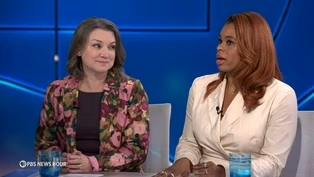
For that, we turn to our Politics Monday duo.
That's Tamara Keith of NPR and Jasmine Wright, White House correspondent for NOTUS.
Amy Walter is away.
It's great to see you both.
TAMARA KEITH, National Public Radio: Good to be here.
AMNA NAWAZ: Let's pick up where Lisa left off there.
And, Tam, I will start with you.
Your reaction to the news of Eric Swalwell's resignation, under growing pressure from his own fellow Democrats?
What it means for the California governor's race too.
What do you make of it?
TAMARA KEITH: Well, in terms of the California governor's race, that race had been sort of stuck.
It's a huge field of Democrats, two major Republican names, and it was -- it just hadn't really moved much at all.
And then in the past week, we got President Trump endorsing Steve Hilton, one of the Republican candidates, and then Eric Swalwell dropping out.
Swalwell had in some polls been the leading Democrat.
That really scrambles that race.
Some Democrats had been concerned that -- it's a top two primary.
Democrats and Republicans all compete against each other to find out who will go on to the general election.
There had been some concern among Democrats that two Republicans would emerge from that primary.
Now, with Trump endorsing Hilton and with Swalwell dropping out, there's some -- there's more movement in this race than we have seen in a long time.
And it seems likely that it will end up being a Democrat and a Republican that makes it out.
AMNA NAWAZ: Jazz, what do you make of how quickly this all moved with Eric Swalwell, and also the pressure he was under from his own fellow Democrats?
JASMINE WRIGHT, NOTUS: I mean, it showed that it had momentum.
And I think, to Lisa's point, it showed that he at least believed that there could have been a vote to expel him, something that, again, is a high bar and doesn't often happen.
I will say that, if you take a step back, Democrats for the last eight months have really been focused on this idea of accountability.
We have seen them push forward on the Epstein files, wanting to see more people brought in, in front of the House, Oversight Committee wanting to see more people be deposed, wanting to see the Department of Justice do more, show more files.
That's really been a charging message of their own.
And so it would have looked pretty hypocritical if for their own party they didn't say, hey, you have these really horrid and tragic allegations against you.
You can stay in the House.
And I think that the key mark that we saw earlier today was Senator Ruben Gallego, a close friend of Eric Swalwell's, come out and say that I support expelling him because of these allegations.
That kind of was a canary in the coal mine.
And then, afterwards, we saw that message from Eric Swalwell.
AMNA NAWAZ: Of course, we're now also following the back-and-forth between President Trump and the pope.
Pope Leo last week condemned the president's rhetoric towards Iran.
Trump has criticized him over the weekend.
The pope said today he has no fear of the Trump administration.
Tam, it is not the first time that the president has criticized the pope.
But I also want to point out, as we reported earlier, the president posted this picture of himself as Jesus, it looks like in the photo, before deleting it today.
When he was asked about it, he said he did post it.
He thought it was an image of him as a doctor.
From the president's perspective, someone you have covered for years, what's going on here?
TAMARA KEITH: The president probably saw something on TV about the pope and got upset at things that the pope was saying.
The pope has been subtle, but not entirely subtle.
He's made it clear that he believes that the war in Iran is problematic and that he has offered some shade about the war.
And then you have the president.
He frequently posts A.I.
images that put him in a glowing light, quite literally a glowing light in this one as Jesus.
And there was that previous post where he had himself in papal gear.
He is just a sucker for A.I.
images that show him doing something awesome.
And so these posts happen late at night, and it's just incredibly common.
The president also has a view that he was saved in Butler, that he is in office to do God's will.
He really has... AMNA NAWAZ: The assassination attempt against him, we should say.
TAMARA KEITH: Yes.
JASMINE WRIGHT: Yes.
TAMARA KEITH: Yes, after the assassination attempt.
AMNA NAWAZ: But that he is there because of divine intervention.
TAMARA KEITH: He is there because of -- yes, exactly.
AMNA NAWAZ: Well, Jazz, pick up where Tam is leaving off here.
And we should also point out that he's seen a bit of a dip in support from groups that might care about these kinds of issues.
The latest numbers from Pew show less than half of white Catholics now support his agenda.
It's a five-point drop from last year, eight-point drop in white evangelicals, 13-point drop among white Protestants.
How do you look at that?
JASMINE WRIGHT: I mean, I think you have to take a look back to 2024, which is the coalition that he put together to win going back into the White House.
It was kind of a handshake deal from the Christian right, from the Catholic right, who may not like everything about President Donald Trump, who may not like part of his personality, the brashness, but like fundamentally what he has decided to do on abortion, has decided to do on other issues that they really care about, expanding the rights of the church in America, something that perhaps maybe a Democratic president wouldn't have done so quickly.
And so they made that agreement, in essence, to kind of vote for President Trump, and not only white Christians and white Catholics, but also Hispanic Christians and Hispanic Catholics.
So that was that kind of armchair deal with them.
And so now you're looking at it, and the question is whether or not they're feeling that that's fulfilled.
I think that your -- those polls are concerning, and that's why you saw J.D.
Vance just a few minutes ago on FOX basically trying to downplay it, say the president likes to post jokes, and he took it down because people did not -- he felt that people did not understand his humor.
But when we go back to the midterms in November, the question is going to be whether or not they can pull some of that coalition that put President Trump back at the White House in November.
And numbers like that don't show - - or don't provide a sense of confidence.
And things like this obviously don't grow numbers like that.
AMNA NAWAZ: Meanwhile, Vice President Vance is just back from Pakistan, Tam, as you know, where he was in those first round of talks to actually get an end to the war in Iran.
They failed to get that deal.
We're now in a world, Tam, as you know, where gas prices are going up.
The national average is now over $4 a gallon.
The president said they could be even potentially higher by midterms.
Is this president incentivized to make a deal with Iran?
TAMARA KEITH: The president has given every indication that he wants to make a deal, though he does have red lines, as J.D.
Vance talked about in that FOX News interview, the red lines involving nuclear weapons or the ability to make nuclear weapons, the president wanting to get that enriched uranium that is currently buried deep under the earth.
So -- but the president wants a deal and needs a deal.
And his action related to the blockade of the Strait of Hormuz is another acknowledgement of that, that he's trying to find a way to get an upper hand, he's trying to find a way out, because every voter I talk to these days - - and I have been talking to a lot of swing voters who voted for President Trump -- they all mention gas prices.
It is a very real and present problem in people's lives, which makes it a very real and present problem for the politicians.
AMNA NAWAZ: Jazz, how do you look at it?
JASMINE WRIGHT: Yes, I think the president is trying to create leverage.
And they want Iran to come back to the table.
Now, there are reports that there are negotiations going on.
There are reports that there could perhaps be another set of talks, although it seems like it'd be on a lower level than what we saw, Vance in Pakistan, over the weekend.
But, fundamentally, I think you are seeing two notable things.
One, you're saying -- you're seeing President Trump say, I think that they will come back and make a deal.
Now, this is obviously something that he said before, but we know that he really wants to find a solution so that they can move on.
When I talked to White House officials last week, they talked about things in the future, looking past Iran.
So the White House wants to get past this conflict.
And then, secondly, you're not hearing him go back to the language of combat or strikes.
Yes, he says that it could happen, but you're not hearing him full-throatedly endorse it.
And so it's very clear that the White House wants to make some sort of diplomatic deal, no matter how difficult that may seem at the moment.
AMNA NAWAZ: Jasmine Wright, Tamara Keith, great to start the week off with you both.
Thank you so much.
JASMINE WRIGHT: Thank you.
AMNA NAWAZ: Well, the media industry has been navigating substantial turmoil in recent years, from big mergers to layoffs to accusations of government censorship.
On a recent episode of our PBS News podcast "Settle In," Geoff Bennett explored all this upheaval with Evan Shapiro.
He's an award-winning producer who now writes about the industry for his Substack Media War & Peace.
Here now is a clip of that conversation.
EVAN SHAPIRO, Media War & Peace: I do think we have this perception that very few people control the media.
That is less and less true on an ongoing basis, especially when you consider that YouTube is now the biggest channel on TV sets in the U.S.
and everyone says, well, they're the big tech.
They control so much voice.
In reality, YouTube is 4.6 million different channels.
And a million of them control a lot of the voice there, but that's still a million channels.
So, in my mind, fragmentation is now the most important factor in media.
I like to say that, when I was rising up in media, it was a lot easier because your competition was a few other channels.
Now your competition is everybody, all seven billion people on the planet Earth with a smartphone.
The good news is that, back when I was coming up in media, there were only a few buyers of the stuff that you would make.
Now there are seven billion, eight billion buyers of the media you make.
So the control has shifted from these ivory towers, who think they're still in charge, to the consumer themselves, who really do control the media in their system settings whenever they touch that piece of glass that they pick up first thing in the morning.
GEOFF BENNETT: You recently gave a talk called "The Year of Change or Die," which is pretty -- pretty stark framing.
What did you mean by that?
EVAN SHAPIRO: So this is the year that the combination of the creator economy and mainstream media will really intersect in a way that they hadn't before.
And you see this in Procter & Gamble producing a microsoap for TikTok and Instagram.
You see this in MrBeast being on Amazon, Ms.
Rachel being on Netflix.
And so the folks who operate their businesses by the vanity metrics of eras past, they're going to find it more and more difficult to succeed.
The best example I will give you is, last year, all premium streamers on the face of the Earth -- so these are the paid streaming platforms like Amazon Prime and Netflix and Disney+ and Hulu and the rest -- they gained 175 million new subscribers.
Hooray.
They also lost 158 million subscribers.
The retention has been -- it's a third of what it was five years ago.
It's half of what it was four years ago.
They're going to get to a zero retention in the next couple of years, and then suddenly, premium streaming, this thing that was going to save television, right, is going to be in the same place cable is, losing subscribers, revenues shrinking, instead of growing.
And, in reality, at the same time, these social media platforms, social video, things like YouTube, TikTok, Instagram, Snap, these are now where people under the age of 50, not under 30, not under 20, under the age of 50, they're spending much more time there than they are on other platforms.
The fastest growing segment of viewers of YouTube on television are people 55-plus.
AMNA NAWAZ: And you can watch that full conversation and all episodes of "Settle In" on YouTube or wherever you get your podcasts.
And that is the "News Hour" for tonight.
I'm Amna Nawaz.
On behalf of the entire "News Hour" team, thank you for joining us.
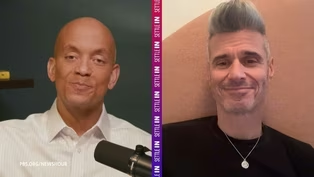
Evan Shapiro and Geoff Bennett on the future of media
Video has Closed Captions
Evan Shapiro and Geoff Bennett explore the future of media on 'Settle In' (3m 39s)
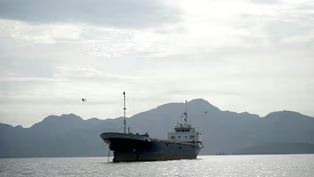
How the U.S. blockade could pressure the Iranian regime
Video has Closed Captions
Mideast experts discuss how the U.S. blockade could pressure the Iranian regime (8m 58s)
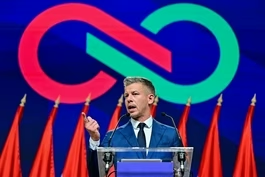
How the vote to oust Orbán could have global implications
Video has Closed Captions
How Hungary’s vote to oust Viktor Orbán could have global implications (10m 8s)
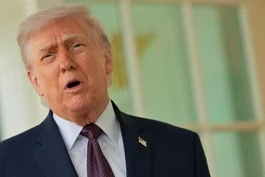
News Wrap: Judge dismisses Trump's lawsuit against WSJ
Video has Closed Captions
News Wrap: Judge dismisses Trump's lawsuit against WSJ for story on Epstein ties (3m 13s)
Pope Leo vows to continue speaking out after Trump clash
Video has Closed Captions
Trump clashes with Pope Leo, who vows to continue speaking out against war (4m 59s)

Rep. Swalwell resigning after sexual assault accusations
Video has Closed Captions
Swalwell resigning from Congress after sexual assault accusations (7m 52s)
Tamara Keith and Jasmine Wright on Trump, Pope Leo feud
Video has Closed Captions
Tamara Keith and Jasmine Wright on Trump's feud with Pope Leo (8m 48s)
U.S. begins naval blockade after Iran peace talks fail
Video has Closed Captions
U.S. begins Strait of Hormuz naval blockade after Iran peace talks fail (5m 15s)
Providing Support for PBS.org
Learn Moreabout PBS online sponsorship
- News and Public Affairs

Today's top journalists discuss Washington's current political events and public affairs.

- News and Public Affairs

FRONTLINE is investigative journalism that questions, explains and changes our world.












Support for PBS provided by:
Major corporate funding for the PBS News Hour is provided by BDO, BNSF, Consumer Cellular, American Cruise Lines, and Raymond James. Funding for the PBS NewsHour Weekend is provided by...