
August 21, 2026
8/21/2026 | 55m 38sVideo has Closed Captions
Annalena Baerbock; Sepideh Moafi; Sherine Ibrahim; Susan Saulny
President of the U.N. General Assembly Annalena Baerbock discusses the U.S.-Iran deal. “The Pitt” actress and activist Sepideh Moafi and IRC’s Sherine Ibrahim mark World Refugee Day. Susan Saulny uncovers a decades-old family secret and unpacks its impact on her family.
Problems playing video? | Closed Captioning Feedback
Problems playing video? | Closed Captioning Feedback
August 21, 2026
8/21/2026 | 55m 38sVideo has Closed Captions
President of the U.N. General Assembly Annalena Baerbock discusses the U.S.-Iran deal. “The Pitt” actress and activist Sepideh Moafi and IRC’s Sherine Ibrahim mark World Refugee Day. Susan Saulny uncovers a decades-old family secret and unpacks its impact on her family.
Problems playing video? | Closed Captioning Feedback
Where to Watch Amanpour and Company
Amanpour and Company is available to stream on pbs.org and the PBS app.
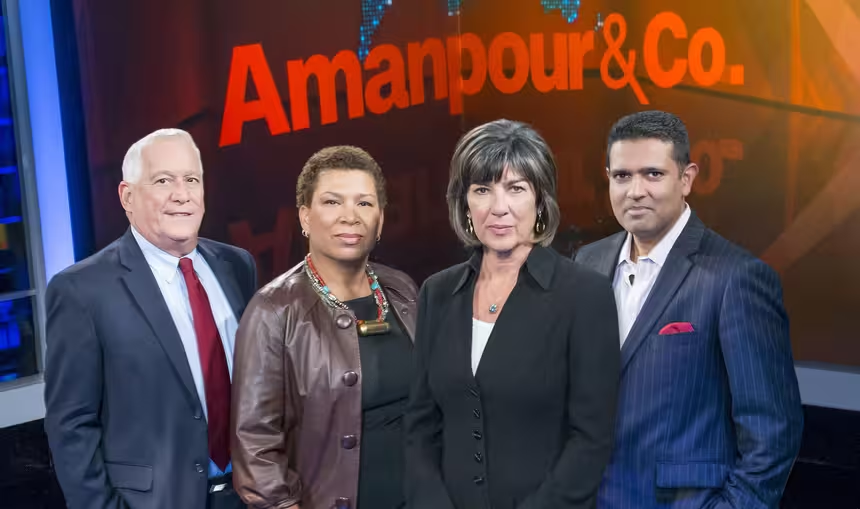
Watch Amanpour and Company on PBS
PBS and WNET, in collaboration with CNN, launched Amanpour and Company in September 2018. The series features wide-ranging, in-depth conversations with global thought leaders and cultural influencers on issues impacting the world each day, from politics, business, technology and arts, to science and sports.Providing Support for PBS.org
Learn Moreabout PBS online sponsorship(graphics whooshing) (dramatic music) - Hello, everyone, and welcome to "Amanpour & Company."
Here's what's coming up.
- We need a just and lasting peace, and having a refocus on these debates is extremely important because people are dying everywhere.
- [Christiane] War and peace in the balance.
I asked the president of the UN General Assembly, Annalena Baerbock, for a reality check on Trump's Iran agreement, Ukraine's resilience against Russia, and the future of the United Nations.
Then... - I have lived with the stories and the journey of my parents and the pain of displacement and exile my whole life.
- [Christiane] To mark World Refugee Day, I hear from the International Rescue Committee's Sherine Ibrahim, and a former refugee now star of the acclaimed TV show, "The Pitt," Sepideh Moafi.
Also ahead, a family secret no more.
Reporting on her own history, journalist Susan Saulny tells Michel Martin the story of two Black brothers, one living under Jim Crow laws, the other passing as white.
(dramatic music) (dramatic music continues) - [Narrator] "Amanpour & Company" is made possible by the Anderson Family Endowment, Jim Attwood and Leslie Williams, Candace King Weir, the Sylvia A. and Simon B. Poyta Programming Endowment to Fight Antisemitism, the Straus Family Foundation, the Peter G. Peterson and Joan Ganz Cooney Fund, Charles Rosenblum, Monique Schoen Warshaw, Koo and Patricia Yuen, committed to bridging cultural differences in our communities, Barbara Hope Zuckerberg, and by contributions to your PBS station from viewers like you.
Thank you.
- Welcome to the program, everyone.
I'm Christiane Amanpour in London.
A win-win or a capitulation?
This week, G7 allies praised President Trump for his agreement with Iran as he signed his very own Versailles Treaty at a dinner with them on Wednesday night.
But even many of his own Republican supporters are highly critical.
Here's his former vice president, Mike Pence.
- I do have concerns about the memorandum of understanding now that we see it, and the terms about what's in it and also what's not in it suggest to me that it does smack with the kind of appeasement that our administration rejected in the Obama-Iran nuclear deal.
- The MOU is in agreement to deal with the biggest challenges ahead, especially the nuclear file.
But it is front-loaded with immediate concessions to Tehran, notably to waive sanctions on its oil exports, with billions of dollars then flowing back into the regime's coffers, and no mention of human rights for the Iranian people.
Is this a case of a superpower misjudging its less powerful adversary, like Vladimir Putin has done with his invasion of Ukraine?
This week, the G7 committed to supporting Ukraine and strengthening sanctions on the Kremlin.
And Kyiv has pounded Moscow with his heaviest drone barrage of the war, forcing the capital to temporarily close its airports.
And the latest from the front, it is Ukraine now incrementally pushing Russia back.
Now that the Iran agreement is signed, perhaps Trump will turn his attention back to negotiations between Putin and Ukraine.
But where has the United Nations been all this time?
Historically, it is the global conflict resolution mechanism.
Annalena Baerbock is a former German foreign minister and now President of the UN General Assembly.
I spoke to her this week to discuss the state of war, peace, and the future of the United Nations.
Annalena Baerbock, welcome back to our program.
- Thank you so much for having me on the show.
- So, there are big issues that are being talked about right now, issues that are not just global, but also very pertinent to the United Nations.
Let me ask you first about what you think is going to be the result of this MOU between the United States and Iran.
What do you think it's going to lead to?
- Hopefully to more peace and ending the consequences all around the world, because ending hostilities, ending a war, is always a good thing.
Yet we have to be very honest to ourself to see where the world stood before February 28, and some of the dramatic consequences will be felt even in months after.
Fertilizers not getting to different parts of the world, especially to those who need it most, will be consequential for the poorest around the world not having the harvest they should have.
Also, the energy prices hit the poorest most.
And we should not forget about the people of Iran demanding freedom for themselves for a very, very long time, and therefore a ceasefire, an end of war, an end of hostilities is always very important, it's always the best we can achieve, yet we should not ignore that the reasons after this war, and also that the Secretary General and I called immediately to everyone that the charter is not optional, but that there's a reason that member states should settle, that this was peacefully should be one of the strongest reminder of the last months.
- Because the nuclear issue is also so important to the United Nations, this is still to be negotiated.
Iran is going to pledge, or it has pledged, that it will not seek a nuclear weapon.
Of course, this was its position, and it was on the table before the war, as you say.
But I'm interested in what you just said about the Iranian people, because as you know, the President of the United States, the Prime Minister of Israel, both of them went to this war together, talked about liberating the people.
And instead, the deal has been made to keep the current Islamic Republic of Iran regime in power, and not only that, one of the main points suggests or says that both Iran and the United States will respect each other's territorial sovereignty, integrity, and pledge not to interfere in each other's affairs.
That seems to me, how I read it, as no more attempts at regime change and the Iranian people are on their own.
- First of all, it's not up to me to comment on the specifics of bilateral negotiations.
Yet it's my role to uphold the charter, the charter of the United Nations, which makes very clear that every member state has a sovereign right to their own territorial integrity.
And then we have other documents like the Universal Declaration of Human Rights, which is, by name, universal, underlining that every person around the world has the right to live in freedom, in dignity, in security, and express their opinion freely.
And upholding these principles is more important in these times than hardly ever before.
And therefore, this has to be part of the current discussions as well.
We saw how many people died in the last months, and also before February, and this is also global responsibility to stand up for human rights as to stand up for the charter and the territorial integrity of every country.
And thank you for raising the point of the nuclear safety as well.
This is one of the most severe global threats.
This is one of the reason why this institution, the United Nations, was founded 80 years ago, with the consequences of using a nuclear bomb.
And therefore, the point around the securing of Iran applying the international rules on nuclear safety, and also non-proliferation, has to be followed up immediately in the upcoming days.
- Let's talk about Ukraine, which you were very involved with when you were Germany's foreign minister in the aftermath of the full scale invasion by Putin.
And obviously it's a big issue for the United Nations because it goes to the heart of the UN promise that there will be no more war and that countries will not invade their neighbors and break international borders.
At the G7, they all pledged again to turn their attention back to Ukraine and to try to help.
But it appears that Russia is becoming, I don't know, it's being described as maybe more desperate, maybe Putin more paranoid, all sorts of activities are being blamed on Russia.
Right here in the UK, for instance, in the English Channel, they're blaming Russia-backed arsonists for damage against properties connected with the British Prime Minister.
All those things are going on.
What do you think the UN can do about it, given that Russia is part of the Security Council and has a veto, and the General Assembly, which you're president of, doesn't have that power to constrain a member state?
- This is a big challenge of the United Nations.
This institution was, as one secretary general said at the beginning, not built to bring humankind to heaven, but to prevent it from hell.
And it's in the hands of the member states, 193, to follow up on the principle they all signed back 80 years ago.
And if a permanent member of the Security Council, which is, by definition, responsible for upholding peace and security around the world, is violating that charter by itself, an institution like the UN, which doesn't have any proceeding powers, cannot solve this problem alone.
And this is why the debates within the United Nations, in the General Assembly, by 193 member states, are so crucial, that the vast majority of member states knows that the charter is their life insurance, that any breach of the sovereignty of another state, of neighbors, is also a direct threat for themselves.
because they are not sure whether they might be next in the future.
And therefore, the majority of the General Assembly has made very, very clear in all the last years that this is a fundamental breach of the charter of the United Nations, that Russia has to withdraw their troops, that we need just and lasting peace, and having a refocus on these debates is extremely important because people are dying everywhere, every day.
And as you mentioned, this is a hybrid warfare.
We see the consequences, again, all around the world with regard to, in the past, grain prices, with also energy prices, but also, as we saw, for example, in Romania, where a drone hit a civilian place even in the territory of the European Union.
- Yeah, I mean, it makes me want to ask you about Article 5 of the NATO Pact, because Romania's part of NATO, and it hit a NATO country, and it was, you know, the mantra is, "Not one inch."
Do you fancy expressing yourself on whether NATO should have reacted to that?
- Again, my current position is the President of the General Assembly, and this is why I defend the charter of the United Nations with everything I have, yet we have to also call out violations of the charter.
And this underlines, again, that neutrality in a situation of injustice is not neutrality, but it always supports the aggressor.
And therefore, taking a side, taking a side for humanity, for peace, and for protecting the charter, should be in the interest of all.
- Mm-hm.
Let me now go back to the sort of founding principles of the UN, and we're talking at a time when the UN has been struggling to assert its legitimate and historic positions on the world stage.
The United States' current administration kind of sidelines the UN to a great extent.
And you are facing a upcoming election for the next Secretary General of the United Nations.
Now, you obviously know Thant Myint-U.
He's the grandson of one of the founding UN Secretaries-General.
And he's basically just written that the UN's founding strength was not institutional.
It's not just because you're called the UN.
It was based on two convictions.
One, that wars of aggression are intolerable, and two, that empires must end.
And he says that both those principles are eroding with the, you know, we've talked about Russia, we've talked about Iran and all the rest of it.
Do you think, do you agree that those principles, you know, the founding sort of, you know, the founding principle of stopping wars of aggression, has been somewhat watered down, or a lot watered down?
- Without question, the UN is not only under pressure, and I made that very clear at the beginning of this year, it is under direct attack.
If member states who have the responsibility due to the permanent seat in the Security Council are not protecting the charter, but are even in violation of the charter, obviously this is a not only challenge, but this is dramatic for the United Nations.
But the United Nations can only be as strong as their commitment of their member states.
It is a sum of 193.
And therefore, the call by some of arguing now, "Well, if they are not delivering on the principles, maybe we should get rid of the United Nations," is playing in the hands of those who are in violation of the charter, because what would be the alternative?
If we would say, "Well, then we should just not engage in the United Nations anymore," no single day would the world be better off, because then even more countries would be encouraged to use force to come forward with their interests.
And also on the other hand, the United Nations was mainly built to protect civilians.
And on this part, there's no other actor around the world who can deliver on that one.
We saw it also with proposals like, for example, the Board of Peace, and also the proposals of saying, "We organize now the humanitarian aid for Gaza."
We see that this cannot be done by a group of some, but it needs the power of the whole United Nations.
And without the UN and all its sub-agencies, for example, millions of people would literally starve.
Without United Nations and UNICEF, million of children would not go to school.
Look at the example of Ebola.
Without the preventive action by an international organization, we have outbreaks of health crises again, which we are dealt with successfully when everybody joined hands in the past and did not cut so heavily on funding.
So if we want a strong United Nations, we need a strong commitment by member states, especially those having a special right, and therefore, a special responsibility within the Security Council.
- Well, what if they don't want a stronger United Nations, and particularly your strongest backer and your strongest fundraiser, which is the United States?
And I know you're talking obliquely, but it's the United States which has cut all of this aid, especially to the UN, especially in humanitarian affairs, particularly around the Ebola breakout.
And we also see the Board of Peace is a US construction.
And the director of that has said in his own words that despite six months or more now of the ceasefire in Gaza, there are, quote, "No recovery in Gaza."
80% of the buildings destroyed, no reconstruction barely begun.
Israeli forces now control up to 60 or even more percent of the strip.
Well beyond the line the ceasefire was supposed to bring them back to Palestinians.
At least 980 have been killed since the ceasefire.
I mean, isn't that a slap in the face to the United Nations?
- Well, I would rather say it shows that alternative organizations obviously cannot deliver as the United Nations.
By all its imperfection of the UN, without any doubt, I've worked now for a couple of months in this system, we need a deeper reform.
Yet, the strengths of the United Nations is that every country, no matter how big or small, how strong or how weak, has a equal seat at the table that different than the institution you mentioned.
You don't, or you cannot buy yourself into this club, but everyone is equal.
And this sometimes take longer, because if you have to agree with 193, or if you need a majority with 193, it's harder.
Yet, if you have the whole commitment of the world, you can also deliver better.
But yes, indeed, the heavy cuts by member states, which you mentioned, are dramatic, and we should not sugarcoat.
People are dying because of that.
And we even have aid in warehouses which cannot be delivered to infants, for example.
And we have to ask also ourselves at this moment, why are we endangering all the successes from the past?
I mentioned Ebola.
Another example is HIV/AIDS.
This was one of these global diseases more than 30 years ago where the world did not know what to do.
They joined hands, we managed to control it, and now we are on the edge of destroying the success at the last miles because the cuts are being so heavy.
But to be frank and open, it's not only the US.
The US is one of the biggest donors because of their size, and the non-payment by the US is dramatic, as I described, yet also, other member states did not pay yet full, and definitely not in time, so it's fundamental discussions which we have to have in the United Nations about the funding system itself.
- Well, many of those who back you and back the United Nations believe that whoever is the next Secretary General needs to actually really insert themselves and to exert the moral bully pulpit and all the things that you can actually do at the United Nations.
So my question to you is, would a woman, for the first time, a Secretary General, be able to do that?
- To quote the current Secretary General, Antonio Guterres, "Not after 80 years it's time for a woman."
It has been time 20 years ago, it has been time even 80 years ago, because women are half of the world's population.
We know if you include women in peacebuilding negotiations, peace treaties last longer.
We know if you have equal representation in businesses, in your economy, economies grow stronger and better.
We know that education raises if women are engaged.
And this is why two years ago, all member states, it's a bit of surprise, in unity called for strongly nominating women.
And we have now even more women candidates because more applied in the last days.
And therefore, this becomes also a question of credibility for the United Nations itself.
So, if they call in consensus for strongly nominating women, it will be really hard to explain afterwards why, in a time of 2026, it was not possible again.
And this lies really in the hands of the member states.
And the General Assembly, at least more than 150 heads of states, made very clear in September in the General Debate that they really want to see that the UN is standing up to its own principles also by appointing the next Secretary General.
- You've made your point.
Annalena Baerbock, President of the UN General Assembly, thank you for being with us.
- Thank you.
- Now, in a world plagued by war, crises, and climate change, it's vulnerable communities that are hurt the most.
Official UN figures show almost 118 million people are displaced.
That is double the number since 2014.
So, this year's World Refugee Day, the International Rescue Committee is trying to raise awareness.
Sepideh Moafi was born in a refugee camp in Germany after her family fled Iran following the revolution.
And now she's an actress best known for her role in the hit series, "The Pitt."
She's also an ambassador for the IRC.
And she joined me along with senior IRC official Sherine Ibrahim.
Sepideh and Sherine, welcome to the program.
- Thank you for having us.
- Let me start with you, Sherine.
I want to get your reaction to what the EU has just legislated.
The parliament there has approved the strictest ever migration, you know, law in decades this week.
It apparently allows EU countries to set up deportation centers outside the EU itself.
Sort of return hubs, they're calling it.
Do you know what this is all about, and what is your assessment of it?
- So, thank you, Christiane.
Obviously, we are still trying to understand the implications of these decisions.
But we as the IRC call on governments, whether they are the US or within the European Union, to make sure that they preserve access to asylum and refugee resettlement programs.
And people who seek that asylum or seek that resettlement opportunity have safe and dignified pathways to do so.
Because what we are seeing is that people go to great lengths and risk their own lives to get to other shores.
So, that is important for the IRC, to make sure that asylum and refugee resettlement are safeguarded.
- So, just to continue, because there are millions of refugees who need to be settled.
The UNHCR, Sherine, says that for the first time, though, in a decade, the total number of forcibly displaced people has declined.
Do you buy that?
I mean, declined, you know, over the last year.
- So, I think there is room for optimism, but we also have to see the nuance of these figures.
UN figures are telling us that there are 118 million forcibly displaced people globally.
Today, you know, as we look at 2026 numbers, we can celebrate that 14 million people have returned to their homes, so displacement figures are declining.
However, on the flip side of that, Christiane, you also have 14 million newly displaced people just this year alone as a result of new wars and shocks.
So I would take that, obviously, that figure or that optimism and really dig into it a little bit more deeply.
What we're feeling as humanitarian organizations, especially, as you know, I represent the International Rescue Committee, we are feeling that this doesn't feel optimistic.
It doesn't feel like recovery.
It feels like a revolving door.
People returning, but more people being displaced.
And unfortunately, the displacement experience takes much, much longer to resolve.
So, even though we have an optimism today, this number may see an increase in the very near future if wars and climate disasters continue.
- Well, keep an eye on that.
Let me turn to you, Sepideh.
You are now incredibly well known in the United States for many things, but on the back, especially, of "The Pitt" on HBO.
But you also have been a refugee.
You were apparently born in a refugee camp after your parents fled the Islamic Revolution of 1979.
So, talk to me about what you remember from that experience and why you decided to become a special ambassador for the IRC.
- Well, Christiane, my lens on the world was forged by how I entered it.
My parents were both political activists in Iran, fighting for democracy.
My father was actually imprisoned under the reign of the Shah.
And then after the Islamic Revolution, with the rise of the Islamic Republic, as you know, repression became much more brutal.
Many of my parents' friends were imprisoned, executed, and yet they continued their activism until they were forced to flee.
They left their home with nothing more than a suitcase and my older sister in hand, and fled to Turkey, where they sought asylum, and then lived across refugee camps in Germany.
At the time, it was East and West Germany, and I was born in Regensburg in a refugee camp.
And so I was still a baby when we came to the United States and were ultimately granted asylum, but I have lived with the stories and the journey of my parents and the pain of displacement and exile my whole life, and this has fueled my advocacy work and my work as an artist.
I simply can't separate my parents' story and our journey to the United States from the 118 million displaced people around the world and their stories.
And so I've been a long time admirer of the work that the International Rescue Committee does.
I started by donating in high school whatever small amount I could, and then about seven years ago, they invited me to be an ambassador, where I help amplify the incredible work that they do to help refugees and displaced people around the world survive, recover, and rebuild their lives.
- So, could I ask you, because I know that for the IRC, you have visited the Zaatari refugee camp for Syrians that is in Jordan, and even with the fall of Assad and so many people already gone back, there are still many, many thousands of people still there.
But did this experience you've just told me about, did it inform your role in "The Pitt?"
You play in "The Pitt," in the second season, Dr.
Baran Al-Hashimi.
And before, you know, you come to the Pitt, your story is that you worked with Doctors Without Borders in Afghanistan, so the whole humanitarian landscape, where you would have met, you know, all these people who we're talking about right now, refugees and the most vulnerable.
- Yes, absolutely.
I mean, some of the people, even before "The Pitt," some of the people that I admire most and who I'm lucky enough to call my friends are humanitarian aid workers and humanitarian doctors who work in conflict zones.
And so for me, it was about absorbing as much information and experience that I could from my friends and people that I spoke to, to understand, you know, what kind of person it takes to leave your life, to leave your family and the comfort of your home, and really just go to an unfamiliar place and an unknown place, and risk your life to help where help is needed most.
I mean, it takes a particular kind of person, character, to do such selfless acts, to go to places like Gaza and Lebanon and Afghanistan, someplace that my character served, and go to these areas where, in some cases, entire cities are seemingly one continuous emergency department where resources are scarce and the need is overwhelming.
And something that moved me that I layered into this character was that across the board, anyone who I've talked to or anybody who I've seen or read speak when they come back from having been deployed, talks about, despite the horror, despite the destruction and death, they would go back in a heartbeat, because even in the depths of darkness, they witnessed these extraordinary acts of courage and solidarity and generosity.
And so for me, it was so important for this character to hold the voices of her colleagues that she's left behind, to hold their practice in her own practice.
And I think this detail gives a specific gravity to this character in the world of "The Pitt."
- I mean, Sherine, to have somebody like Sepideh being an ambassador and an advocate must actually help you, right?
Because we know there's this whole global fatigue and, you know, with one thing after the other in terms of global crises, some of these really important stories get very short shrift.
- Absolutely, absolutely.
And I wanted to bring to this conversation, you know, the voice of another displaced person, a refugee that I recently met, Christiane, and she spoke about very similar sentiments to what Sepideh was talking about.
You know, she expressed to me that she felt that her life had been uprooted, that her future and that of her children had been jeopardized, that her protections had been compromised, that everything, you know, felt quite unknown.
And the only thing that sort of helped her and her family, you know, survive this displacement experience was the solidarity and the empathy and the compassion that comes with this experience.
So, it does take a lot of solidarity to address these experiences, and I'm very thrilled that Sepideh does the work and calls for the change that we need to see in this world of massive crisis.
- Yeah, and again, I'm just gonna say it, I don't know whether you would, but we live in a world where refugees and migrants are some of the most pushed back against communities right now.
Everywhere you look, in Europe, the United States, everywhere, nobody has a soft spot for refugees.
And this Iran war has exacerbated the issue of displaced, I think.
So has the war on Lebanon.
I just want to play you, Sherine, a soundbite from an elderly man who saw his entire home and possessions destroyed in the city of Tyre.
Here, take a listen to him.
(Youssef speaking in foreign language) - I wanted to go and see the house.
I swear to God, by my children's lives, I went on foot from here to Tyre.
When I saw the scene, I started to cry.
I'm telling you, I couldn't.
You couldn't even look at a single room.
It was dark from the soot.
We had a shop with millions worth of goods.
It is all gone.
Not a single lira is left.
Yes, indeed.
Thank God.
Thank God my children remained safe and we were not hurt.
- I mean, it is just extraordinary.
This man is actually 90 years old.
Just briefly, Sherine, tell me the state of what's happening in Lebanon, I was just there recently, but you were there in March actually seeing this particular crisis, and what's become of people displaced by the war in Iran.
- Well, a couple of things.
In Lebanon itself, you know, we have a, and you've experienced it, over 1.2 million people displaced since the latest escalations of March the 2nd.
And many, many, many of these people are displaced into locations that, you know, are unforgiving, sometimes unwelcoming.
There are, you know, over 700 collective shelters, but they are only housing a fraction of the people who are displaced.
- Let's talk to Sepideh because, really importantly, I mean, look, you're in the United States.
Right now, there is, according to CNN, maybe some plan afoot to strip some 250 American migrants or immigrants of their US citizenship.
And, you know, the word, "Alien," is used, I think you yourself were teased or bullied by the fact that, as a foreigner, you were an alien somehow, and the White House uses that now as its own sort of weird memes on its website.
So, the atmosphere around migration and refugees, particularly through your own experience in the United States.
- I mean, it's overwhelming as somebody who has close proximity to a lived experience and somebody who's bearing witness.
My experience at, for example, you mentioned Zaatari refugee camp.
The people that I met, I mean, a refugee camp is meant to be a temporary settlement, an emergency shelter, and I met so many people who had lived there for years and years.
Women, mothers who had given birth in the camp and whose children were now nine, 10, 11 years old.
I mean, 50% of the camp was children.
And it's the international community's fault.
We are to blame because we have turned our backs and we have rejected, and refugees are stigmatized.
But I will say that despite this reality, these people at Zaatari have taken a plot of land in the middle of the desert in Jordan and blossomed life there.
What was once a tense settlement turned into a bustling city, bustling with life.
I met artists there who invited me into their creative process.
I met health clinic managers, Khulood Al Qamasa, and Mohammad Joukhadar was the artist who gave me a tour of the facilities, and I met budding entrepreneurs and students and educators.
And many of the IRC staff who are working there are refugees themselves, and are supporting and servicing the communities that they are from.
And so while I was deeply moved, I was also disturbed, because, you know, the best refugee camp is a camp that doesn't need to exist, and it is incumbent upon all of us to do everything we can to find safe pathways for people to return home if that's possible.
And if not, to resettle them with welcome, open arms into our countries.
And that's where the IRC's work comes into play, that they not only do invaluable work on the ground, providing life-saving aid and resources and care, but also helping refugees resettle.
And this is why I'm so committed to the organization, because they not only help displaced people, you know, change their story in the media, they help them resettle and rebuild their lives and thrive in their lives.
So, their work is more important than ever right now.
- Sepideh, thank you so much indeed.
And of course, we thank Sherine Ibrahim as well.
I just think it's so moving to hear you talk about all those, I mean, professionals, they've become professionals in their thriving, what used to be a tent city in Amman, and we tend to forget that they're so rich in human resources and potential, and I think it's really great that you've been able to highlight that.
So, thank you so much indeed for joining us.
- Thank you so much, Christiane.
It's my pleasure.
Thank you.
- Thank you, Christiane.
- We turn now to a deeply personal story of race in America.
100 years ago, two Black brothers from New Orleans were separated by the harsh reality of the Jim Crow laws.
One lived as a Black man in Louisiana.
The other, with lighter skin, moved to Chicago, passing as white.
Journalist Susan Saulny uncovered this story by tracing her own ancestry, and she joins Michel Martin to discuss the legacy of this long buried family secret.
- Thanks, Christiane.
Susan Saulny, thank you so much for talking with us.
- Thank you for having me.
- And I understand that you are joining us from a very meaningful and very beautiful location.
Where are you?
- I'm in the Lower Garden District of New Orleans, I'm on Prytania Street, inside the home, believe it or not, of my great-great-grandfather, Colonel Joseph H. DeGrange.
- Amazing.
Amazing.
And one of the reasons this is amazing is that your article begins with a family mystery, and it ends with a family reunion.
But before we get to that- - And the reunion was right here in this- - Was right there in that house.
So let me start with, what was the mystery?
- Well, my grandfather and his brother spent time in an orphanage in New Orleans in the 1910s, and it was a pretty grim existence.
They aged out of the orphanage at a time of harsh segregation in the South.
And one of the brothers, Edward, who was just a few shades lighter than my grandfather, George, decided to take a chance on a better life in Chicago as a white man.
And his skin color allowed him to do that.
My grandfather, being just the shade or too darker, didn't make that choice.
I don't know if he wanted to or chose not to, but the reality is he stayed in New Orleans and lived as a Black man.
So, what we have from that point are parallel lives of one brother living in New Orleans and having children and grandchildren, and one brother living as white in Chicago and having children and grandchildren.
We have a very neat 100-year arc to look at.
So that Edward left the family and passed for white in another city, that was the secret.
That was the secret that I've known since I was a little girl and we were taught not to talk about.
- I have so many questions.
How did this come up when you were a child?
- Well, my grandfather still loved his brother.
And I think he wished him the best in life.
And if Edward thought that this was his opportunity to go chase the American Dream, George wanted him to do it.
George was a protective older brother, and he wanted us to protect Edward by not talking about it, because there was tremendous amount of risk involved.
And we're talking about a time when a man, a Black man, found to be posing as white could face enormous violence, mob violence, perhaps even lynching.
He could be accused of race fraud, lose his job, lose his home.
So, in my grandfather's time, this secret was truly life and death.
And he passed that sense onto his children, who knew that their uncle passed, but that they weren't to talk about it.
And then my parents' generation passed it on to me and my cousins, of which there are 30.
(chuckles) So, yes, George created a really big family.
- He may not have been rich in possessions, but he was rich in love.
- Right.
We see that both brothers were able to create things from scratch.
In Edward's case, there was a smooth trajectory to the middle class, and home ownership, and buying a car, and the children went to college, some went on to law school.
Everyone had a nice amount of success and achievement, comfortable lifestyle, summers on Lake Michigan.
In George's case, now, remember, same upbringing of these boys, just a few shades apart in color, George didn't have those opportunities in New Orleans.
George couldn't find work except as a bricklayer.
And he laid bricks until he retired.
He was living in poverty for quite a lot of time during the Depression, and I've heard stories about how he burned his own furniture for firewood when it was cold, or how he would go look for food that had fallen off of cargo ships unloading at the Mississippi River docks.
And this was a man who had a good amount of intelligence and ambition, but you can see how race plays out across time, across families.
And that's what I was hoping this article would show, that, you know, we know passing happened as a historical fact, but what was the emotional toll, the psychological toll, and how did the pain morph and mutate over generations?
That's what I was hoping my story would show to add to the conversation, to see the real lived experiences of an actual family going through this Black and white, North and South.
- But the spark, as I understand it, was Pope Leo, the first American Pope.
His family had Creole roots in New Orleans.
And how did that make you kind of think differently about your family or, or did it?
- It did.
I remember when the American Pope was announced and the amount of excitement I saw in the media all across the country, and then later that night, for it to be confirmed by a local historian here in New Orleans, and also the Archdiocese of New Orleans, that, in fact, Pope Leo's maternal grandparents lived in the Seventh Ward of New Orleans, this is a historic center of Afro-Creole culture, and that they identified as Black and Mulatto while here, but then lived as a white family in Chicago, it really, it sort of felt like the quiet part of so many Creole family histories was just said out loud.
(chuckles) And I thought I could help explain not the Pope story in particular, but the circumstances of the time that might lead someone to make a decision that way.
I could focus on my own family and just provide some historical context that might be helpful in this moment.
That was one reason.
And my mother has never known, she's 85 now, what happened to her Uncle Edward.
She didn't know if he died young or lived to an old age, how many children he had, if he had children at all, and I wanted to give her some peace of mind as she, you know, enters her final years.
And I had a feeling that since the secret now is not a matter of life and death, that this third generation of descendants of Edward would probably be more open to having more information about their family, and it turns out that all of that was true.
- Well, hold that thought for a second.
Let's go back to where you are.
That is a grand house.
How is it that your grandfathers were living in poverty if their grandfather lived in that house?
What's the story there?
- That's a really great question, and that's the crux of it all.
So this house was built in the mid-1800s, and the owner, my great-great-grandfather, used enslaved labor to build wealth and was someone who fought for the South in the Civil War, and he had really strong and certain ideas about the separation of the races.
His son thought differently.
And his son, my great-grandfather, Ned, ended up having a very open relationship with a Black woman in the city who lived just a few miles away in Treme, which is, you know, the historic heart of Creole culture.
I would say a lot of white men at the time had second families or secret families, but what was different about this relationship is that Ned and Minerva lived openly.
Ned was different for his time.
And I tried to figure out why, and I think that maybe some of his formative years were during Reconstruction, and maybe he had a more optimistic spirit about what the future was gonna be like for African Americans.
Maybe he thought it would be easier over the long run than, indeed, it turned out to be.
But long story short, Ned and his father had a falling out over this, because you can imagine a Confederate veteran son who is openly living and having children with a Black woman, the colonel who lived here in this house did not approve.
And so when the children's mother died young and Ned found himself alone with those children, my great-great-grandfather, who lived here in 8,000 square feet of space, did not take them in.
And that's how they ended up in an orphanage called the Lafon Asylum for Colored Boys.
- So how did Edward wind up getting to Chicago?
How did that happen?
- I think Edward, through his father, had some exposure to the white world and probably picked up on how to pretend to be a part of it.
And with his light complexion, I think one day in his late teens or early 20s, he decided, "There's nothing for me in New Orleans."
No parents, no money, no job opportunities, not much education.
I haven't interviewed him since he died in the 1970s, but I'm imagining that he had to make a very hard choice between family and survival, and he chose survival.
And I don't know as well whether my grandfather was upset about this or distraught or supported it, but however he felt, in the end, he decided to keep the secret and wish for the best for his brother.
- So let's fast-forward.
You always knew that you had this ancestor who, passe blanc, right?
You weren't really sure how the, for want of a better term, I'll call it the white branch of the family, would react to your queries.
What were you anxious about or worried about?
- I think there were a lot of things.
I think my grandfather's voice was still in the back of my... It was in my ear somewhere, saying, "We just leave well enough alone.
For what reason?
Just leave things alone."
And so I was going against my grandfather's wishes.
So, just personally, as a granddaughter who's somewhat obedient, somewhat, (chuckles) I knew I was doing something that Grandpa George might not have approved of, right?
And then there's the fact that 20 years or so ago, I lived in Chicago, and I could have reached out to them, but yeah, think of the amount of racial animus in our country right now, and the polarization, and the fact that hate crimes based on race are rising and not going down.
I remember thinking, "Hmm, maybe this is something I just don't want to touch."
I prioritized it now for a whole host of different reasons that have to do with, you know, being more mature myself and dropping those assumptions about how the other side would react, my mother's age, and the Pope's announcement.
And also I thought, we're in a society now that is so deeply connected online and in every other way.
It's hard to keep a secret these days.
I had a feeling that I'd be giving them information that maybe they already knew or at least had an inkling of, and sure enough, that turned out to be the case.
- So, how did you go about finding them?
And, you know, of course, here, the big reveal, how did they react when you reached out?
- Right, well, I had a good amount of research help, and I thank The New York Times for that.
So, we used all sorts of ancestry tools.
And beyond that, I looked for obituaries.
I looked on social media.
We looked in old newspapers.
There was a lot written in ancient French in New Orleans.
We just tried to gather every bit of information we could about my grandparents and great-grandparents and their descendants.
And then it just came down to the very gentle reaching out and just hoping for the best.
And I reached out with short messages either over social media or, you know, if I found an email address or maybe in a search, we'd come up with a phone number.
But I broke through, I'll say, first with one cousin, her name is Christine, and I got such a positive reaction from her, I was really encouraged to keep going.
As soon as she saw the message, she wrote back, like, something to the effect of, "Oh, hey, yes, of course.
I would love to.
When can we talk?"
And then through Christine, I found out that she had longstanding questions that she wanted answered.
And she said, "Cousin Lauren feels this way too, and Cousin Lauren feels this way too."
And so through one person, I learned of other people, and I just slowly made my way through the family tree, introducing myself as someone who shared a common ancestor, and also pointing out pretty quickly that I was a writer and reporter, and that I'd want to share our story.
- When you first encountered some of the family members, when you all first met each other, there were tears.
- Oh, yes.
- There were tears.
- Yes.
- Say more about that.
- When Edward left Louisiana and New Orleans, he left his culture, he left his kinship ties.
He carried a secret, along with his wife.
She was also a very light complexion Creole from Louisiana who was passing in Chicago as a white woman.
So the two of them were bonded by their cover stories.
And I think they must have lived with quite a bit of isolation because of fear.
If you get too close to someone, maybe they'll figure something out.
So, one thing Christine described to me was always wanting extended family and wanting to know more about where they came from and who their grandparents were and things like that.
And they didn't have that sense that I grew up with in New Orleans of an enormous, sprawling family and very clear lineage, and I think they wanted that.
And when you long for that all your life, and then one day it's finally explained to you why you didn't have it, and then you have it, because we were all there with open arms, I think the emotion of it was just overwhelming to them.
- Does anyone not feel that way?
- It's a totally understandable, legitimate question.
I think anger is among the responses that a person could have, especially in the past, right?
You know, why him and not us?
And was it a selfish and escapist thing to do?
I think when I was a little girl and I first heard the story of the man in the picture who left the family, let's say I'm like eight, nine, or 10, I thought, "What, we weren't good enough for him?
Why did he leave," you know?
(chuckles) And I may have had these feelings that were anger, but I didn't understand everything then.
As I grew up, I understood more, and I can see him as a fuller person and with a lot of empathy.
And now, of course, I totally understand that he was stuck in a terrible system that forced hard choices on people who I'm sure would've rather do other things with their lives.
But the system of judging people along color lines and then netting out opportunity along those lines is illogical, absurd, and completely arbitrary.
And that's what I want to show with this family story and what I'd hope, you know, that the story gives us an opportunity to think deeply about our own racial history in this country, and how it plays out in families across time.
- So before we let you go, you know, the country is beginning to commemorate the 250th anniversary of the founding of the United States.
Your story encompasses almost all of it, you know?
Slavery, the Civil War, Jim Crow, the Great Migration.
And I just wonder if there's something that you're thinking about as the country enters this period of commemoration.
As you thought about how your own family's story fits into that bigger story, what comes to mind?
And what would you like us to be thinking about?
- That we're always working towards something better, right?
My story, our story, so many people's story, is about race and poverty and injustice, and a shameful part of the American past.
But it is equally about love and loyalty and resilience and the possibility of new beginnings, of joy, of hope.
And that latter part is the part I'm trying to focus on.
And I think the more empathy we have for people who are not exactly like us, and in our case, it's me being Southern and Black and opening myself up to cousins in Chicago who are Midwestern and white, them doing the same, vice versa, the more we can see other people as extensions of ourselves, the more we will move our country forward out of the polarization and gridlock that we're seeing right now, and especially out of the pits of racial animus that have gripped some of us in the wake of the last several years of many prominent people in this nation trying to pit us against one another, and framing things in terms of us versus them.
I think this is an opportunity to look at our past and get a deeper understanding of what still needs to be healed in America.
- Susan Saulny, thank you so much for talking with us.
- My pleasure, Michel.
Thank you.
- And finally... (hammers banging) Hammering home the resilience of Ukrainians, literally, workers began repairs to the roof of the Pechersk Lavra monastery in Kyiv after it was badly damaged in a major attack by Russia on Monday.
Now, Putin has long positioned himself as a defender of Christianity, but this Ukrainian cathedral complex is a UNESCO World Heritage Site which traces its roots all the way back almost 1,000 years.
The rush to repair it demonstrates one more time, Ukraine will not allow Putin to break its will.
And that's it for our program tonight.
If you want to find out what's coming up every night, sign up for our newsletter at pbs.org/amanpour.
Thank you for watching and goodbye from London.
(dramatic music)
 New Episode
- News and Public Affairs

Top journalists deliver compelling original analysis of the hour's headlines.
 New Episode
- News and Public Affairs

Today's top journalists discuss Washington's current political events and public affairs.


 New Episode
 New Episode
 New Episode
 New Episode
 New Episode
 New Episode
 New Episode
Support for PBS provided by: