Prairie Sportsman
Making Minnows
Clip: Season 17 Episode 10 | 13m 18sVideo has Closed Captions
Barry Thoele raises millions of native minnows every year for sustainable fishing.
Host Bret Amundson visits Barry’s Cherries, a hydroponic and aquaponic farm where Barry Thoele raises millions of native minnows every year. He hopes others will follow his lead to create a sustainable bait fish industry in Minnesota and across the country.
Problems playing video? | Closed Captioning Feedback
Problems playing video? | Closed Captioning Feedback
Prairie Sportsman is a local public television program presented by Pioneer PBS
Production sponsorship is provided by funding from the Environment and Natural Resources Trust Fund and Shalom Hill Farm. Additional funding provided by Big Stone County, Yellow Medicine County, Lac qui...
Support provided by:


Prairie Sportsman
Making Minnows
Clip: Season 17 Episode 10 | 13m 18sVideo has Closed Captions
Host Bret Amundson visits Barry’s Cherries, a hydroponic and aquaponic farm where Barry Thoele raises millions of native minnows every year. He hopes others will follow his lead to create a sustainable bait fish industry in Minnesota and across the country.
Problems playing video? | Closed Captioning Feedback
Where to Watch Prairie Sportsman
Prairie Sportsman is available to stream on pbs.org and the PBS app.
Providing Support for PBS.org
Learn Moreabout PBS online sponsorship(spry elegant music) - There probably isn't a more tried and true method for catching walleyes in Minnesota than a jig and a minnow.
But, there is a growing concern across the state about the supply of live bait, and what the future of fishing may look like.
Hi, today we're just outside Staples, Minnesota, where Barry's Cherries is working hard to save the bait industry.
(elegant turns serious) What is Barry's cherries?
- It's a hydroponic, aquaponic farm.
We started out as a fish farm.
I have 13 ponds on the property, and we raise bait fish.
I was a fishing guide for 12 and a half years.
I went into the bait business because I couldn't get the bait I wanted from the wholesalers I was dealing with.
My predominant bait that I used in the guide service was redtail chubs.
I learned over the years that probably anywhere from 60% to 70% of the harvest takes place while this fish is on the spawning beds.
You can't do that with any species and expect it to be sustainable.
And if you look around the state right now, red-tailed chubs are $20 a dozen in the bait shops.
The reason they're at $20 a dozen is because they're almost wiped out.
In '92 I saw this coming, that's a long time ago.
I decided that at that point I was gonna spend some time figuring out the species, how to spawn it, how to raise it in captivity.
I started digging ponds, there were no ponds on the property when I got here, now I have 13 on the property, and one raceway system for spawning redtail chubs.
(deep ambient music) - What are we looking at here?
- This is a raceway system, an artificial river developed for spawning river minnows.
You can spawn redtail chubs or hornyhead chubs, common shiners, creek chubs.
Right now you can see down here, we've got common shiners here that are moving along the shoreline.
Down below you can see the redtail chubs or the horny head chubs.
- Essentially, you try to create river conditions here.
- Yeah.
This is an artificial river, is basically what it is, it's lined with gravel.
You can see on the bottom, it's got 3/4 gravel, that's what redtails use to build a nest in the river.
The male redtail builds a nest that is essentially a flow-through hatchery for the eggs, the eggs have to be aerated.
The common shiner, the male common shiner, he'll cohabit the nest with the redtail, and he will keep all marauding minnows from eating the eggs, he'll protect it.
Plus, he spawns on the nest at the same time.
- So you need both of them to make this work.
- Yeah, to get it successful.
You'll get redtails spawning by themselves, but you get more redtail successful spawning with when you have both of them together.
(deep ambient music) The ideal would be to put this under a greenhouse.
I could probably spawn those fish in May, or maybe even April, because of getting- - Because of the water temperature.
- Higher water temperatures.
- [Bret] There's a lot swimming around down here, how many are in here?
- I'm estimating between one and a half and two and a half million.
- Oh wow.
- Total.
They're this thick all the way around the raceway.
And then there's probably another, maybe a million that have already gone out into the pond.
So this raceway, we pump from the pond here behind the trees, it pumps in, comes over by the paddle wheel here, rhe paddle wheel keeps the current moving.
- So the minnows will spawn in the raceway, and then they move into this pond, and then that pond is done essentially, you keep 'em here until next spring.
When they're ready to go to market then, what's the next step here?
- We drop traps in, bait the traps, I check 'em once a day.
We run those fish through a bar grader that gives them the size, the small ones go back in the pond, the large ones stay on top of the grader, those get put onto my truck and then moved up to a tank inside the shop.
(calm cheerful music) This pond is pond one, it's part of a research project with Sea Grant, the University of Minnesota, and DNR, Minnesota DNR, to raise golden shiners.
So this pond, three years ago, we stocked golden shiner fry in it in June, and let them go for a year, and now I'm taking about 20 to 25 gallons of golden shiners out of it a year.
They reproduce in the pond itself, so I don't have to do anything.
The original intent when I dug it was to be able to put a greenhouse dome over the top of it.
Minnesota's failing is that we have a short growing season in the water, you need water temperatures above 55 degrees in order to get growth out of your fish.
If you put it under a greenhouse dome just like this one, I could extend the growing season in the water by 60 to 90 days.
You can see young of the year from last year, these smaller fish that are swimming across it, those are last year's hatch.
This pond cost me about $700 to excavate it.
It's about eight feet deep total in its deepest spot.
This is a groundwater pond, so this is the water table where it is right now.
So those are this year's, they're about three-eighths to a half an inch long now.
- I know this would be counterproductive as a business model, but it'd be kind of fun to just throw large mouth in there and just watch 'em go to town.
(both chuckle) - See how fast you can grow 'em?
- Yeah.
- Actually there's probably people that are looking at doing this.
DNR is actually raising golden shiners and feeding 'em to their muskies.
- [Bret] Oh sure.
- The New London Hatchery, Jeff Tellock down there has been working with the research project that we've been doing, and he's got fish that they're actually moving out into ponds and spawning them there, so that they can either feed them to their muskies or trade them for fathead minnows.
And golden shiners are worth four times what fathead minnows are on the wholesale market.
We could benefit DNR, we could benefit the bait industry, keep it going, and there's opportunity there.
(uplifting music) Originally there was 38,000, so there's about 37,000 golden shiners in here right now.
There are two different batches that were put in here in order to assess whether they're compatible, and they are, the golden shiners aren't eating each other.
(tranquil music) We do wetland restoration.
We just got done with a research paper that was done with Minnesota DNR and the USGS, and that was restoring freshwater shrimp, or Gammarus lacustris, back across the range in Minnesota.
It's been touted as one of the reasons why we lost the birds on this flyway, the waterfowl on this flyway.
We've lost a lot of the food sources for these birds, and without those food sources, those birds aren't gonna come back to this flyway.
This tank is growing ivy-leaved duckweed, star-leaved duckweed, biological name is Lemna trisulca.
This is a weed that we use for wetland restoration in the wintertime, when we stock in most lacustris for waterfowl, we stock this in at the same time, and it's easy to grow.
This is being actually grown on nutrient from my lettuce house, we use our spent nutrient and pump it into this tank.
We have a pretty ready market for it.
The problem with it in the wild is that it's very susceptible to herbicide infiltration from fields, it wipes it out and it won't reseed itself, it doesn't turn into a flower, it won't move from pond to pond.
Ivy-leaved duckweed will double in size every 24 hours, so it's a pretty prolific plant.
One of the things that we find in our natural ponds now is the swan population, which has rebounded in recent years.
This is a favored food of them, so they will clean this out, literally clean it out of ponds where they can reach it.
We found one of the common features in what they call super wetlands that have high populations of freshwater shrimp, is the presence of that ivy-leaved duckweed.
I know that you can raise it in captivity, so we will be selling that along with the Gammarus this year for stocking.
Most of the research has been done on the scaup.
Those birds rely heavily on Gammarus lacustris as a food source.
Between the Gulf of Mexico and Canada where they brood, there's no food source left, we've eliminated it through our agricultural practices.
I think we can restore that in a great number of wetlands in Minnesota.
We've had Ducks Unlimited, Minnesota Waterfowl, DNR, US Fish and Wildlife have bought up lands and gotten deeded lands that now can be restored back to their pristine nature.
(sober music) - [Bret] So do you feel that what you're doing here could save the bait industry?
- I know it can save the bait industry.
We have a way to produce these in captivity, in manmade facilities, produce them in large numbers.
It can be done without investing a million dollars.
The raceway that we demonstrated here costs me about $600 to put in.
The pond that goes with it, you're probably gonna be another $700 to $1,200.
I published the information back in '98 on how to do this.
The industry isn't interested in doing it that way as long as they can get 'em out of the wild.
- And is that because of the cost and the work, they think it's just easier to go get 'em naturally?
- No.
Unfortunately, the industry in general has an attitude of, grandpa did it this way, dad did it this way, why am I the one who has to change?
The resource is changing, we're losing more and more waters to zebra mussels.
Zebra mussel waters, once zebra mussels gets into a river, it closes that river as of May 26th every year, and doesn't open again until October 16th.
So basically, the time of year where redtails are popular, you can't get them, because that water's closed, you can't go in and you can't harvest them.
Unfortunately, the attitude with bait dealers is, it's not an unending supply.
They're all learning really fast that this is not true.
People raising these fish can raise them to the point where you can export them.
They're valuable, not just in Minnesota, redtail chubs, common shiners, golden shiners, are marketed all over the country.
It's an opportunity for growth in an industry that's being overlooked, and has been overlooked forever.
If we do not look at sustainability in the bait industry, then the bait industry in 10 years is going to be gone.
(sober music turns uplifting and subsides) (bouncy upbeat music) - [Narrator] We can stop aquatic hitchhikers from infesting more lakes and streams by cleaning up everything we pull out of the water.
It's a simple drill, Clean in, clean out.
Before leaving a water access, clean your boat and water equipment.
Remove and dispose of all plants and aquatic species in the trash.
Drain water from your boat, ballast tanks, motor, live well and bait container.
Remove drain plugs, and keep drain plugs out while transporting equipment.
Dispose of unwanted bait in the trash.
To keep live bait, drain the water and refill the bait container with bottled or tap water.
And if you have been in infested waters, also spray your boat with high pressure water, rinse with very hot water, dry for at least five days.
Stop the spread of AIS.
Video has Closed Captions
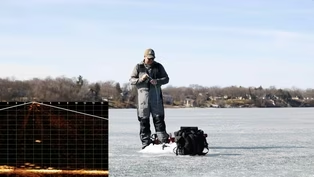
Clip: S17 Ep10 | 11m 50s | Drake Herd takes host Bret Amundson to hook some late season crappie before the ice melts. (11m 50s)
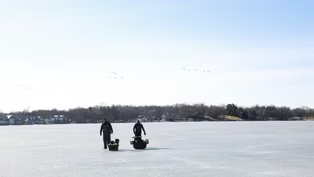
Late Season Ice Fishing and Native Bait
Video has Closed Captions
Preview: S17 Ep10 | 30s | Host Bret Amundson joins Drake Herd to go ice fishing and Barry Thoele raises native minnows. (30s)
Providing Support for PBS.org
Learn Moreabout PBS online sponsorship New Episode
- Science and Nature

Explore scientific discoveries on television's most acclaimed science documentary series.
 New Episode
- Science and Nature

Capturing the splendor of the natural world, from the African plains to the Antarctic ice.


 New Episode








Support for PBS provided by:
Prairie Sportsman is a local public television program presented by Pioneer PBS
Production sponsorship is provided by funding from the Environment and Natural Resources Trust Fund and Shalom Hill Farm. Additional funding provided by Big Stone County, Yellow Medicine County, Lac qui...