Compass
March 2021 Edition
Season 5 Episode 6 | 28m 47sVideo has Closed Captions
Cansayapi land return, Central Community Transit and an episode of Undowanpi (We Sing).
114 acres of land was returned to the Cansayapi community by the state of Minnesota & the Minnesota Historical Society. Then, many rural counties have community transit options, like Central Community Transit, that are vital supplements to rural transportation networks. And Desirae Desnomie was interviewed for a project exploring what traditional song & drum means to four different Native artists.
Problems playing video? | Closed Captioning Feedback
Problems playing video? | Closed Captioning Feedback
Compass is a local public television program presented by Pioneer PBS
Compass
March 2021 Edition
Season 5 Episode 6 | 28m 47sVideo has Closed Captions
114 acres of land was returned to the Cansayapi community by the state of Minnesota & the Minnesota Historical Society. Then, many rural counties have community transit options, like Central Community Transit, that are vital supplements to rural transportation networks. And Desirae Desnomie was interviewed for a project exploring what traditional song & drum means to four different Native artists.
Problems playing video? | Closed Captioning Feedback
How to Watch Compass
Compass is available to stream on pbs.org and the free PBS App, available on iPhone, Apple TV, Android TV, Android smartphones, Amazon Fire TV, Amazon Fire Tablet, Roku, Samsung Smart TV, and Vizio.
Minnesota’s Alt-Meat Revolution
“Minnesota’s Alt-Meat Revolution" is a year-long video and print journalism collaboration project, looking into the roots and impact of the plant-protein phenomenon that’s exploding across the globe.Providing Support for PBS.org
Learn Moreabout PBS online sponsorship(upbeat chime) - [Announcer] Funding for Compass is provided in part by, the Otto Bremer Trust, the McKnight foundation, and members of Pioneer PBS, thank you.
(soft upbeat music) - Hi, I'm Amanda Anderson.
Welcome to the March edition of Compass, the regional public affairs show on Pioneer PBS.
A quick check-in so you know what's going on with this new look, our new Compass format is digital first.
That means all of these stories that you're about to watch have already been posted on Compass' website and social pages.
We encourage audience interaction and feedback, so have your devices at the ready so you can comment and tell us what you think of each story as you watch.
First, in historic event, 114 acres of land was returned to the Cansayapi community by the state of Minnesota, and the Minnesota Historical Society.
The Lower Sioux Indian Community recently held a signing and land return ceremony at their community center.
The event started with a prayer and ceremonial songs.
The smudge was lit to cleanse the sunshine soaked gym.
Cansayapi President Robert Larson, noted the eagle staff displayed at the front of the room and the flags set up off to the side that represented this community before the Minnesota or US flags existed.
The Landbakk ceremony featured the signing of an agreement between the state of Minnesota, the Minnesota Historical Society, and the Lower Sioux Indian Community to return 114 acres to the Lower Sioux, the original caretakers and stewards of the land.
President Larson gave an emotional and candid speech to the masked and socially distant gatherers in the Cansayapi Community Center, and to over 100 people streaming the ceremony online.
- Just like to say again, thank you for being here.
This is, just feel it in you, don't you?
(laughs) - [Amanda] He thanked all the Dakota relatives who came before, that made this accomplishment possible.
His speech centered the importance of persistence, conversation, and relationship, because ultimately, that's how people are able to have difficult conversations and move towards healing.
This land return conversation started about 20 years ago but stalled after public push back.
- Well, my father was on council back in the early 2000s, and one of them that started the conversation.
It ended unfortunately partway through with the public comment period, the township stepped in and said they opposed so it stopped.
2015 when I was elected president here, in conversations with him that came up about transferring the land and the management agreement with MHS, and I decided, talked with the rest of the council and we called them up and said, "Can we talk about this?"
They didn't say, "Nope, that's off the table."
And, it's been a very slow process, but like I said, we felt heard.
And apparently we were, because it was a unanimous decision when they took their vote.
- [Amanda] This land plays a significant role in Minnesota's history and the history of the Dakota people.
The story is complex, complete with unfulfilled treaty promises and shady dealings by the United States government, but briefly and running the risk of over-simplification, this land is where Dakota people lived long before Minnesota was a state.
This land is the site of the beginning of the U.S.-Dakota war.
Minnesota's Lieutenant Governor Peggy Flanagan, a member of the White Earth Band of Ojibwe, recognized this during her speech.
- And although this is a joyous occasion, we cannot forget the history of these lands, and the connection to broken promises, unfulfilled treaty obligations, and the events that led to the loss of the Dakota 38+2.
- [Amanda] She said that when people think about Landbakk, this process is what it looks like.
- And it speaks to, I think the, just the real need in this moment for healing and how we move forward for the state, right?
To acknowledge the role that they've had in the trauma and displacement of native people.
And this is one of the ways we can be really intentional to move us towards that healing that's long overdue.
- [Amanda] Another moving acknowledgement came from Kent Whitworth, Director and CEO of the Minnesota Historical Society.
The ceremonial day was busy, so I caught up with Mr. Whitworth later via Skype.
He said that MNHS uses the power of history to transform lives, but this time the rules were flipped.
- But what made this experience so meaningful is it was our lives, those of us in MNHS that were transformed in this process.
Like, yeah, in the resilience, the graciousness of the Lower Sioux Indian Community, but also that understanding that it's not enough to be just good stewards of the land and to understand its historical significant, but we really treat it as a relative.
And it just really deepened our understanding and appreciation for those who went before us and their relationship to that land.
- [Amanda] In a 20-year conversation full of complexities, Mr. Whitworth said that one of those was the Land and Water Conservation Fund known commonly as LAWCON.
- And I'd be remiss if I didn't recognize our partners at the department of natural resources.
In order to remove that LAWCON status on that particular land, a comparable amount of acreage had to be provided in its place, and DNR made that possible.
They provided land that could be considered LAWCON property in replacement of the land that was returned to Lower Sioux.
So it was DNR's generosity in many respects that enabled us to just return that land and not have to come up with financial resources to purchase, for MNHS to purchase LAWCON replacement property.
- [Amanda] Additionally, because of Minnesota law pertaining to the use of bond funds, the MNHS was unable to transfer ownership of the Lower Sioux Interpretive Center.
- But I pledge to you that MNHS is committed to working with the tribe, in support of that transfer possibility in the future.
We so look forward to the next chapter of our relationship, as together we tell a richer and a more complete history.
- So we have the agreement with MHS that we're interpreting that area as visitors come, and we're not trying to change that story, we're trying to add to that story.
The part that people don't learn in school - [Amanda] It was the thoroughness and working through these complexities and roadblocks that President Larson appreciated, because they did it the right way.
- It's nice to be able to be part of the right thing.
Not because somebody is ordered to or we paid em enough money, but because they open their eyes, they open their heart, they asked the hard questions, heard the answers, and decided this was the right thing to do.
- Many rural counties have community transit options that are vital supplements to rural transportation networks.
One of them is a central community transit.
Compass recently rode along with senior volunteer drivers to get a feel for what it's like to drive for central community transit.
A community transit service for residents of Kandiyohi County was founded in 1998, then known as Kandiyohi Area Transit.
After adding Renville County in 2015, and Meeker County a year later to their service area, Central Community Transit was formed.
You can find the CCT headquarters in Willmar, right across the street from the Willmar Stinger Stadium.
Tiffany Collins is CCT's Transit Director - We were meeting and this picture was taken downtown, at a very first office that we had.
We barely fit in there to take this picture.
- [Amanda] She said that this original board spent many hours researching the best transportation service for their rural community.
And you know what, none of these original board members were experts in transportation systems.
What they had were skills and what people need.
- They were experts in knowing what seniors needed.
They were experts in knowing what children needed.
They were experts in knowing what the medical field needed.
- [Amanda] CCT has two different types of transportation offerings in their 3-county service area.
There's the bus service, and there's the volunteer driver program.
Available for people aged 60 and older, the volunteer driver program expands CCT's reach and enhances the overall transportation system in this rural area.
- The volunteer driver program really provides a gap service for the overall transportation system, because it is helpful to really get into the nooks and crannies of rural Minnesota.
We can go directly to their homes, we can pick them up when they're on the, either still living in the farm, they're still living on the lake, they're still living in the small towns, and they need to get to getting their resources in the community.
- [Amanda] Drivers use their personal vehicles when volunteering, and CCT reimburses their mileage.
The volunteer driver program gets the majority of its funding from the Minnesota River Area Agency on Aging.
There's also a fee that riders pay to use the service based on how far they ride, if they stay in-town or need to go further away, and longer rides have a sliding fee scale based on the rider's monthly income.
Jennifer Seubert is the volunteer driver coordinator, and she gets to know driver preferences.
If drivers prefer to stay in-town or are able to commute further away, will they be able to drive during the winter, or are they planning a vacation to Florida?
Seubert said that although CCT is headquartered in Willmar, their volunteer drivers are scattered all over CCT service area.
- The ones here in town usually are doing three to four rides a day.
So I will start them, a volunteer driver I'll usually pick like, "Hey, I wanna do the morning."
So I'll pick a 9:15 as one appointment, 9:30 is the next one, 9:45 is the next appointment.
They'll get all these people to their place where they wanna go.
And then they get a little business card, the passenger does, with the volunteer driver's cell phone number on, so when they're done with their appointment they can call them back.
- Hello.
- [Linda] Hi Lila.
- Hi.
- [Linda] This is Linda at Nelson Chiropratic, and Bev is ready to be picked up and she'll be at the back door.
- Okay.
It'll be about five, 10 minutes.
- [Amanda] Lila and Bob Rekedal have been married for 57 years, and have been volunteer drivers for six.
- I'm Lila Rekedal and I'm a senior volunteer driver.
My husband and I are retired, and he needs to be doing something all the time.
And I said, "Let's try this out," get us out of the house, and, we can meet new people that you wouldn't ordinarily.
- After responding to an ad in the paper Bob was reluctant to start.
- Then they called me and they says, "So are you gonna drive or not?"
So I said, "Well, I suppose I can."
And now I love it.
(laughs) - [Lila] We're going to pick up a lady who wants to shop at Target and Cub, so we'll be taking her first.
And then they all have my phone number with my card, so when they're ready to be picked up then I go back to pick em up at the door.
- [Amanda] The volunteer driver program isn't ideal for people who use wheelchairs, those riders need to use the bus service.
But volunteer drivers are trained in helping people transport walkers and other walking aides.
Lila, who is a retired business manager for the West Central Tribune prefers to stay in-town, while her husband Bob, a retired painter, is partial to the longer held trips.
His longest trip was to Mandan, North Dakota.
Of course, for reimbursements he keeps a log of all of his rides.
- This isn't the first book, I already filled up one.
- [Amanda] This is all today.
- No, not today.
(chuckles) Since I dire started doing this five years ago.
(laughing) - [Amanda] Wow.
- Yeah, this is just from July 7th till now.
- [Amanda] On this trip, Bob was picking up Bill Hagen, a retired family practice physician from West Central Dental in Willmar, with a final destination in New London.
- To be safe.
(chuckles) - [Amanda] Bill buckled up and started talking with Bob like they were old buddies.
- And that reminds me of something my wife told me once, she could tell what kind of day I had by the way I opened the door.
(Bob laughs) - Not the way I closed it, I opened the door.
- [Amanda] Bill Hagan, who doesn't drive anymore had one criticism of the service, he didn't know about it sooner.
- But I didn't really understand what this is all about until I needed it myself.
And it's very, convenient.
So its a necessary valuable service, it should be supported by everyone I think.
'Cause if you live long enough you'll need it or something like it.
- While there are a lot of moving parts for a service like this, working with schedules to get people to appointments on time and scheduling a fleet of mostly retired volunteer drivers, it seems like it's a service that benefits both the driver and the passenger.
Getting one person to where they need to go, and giving another person something meaningful to do.
- My favorite thing of this service is giving back and helping the people.
I mean, you hear so many stories of, "I've been sitting here the whole day, "and I just need to get out."
And to help them get out and just to have fun and enjoy life, I mean that's what makes my day, is to get people out and about.
- To learn more about how to become a senior volunteer driver for Central Community Transit or to schedule a ride, visit cctbus.org or call 320-214-7433.
Pioneer PBS storyteller, Tanner Peterson worked on a video project highlighting what traditional song and drum means to four different native artists.
We've been airing one video from her series for the past two months.
If you've missed any, head over to our website to watch.
The next installment features Desirae Desnomie, a backup singer from the group, Midnight Express.
- It's different, you know, I think it just like, it's such a different feeling when you know that you have loved ones that have gone on, and you know this is a way to connect to them.
And I just think that that's beautiful.
(drumming beats) My passion is to connect with people.
I absolutely love to sing, I love to sing with my family.
I love to share and connect, and create in any avenue I can basically, but my late dad encouraged me to sing in the lodge in ceremonies.
My dad always needed help as a lodge keeper, and so I would gladly sing those songs.
And I started singing then, and then I started being a little more comfortable to sing in round dances.
So I started singing behind Midnight Express in the last little while here.
I've been with Opie for the last five years.
(drumming beats and tribal chanting) Recently, we were at the protest at the Capitol in Saint Paul, Minnesota where they brought the Christopher Columbus statue down.
And we knew that we had a calling the go there.
I said, "Let's go there and let's sing."
I know Opie has this gift to sing, and I'm like, as his wife and as his number one supporter and fan, I'm like, "You need to share that gift with everybody."
(drumming beats and tribal chanting) Singing is prayer, it's a way to connect.
When singing we call upon, not just the people that are around us in the community, but also our ancestors that are here.
They're waiting and come and connect with us and to be here.
So I believe that when we're singing, even if we're singing in a hand drum, in the house with our family, or you have to pow or a round dance, or you're in these circles that are, you know, have that intent behind it, it just really uplifts me and I feel like, oh, I just have this like really good feeling.
And then when I'm singing, I just like I just close my eyes and I go somewhere else.
And there's just like, there's just such a good feeling there, and I love it.
(drumming beats and trial chanting) A big help of how I started singing, was singing with people who are confident in their voice, who have their strong voice, when they're singing loud and they're seeing deep, I would be able to stand beside them and find my voice beside someone who is confident in their singing.
And that way I can just sort of figure out my own pitch and see how much I can go.
(drumming beats and tribal chanting) We have a connection to this land, we have a connection to this and then we can tap into it by stepping forth in our culture, by stepping forth, by finding our gifts, and excelling in them.
And I think that that's like a really beautiful way of self-love is having discipline enough to find your gift.
And really work towards letting that gift shine, so you can share it with your family, share it with the community, share it for the people who need it, and need to see it and need to see that light.
'Cause oftentimes we're going, we have so much hurdles as indigenous people to overcome.
And when we're able to connect and we're able to find our gifts and excel in these things, we're so much stronger as a people, we're so much more powerful.
(drumming beats and tribal chanting) (women ululating) - Finally, as you might already know, here at Pioneer PBS, we're in the midst of our March membership drive.
All of our local programming Compass included, is only possible because of member support, individual people who donate to this station.
It's because of this support that we've been able to reformat this program, to explore more timely, responsive, and sometimes what feels like urgent topics.
I wanna share some clips from stories that we've been able to cover in the past few months on Compass.
- Good evening Compass viewers.
I'm standing here in front of Murdoch City Hall.
So we're here inside city hall.
As you can see, people are masked.
We had to have our temperatures taken when we entered.
- You say you're not a White supremacist group, so why is it so important for you to protect the White family?
Why is it important for your group that white people marry other White people and have White children?
- Because 100,000 years from now I want there to be blonde hair and blue eyes.
- I'm back here in Murdoch, I'm standing in the middle of the street where a number of people have gathered to show their opposition to the conditional use permit that has been requested by the Asatru Folk Assembly.
- What are we saying no, to?
- [Crowd Members] Hate.
- What are we saying no, to?
- [Crowd Members] Hate.
- And I don't know if that's what this group's intentions were when they came, knowing that we couldn't deny the permit.
It just felt like something was wrong and that we're attacking, you know, they came to a small town for a reason.
- This is a social movement that has deliberately tried to evade our understanding, it wants to disappear.
And it's used several strategies over the years to try to avoid being described and understood.
- Every year across the nation, Welcoming America members celebrate welcoming week.
Over the inviting rhythms of the community drum circle, the welcoming week event in Downtown Willmar is in full swing.
Walking around the small downtown park, there are muralists and drummers amidst representatives from the Willmar Interfaith Network, and the Willmar area league of women voters.
- [Mayor] The city of Willmar and the city council has adopted a welcoming resolution that says that all people are welcome here, no matter what their race, or their creed, their sexual orientation, whatever the case is, they're welcome here in Willmar.
(soft upbeat music) - I'm Chuck Tachie, this is my wife Tandy, and we have a pretty large pumpkin patch.
One of the fun things we do every year is as a pumpkin turns orange, I carve names into the shell.
- [Tandy] I got a text yesterday and somebody said, "How much do you charge to put a name on a pumpkin?"
Chuck will not charge anybody, this is his gift to children, that's how much he loves the project.
- We were asked to try to include the COVID-19, this pandemic, to make a piece that is going to reflect some of that.
The design I chose is, I would say it's a historical, a spiritual social piece.
It tells the story of the Dakota life ways.
- [Mikah] I spent three years visiting all 419 of our US National Park Service sites, and that took me to every state and territory, to urban centers and rural areas.
And what I learned during that time is while we have these sort of bubbles in America where LGBT people are really accepted, a lot of LGBT people don't feel safe or welcomed to come experience America's great outdoors.
So I think people who are in rural areas almost have to be a little more vocal or visible about their allyship and their support, and programs like Outside Safe Space, one, are meant to help give them a non-verbal way to do that.
- [Amanda] The Landbakk ceremony featured the signing of an agreement between the state of Minnesota, the Minnesota Historical Society, and the Lower Sioux Indian Community to return 114 acres to the Lower Sioux, the original caretakers and stewards of the land.
President Larson gave an emotional and candid speech to the masked and socially distant gatherers in the Cansayapi Community Center, and to over 100 people streaming the ceremony online.
- Just like to say again, thank you for being here.
This is, just feel it in you, don't you?
(laughs) - This is not only a person running, but an immigrant running.
And this is also another thing we went to to call the attention to, that immigrants are an integrated members of our society who have positive contributions to make as everybody else.
(woman speaking in foreign language) - I point out the fact that we're one of the few facilities that actually has ultra cold storage capabilities and we could have facilitated the Pfizer vaccine.
And if nothing else, we could have partnered with the other Dakota communities, and gotten some of that additional vaccine and had gotten that out.
- This year because of the Corona Virus, just like everyone else we've had to make a pivot to having virtual type opportunities for the youth.
Mckayla, as she said, is a state 4-H ambassador.
She also participated in one of our new programs called 4-H Stock Talks.
- Hi, everybody, I'm McKayla for my Isanti County, and this is my Scottish Highlander heifer, Elsa.
- [Sharon] The stock talk is an opportunity virtually for 4-H members to share their passion around their livestock projects.
- My name is Oliver, from Sibley County, and I'm (indistinct).
And today I'm going to be talking about how I was training my pig.
This is my pig, Steve.
- I planned a march about a week and a half after George Floyd's death, knew I needed to do something.
I had been in the cities protesting and marching, but this is my community, I know full well the problems that we have here.
I know how diverse we are and how we could be a beacon for change here, but we haven't been so far.
- So I'm asking the school board to reconsider the name and the mascot, because I think, although when they were adopted, they were not seen as offensive symbols and an offensive name, over time it's become clear that the Rebels name, and the Hey reb!
mascot are offensive to many people because of their association with the confederacy in the United States.
- People around here don't see him as a confederate soldier or any like it to the negative connotations, but they see him as, you know, the school spirit, the embodiment of that.
- [Talon] One of the things that really resonated with me, is a quote by one activist, and it was something along the lines of, "If you do not hear us when we whisper, "you will hear us when we shout."
When trying to reflect over this project and kind of move forward, that quote never really left my mind.
And so at first I was trying to come up with like, very literal representations of that and like how it would affect Corona.
But then I started trying to think more abstract, and I started thinking about sound itself, and like the resonance of sound.
- We've really been trying to listen to our communities as we've reworked this show.
We want to not only feature stories that are important to our region, but feature people who represent our region, both in front of and behind the camera.
If you find that this type of rural public affairs programming is valuable to our region, I'm asking you to financially support it.
This past year has been hard, and many of us have been challenged in unimaginable ways.
If you find yourself in a position to give, please consider supporting the work here at Pioneer PBS.
Go online to pioneer.org/donate or call +1-800-726-3178 to get started.
Thank you for watching this March edition of Compass.
We encourage audience interaction and feedback, so head over to our social pages and website, and let us know what you think we should be covering.
And a heads up, the April edition of Compass will air on April 8th.
Thank you for watching and supporting Compass on Pioneer PBS.
- [Announcer] Funding for Compass is provided in part by the Otto Bremer Trust, the McKnight Foundation, and members of Pioneer PBS.
Thank you.
(soft upbeat music)
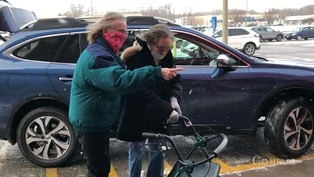
Take a ride with Central Community Transit
Video has Closed Captions
Clip: S5 Ep6 | 6m 59s | Community transits are vital in rural counties to supplement transportation networks. (6m 59s)

Historic event: Land return to the Cansayapi community
Video has Closed Captions
Clip: S5 Ep6 | 6m 48s | 114 acres of land was returned to the Cansayapi community by the state of Minnesota. (6m 48s)
Providing Support for PBS.org
Learn Moreabout PBS online sponsorship
- News and Public Affairs

Top journalists deliver compelling original analysis of the hour's headlines.

- News and Public Affairs

FRONTLINE is investigative journalism that questions, explains and changes our world.












Support for PBS provided by:
Compass is a local public television program presented by Pioneer PBS