
Sara Pajunen and From Nesna with Love Behind the Scenes
Season 17 Episode 8 | 28m 46sVideo has Closed Captions
Minnesota-based composer Sara Pajunen and a teaser of the Pioneer PBS's “From Nesna with Love."
Minnesota-based composer, improviser, and performer Sara Pajunen draws upon her Finnish heritage and Mesabi Iron Range upbringing to inspire her work, and Postcards gives a behind-the-scenes look at the Pioneer PBS documentary “From Nesna with Love.”
Problems playing video? | Closed Captioning Feedback
Problems playing video? | Closed Captioning Feedback
Postcards is a local public television program presented by Pioneer PBS
Production sponsorship is provided by contributions from the voters of Minnesota through a legislative appropriation from the Arts and Cultural Heritage Fund, Explore Alexandria Tourism, Shalom Hill Farm, West Central...
Support provided by:


Sara Pajunen and From Nesna with Love Behind the Scenes
Season 17 Episode 8 | 28m 46sVideo has Closed Captions
Minnesota-based composer, improviser, and performer Sara Pajunen draws upon her Finnish heritage and Mesabi Iron Range upbringing to inspire her work, and Postcards gives a behind-the-scenes look at the Pioneer PBS documentary “From Nesna with Love.”
Problems playing video? | Closed Captioning Feedback
How to Watch Postcards
Postcards is available to stream on pbs.org and the free PBS App, available on iPhone, Apple TV, Android TV, Android smartphones, Amazon Fire TV, Amazon Fire Tablet, Roku, Samsung Smart TV, LG TV, and Vizio.
Providing Support for PBS.org
Learn Moreabout PBS online sponsorship(soft music) - [Narrator] On this episode of Postcards.
(gentle music) - And as time has gone on, I've learned to find my own leanings and artistic voice, borrowing from all of this.
So it really has been a process of self-actualization.
- I would hope that anyone watching this would be excited to learn more about where they came from and how they can help preserve the stories of the people that came before them.
(soft music) (soft music) - [Narrator] Postcards is made possible by the Minnesota Arts and Cultural Heritage Fund and the citizens of Minnesota.
Additional support provided by Margaret A. Cargill Philanthropies, Mark and Margaret Yackel-Juleen, on behalf of Shalom Hill Farm, a retreat and conference center in a prairie setting near Windom, Minnesota.
On the web at shalomhillfarm.org.
A better future starts now.
West Central Initiative empowers communities with resources, funding, and support for a thriving region.
More at wcif.org.
(bow whooshes) (soft violin music) - When I was six years old, I started playing piano, and my mom said that I was unable to sit still.
So my mom saw an advertisement for this violin teacher, and she was from Finland.
She immigrated to the United States.
So in addition to learning classical music, I also learned Finnish folk music and got to hear the language from a very young age, as well as playing the folk tunes on violin.
(soft instrumental music) (soft violin music) My father grew up here in the United States, on the Iron Range, speaking Finnish as his first language before he went to kindergarten.
So I did always know about my heritage, (children singing) and when I would go to perform in Finland as a child, we would see relatives and connect with them, both from my mom's side of the family and my dad's side.
(children singing) I had a Finnish-American duo called Kaivama that was active for many years, and we toured a lot and performed.
And then, after that, I formed a duo with a Finnish accordionist named Teija Niku, and we've played in Europe quite a bit and also played here.
(soft violin music) My work in the last few years has really gone toward my own compositions and more experimental work and audiovisual work.
(pitcher pump rattles) I have a project called Mine Songs that is an umbrella project for a lot of different media that's based on the Mesabi Iron Range, where I come from.
(water babbles) It's very inspired by the landscape there.
However, it is also very connected to immigration, American cultural narratives, and my own family history, thinking about how I have arrived on this planet, in this place, at this time, (soft violin music) having most of my family been in Europe for millennia and now only being here in this country for a hundred years, and trying to create that connection with landscape again through my art.
(indistinct) As a person with so much Finnish blood, it's really second nature to me to be very connected to the earth, and I think, at the moment we're in, where we're living so outside of the earth, how do we create a sense of home in our landscapes, in our environments?
I think it's a really pertinent question nowadays when we're dealing with a lot of environmental pollution and unsafe places to habitate on the earth.
(water babbles) (bird chirping) (throat clears) A few years ago, I had a late-stage cancer diagnosis that was extremely difficult.
I was thrust into a bit of a different universe.
It was survival.
It was as strong a response as I could muster, which I will say, I think was a very, very strong response, because there's an immediate threat to my life.
So I have to have the treatment.
I have to quell the cancer, get it under control.
(soft violin music) When life returns a bit back to normal, even though it's a new normal, it has been a bit challenging to continue living in the moment.
And that, I think, is where the biggest work comes in.
You learn to grapple with how your life has changed, and you use your brain as well as your instinct to guide your experience and what skills you need to strengthen in order to have the best possible quality of life on a daily basis.
It isn't easy, but it is very transformative.
And I don't know that kind of transformation would've happened for me without that diagnosis.
I can't say, but I would guess no.
(soft violin music) Having some gigs planned for when I was in chemo, actually being able to go through with that and play and share things in such a moment really helped me through that difficult, dark winter.
(soft violin music) When you're playing an instrument and truly listening, there isn't space in your brain for anything else.
So it's a safe space for me to play my instrument when I'm feeling troubled or need to calm my central nervous system.
And it's also a gift to share with others.
I've formed community through music.
(violin music) (guitar music) I've gathered a few artifacts from my life in music and the arts.
Here is something from when I played Sounds of the North Festival in Poland with Finnish accordionist Teija Niku, and we played in a beautiful church there from the 13th century.
And this is an album that we made that's on a German label.
It's called (speaking in foreign language), Song of America.
(song playing in foreign language) I also use a lot of drone imagery in my work, and this is some still imagery of mining practices on the Mesabi Iron Range.
(song playing in foreign language) And I had my first solo exhibition of audiovisual work a few years ago at Joseph Nease Gallery.
It was called Listening Through Context, and it was a part of FinnFest 2023.
(song playing in foreign language) And that was special for me to exhibit a bunch of audiovisual work for the first time in a gallery space.
(bright violin music) I traveled to Finland in 1992 to play at Kaustinen Folk Music Festival.
I was 12 years old, but then last year I also played at Kaustinen Folk Music Festival, and I was 44 years old.
(Sara chuckles) When I was in chemo, I was really thrilled that I could still go and present some work at the Boston Symphony Orchestra, which is right around the corner from where I went to grad school at New England Conservatory.
And that was last year, and that was a full-circle moment.
It was a Nordic program.
(soft instrumental music) This instrument is called the Hardanger d'amore.
It's a combination of the Hardanger fiddle, the Norwegian national instrument, and the Baroque instrument, the viola d'amore.
And both of those instruments have resonant strings that run underneath the fingerboard, so they're never touched by the fingers.
They just sympathetically resonate with the played strings.
And I'm going to play a piece of mine called "A Mass."
(soft violin music) When I was younger, I played the music that was available to me or that I was expected to play.
(soft violin music) When I went to college and played classical music, and as time has gone on, I've learned to find my own leanings and artistic voice, borrowing from all of this.
So it really has been a process of self-actualization, becoming myself and stepping into my own power through grappling with artistic output.
(singing in foreign language) My draw to Finnish folk music and to keeping it in my life, especially the singing tradition, is that it has been a part of my family through many generations.
It's keeping these connections through time.
I know that my great-grandmother, who raised my father, would sit in a rocking chair and sing these songs.
So there's somehow like a matriarchal lineage that I draw a lot of power and strength and peace from.
(singing in foreign language) I am very into ancestor worship, for the lack of a better term, which just means honoring our ancestors and believing that they live within us and can be a place of solace and comfort (singing in foreign language) that manifests through physical items I have from my grandparents and great-grandparents.
I have my great-grandfather's clock, my great-grandfather who came from Slovenia.
I have his vest.
I have an old bottle from my other great-grandfather, and I have my great-grandmother from Slovenia, her rosary and prayer book.
Those are some of my most precious possessions.
(singing in foreign language) I'm a person who thinks a lot about legacy.
I think in long arcs, not only what's in the future, but what has come before, and especially because of the cancer diagnosis, leaving a legacy of artwork that only I can create is of utmost importance.
It is intrinsically linked to a spiritual path for me.
Learning to live with the cancer, making peace with death, living in the moment, and letting fear fall away, and really getting to the deep place of my own truth and putting it out in the world to leave for people.
And what happens with it after that isn't up to me.
It's my job in my lifetime now to make my work.
(violin music) - Loading up.
Where are we?
What are we up to?
What are we doing?
- We are headed to Norway for our next documentary.
(bright music) From Nesna with Love is the third installment in a series of "With Love" that we've done about Norwegian craft.
And it is all tied together by my family history from Norway.
So the first time we were to Nesna was during our "Built with Love" documentary filming, and we had a very tight ferry schedule for that particular shoot.
So we were only able to stay in Nesna for about 45 minutes to an hour.
This time, we actually spent a couple nights in Nesna and were able to get to know some of the community members, walk around the town, and kind of get the vibe of what it would feel like to live there.
I just really love the colorful people and the life that's in the community.
(people laugh) (soft music) When we were at the church in Nesna, we had a really special evening where a local musician was able to perform a traditional piece of music for us, and we got special permission to film inside the church.
(singing in foreign language) There was candlelight and the boat hanging from the ceiling, and we had the shoes, and it was a beautiful, reflective moment.
And also there was a statue of a really grumpy-looking priest that I don't think made the cut that I thought he was pretty hilarious.
Do you think this is the guy that wouldn't let my great-great-grandparents be married?
(soft music) So my favorite part about doing this series of documentaries is that every time we do one, we develop relationships that I think are meaningful relationships with people in Norway.
And to have that cross-cultural connection is a rare experience and something I'm really grateful for.
And I feel like we're really lucky to have that as part of our work.
One way to demonstrate that is a couple that we interviewed, Veronica and Ludwig are also LEGO enthusiasts.
- At this apartment, the old doctor office.
- They have a room in their house that they've built an entire fantasy world of LEGOs in, and they've got all these little scenes, and they post them on Facebook.
And about six months after we were visiting with them, they incorporated me, Kris, and Ben, the Postcards crew, into their LEGO scene.
And to be part of their LEGO community in Nesna, Norway, is surprising and super interesting.
And I think we were all honored to be part of that.
(soft music) When we were in the hotel in Nesna, it was after a long day of filming, and we were eating a super late dinner, and there was one other party in this bar restaurant.
A guy from the party was so moved that we were telling a story about Nesna lobbens that he took the time to share his own personal childhood story about getting Nesna lobbens for Christmas and being super disappointed that it wasn't something more posh than a pair of Nesna lobbens.
- I was trying to be happy.
All you can see, you are not happy when you are 14 years old to get a pair of shoes, especially not, that not Nesna lobben.
- Just the way that the shoes connected us to so many people as we traveled through that part of Norway.
The Nesna lobben is actually basically the town mascot of Nesna.
So it is their cultural heritage.
They have it on beers and T-shirts, and everybody knows about the shoes.
It's like a point of cultural pride for them, just like the lutefisk is to the town of Madison, Minnesota.
So it's interesting to see the parallels between the two Norwegian communities, one in Minnesota and one in Norway.
I think the deeper we dive into different cultures, we can see more similarities than differences in people that are even across the world from us.
(bright music) Nesna lobben were actually an economic opportunity for women to be able to earn an income from home and work in a time that that wasn't necessarily common in society.
So that was kind of cool that it was an early feminist movement and impressive that Nesna has been such an inclusive community for so long.
(soft music) One of the most rewarding parts about doing these documentaries is we've been able to establish a relationship with the Vesterheim Norwegian-American Museum in Decorah, Iowa, and Laurann Gilbertson, who has been able to share all of her knowledge with us about the artifacts that we've brought in and shown us some of the vaults at the museum.
It's been a wonderful relationship to have, and I think it's added a great dimension to our documentaries.
(soft music) When people watch this documentary, I just hope they come away with an interest for their own history and where certain artifacts may have come from in their family.
Since doing these documentaries, I've had multiple distant family members reach out with different artifacts that they are hoping to pass on, but they don't have anyone they know of that has an interest to preserve or know about the history.
So if you can become that person in your family that collects the stories and the artifacts and preserves these moments in time, I think if you don't do it, it just gets lost and it's gone forever.
So I think even if you take out your cell phone and record the older people in your family and their memories, I would hope that anyone watching this would be excited to learn more about where they came from and how they can help preserve the stories of the people that came before them.
(soft music) (soft music) Hi, it's good to see you.
- So good to see you again.
Welcome back.
- Yeah, thanks for having me.
(soft music) - This is one of our storage areas at the museum where we take care of the objects and keep them until we're using them for exhibits or for researchers.
So come here, I'll show you where your pieces are going to end up.
(machine clatters) - [Dana] Is this the entire collection in here?
- [Speaker] No, it's just a portion of the collection.
We call these small objects, so trunk-sized and smaller.
- [Dana] Oh, wow!
- So some of the other things we have here include the wool combs, much like you had the carders, and we also have things like this.
This one is called a banketre, a washing paddle, probably things you've never seen before.
This would've been a clamp to hold needlework onto a table as you were using it, and there would've been a pin cushion on top.
This one is from Nordland.
This is a small loom for weaving bands.
Here's the band in progress.
And this is from Nordland County, which is where Nesna is located.
And this is located not far from there.
- [Dana] Oh, that's beautiful.
How did you find one that's in progress?
- It's the way it came to us.
So that's really a great thing because you would tie yourself up, have all of this to weave, and that actually it would be upside down like this.
And then you would pull this up and down to help you weave the band here.
That would work for hair ribbons or sock garters or maybe an apron band.
(machine clatters) So this is a travel chest covered with seal skin from Nordland, and they used the seal skin because then it would repel the water well.
If you were traveling in a boat and it was raining or the waves were splashing, that would keep everything inside dry.
- Oh, that's amazing.
Do you have any other ones like these?
- No, this is our only one with this kind of covering.
We have some with leather for protection, but this is our only one from Nordland with seal skin.
- [Dana] That's beautiful.
(soft music) Okay, so what do we have here?
- We have some more objects from the same family as the coverlet.
So these were brought by Berit and Nils Nesgjerdet from Vefsn, Norway, which is not far from Nesna.
And in the US they use the name Nelson, and we have a bodice.
And the family told us that Berit had handwoven the fabric.
- Oh my gosh!
- And I'm not sure if she wore it or one of her daughters.
- [Dana] Oh my gosh, it's so small.
- I know.
It's tiny.
(Dana chuckles) - [Dana] The buttons on there are beautiful.
- They are.
And this is the back.
The front is missing part of the fabric.
I think it would've had a red velvet in the front, in the center here.
But it's one thing to sew a garment, but to weave the fabric first.
- [Dana] Yeah.
- That's a lot of work.
They brought some textile tools with them, a weaving shuttle and a small loom of the type that you would make these bands.
They brought these as well.
And these could have been used for hair ribbons or sock garters or a tie for an apron.
And then also from the same family is this pocket that would hang on the waistband of a skirt.
And so instead of having the pockets that we're used to, you would hook this on your waist to carry maybe a little bit of money or maybe a spoon or something else that was small.
- Oh, I love the engraving on there.
That's a date on there.
- It is initials and the date of 1821.
- Wow!
This must have been so special to somebody.
- And too special to leave behind.
I think... - Yeah.
- That's why they brought them with them.
And then finally a pair of stockings, and the knitting technique is called entrelac.
These would've been worn probably by Berit or one of her daughters.
And you might not notice them under all the clothes, but it would be fun to have some colorful socks to keep you warm.
- It's crazy, 'cause these look almost new.
It looks like you just bought them from a store.
- They're old.
They're 1800s, brought by the Nelson family.
- And so this all came from the same person.
- As well as the coverlet behind us.
- Oh, wow!
These are beautiful.
Thanks for sharing them with me.
- Of course.
Yeah.
(soft music) (screen whooshes) (soft music) - [Narrator] Postcards is made possible by the Minnesota Arts and Cultural Heritage Fund and the citizens of Minnesota.
Additional support provided by Margaret A. Cargill Philanthropies, Mark and Margaret Yackel-Juleen, on behalf of Shalom Hill Farm, a retreat and conference center in a prairie setting near Windom, Minnesota.
On the web at shalomhillfarm.org.
A better future starts now.
West Central Initiative empowers communities with resources, funding, and support for a thriving region.
More at wcif.org.
(instrumental music)
 New
NewFrom Nesna with Love Q&A with Dana Conroy
Video has Closed Captions
Clip: S17 Ep8 | 9m 22s | Watch excerpts from the documentary “From Nesna with Love” with a Q&A from the film’s producer. (9m 22s)
 New
NewVideo has Closed Captions
Clip: S17 Ep8 | 13m 57s | Minnesota-based composer, improviser, and performer Sara Pajunen draws upon her Finnish heritage. (13m 57s)
Sara Pajunen and From Nesna with Love Behind the Scenes
Preview: S17 Ep8 | 40s | Minnesota-based composer Sara Pajunen and a teaser of the Pioneer PBS's “From Nesna with Love." (40s)
 New
NewVideo has Closed Captions
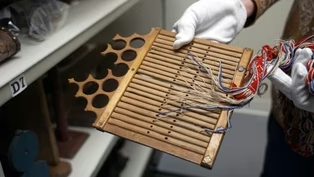
Clip: S17 Ep8 | 5m 56s | Dana Conroy consults with experts at the Vesterheim Norwegian-American Museum about items there. (5m 56s)
Providing Support for PBS.org
Learn Moreabout PBS online sponsorship

- Arts and Music
The Best of the Joy of Painting with Bob Ross
A pop icon, Bob Ross offers soothing words of wisdom as he paints captivating landscapes.










Support for PBS provided by:
Postcards is a local public television program presented by Pioneer PBS
Production sponsorship is provided by contributions from the voters of Minnesota through a legislative appropriation from the Arts and Cultural Heritage Fund, Explore Alexandria Tourism, Shalom Hill Farm, West Central...