
Washington Week with The Atlantic full episode, 5/29/26
5/29/2026 | 26m 46sVideo has Closed Captions
Full Washington Week with the Atlantic broadcast from May 29, 2026.
Full Washington Week with the Atlantic broadcast from May 29, 2026.
Problems playing video? | Closed Captioning Feedback
Problems playing video? | Closed Captioning Feedback
Major funding for “Washington Week with The Atlantic” is provided by Consumer Cellular, Otsuka, Kaiser Permanente, the Yuen Foundation, and the Corporation for Public Broadcasting.
Washington Week with The Atlantic full episode, 5/29/26
5/29/2026 | 26m 46sVideo has Closed Captions
Full Washington Week with the Atlantic broadcast from May 29, 2026.
Problems playing video? | Closed Captioning Feedback
Where to Watch Washington Week with The Atlantic
Washington Week with The Atlantic is available to stream on pbs.org and the PBS app.
Buy Now
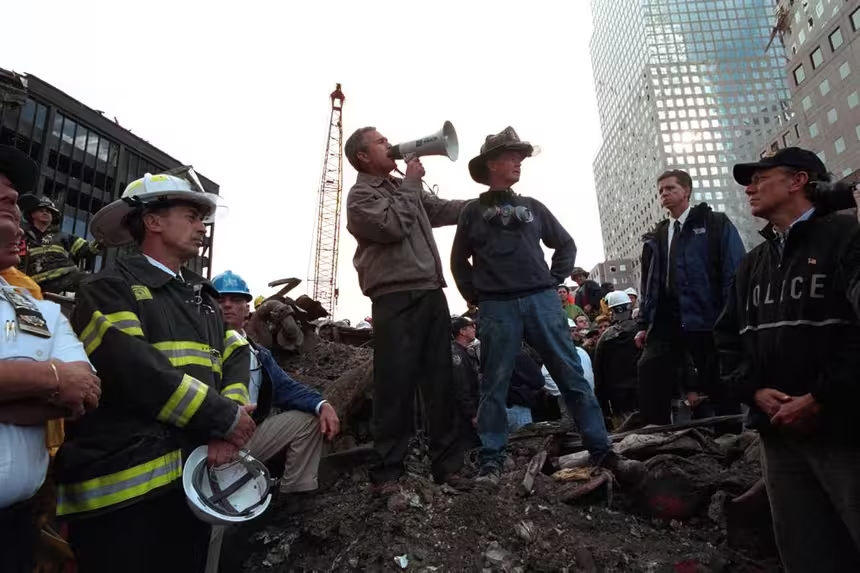
10 big stories Washington Week covered
Washington Week came on the air February 23, 1967. In the 50 years that followed, we covered a lot of history-making events. Read up on 10 of the biggest stories Washington Week covered in its first 50 years.Providing Support for PBS.org
Learn Moreabout PBS online sponsorshipJeffrey Goldberg: President Trump is on the cusp of ending the Iran war he started.
He's also thinking about invading Cuba, and he's simultaneously making America's allies in Europe and Asia wonder if they can ever trust the U.S.
again.
And he's also threatening to blow up Oman for reasons unknown.
Our question tonight, what happens to the world if the U.S.
is no longer seen as a stable, dependable superpower, next.
Good evening, and welcome to Washington Week.
The U.S.
seems to be on the cusp of a negotiated settlement with Iran, a country President Trump promised three months ago he would unconditionally defeat.
Tonight, I'll discuss the war and its consequences with David Ignatius of The Washington Post.
David is the not so elder statesman of foreign policy commentary and analysis, and he has decades of experience on the Iran question along with deep and wide knowledge of America's other adversaries and its friends.
David and I have been in conversation for years about America's unique role in the post-World War II international order, because that's our idea of a good time.
And tonight, I'll ask him about Trump's revolutionary approach to global leadership.
David, thank you for being here with me.
David Ignatius, Foreign Affairs Columnist, The Washington Post: It's great to be here.
Jeffrey Goldberg: I really appreciate it.
First things first, give me your analysis of the Iran deal that's taking shape right now.
David Ignatius: So, the sound bite is that this was a war of choice, and it's a piece of necessity.
Both sides -- Jeffrey Goldberg: That's a pretty good sound bite -- David Ignatius: Pretty much.
It is a good sound bite.
Jeffrey Goldberg: Yes.
David Ignatius: Both sides are exhausted.
The economic cost for the U.S.
at home and in terms of the international economy is growing.
I think Iran is more battered than we sometimes realize.
So, it's been time to make peace, but it's been a difficult to get there.
As we talk, President Trump still hasn't quite made up his mind whether to accept the deal he pushed out today in a post on social media.
He's listed the conditions that he thinks he's gotten from Iran, immediate opening of the Strait of Hormuz, a promise never to develop a nuclear weapon, somewhat fuzzier language about how the highly enriched uranium that Iran has will be removed, a series of things that he's going to claim add up to victory.
I think there's widespread skepticism in the United States and around the world whether you can possibly call this a victory given all that the U.S.
put into it.
But this is a war that Trump does want to end.
He's been looking for an exit ramp.
I think he's finally got it.
Jeffrey Goldberg: So, he said publicly, this is March 7th, right after it started, that, quote, we've decimated their whole evil empire.
And then he asked the Iranian people to rise up, and said, it will be yours to take.
So, now, three months later, he's just trying to get the oil moving through the Strait of Hormuz.
And, yes, he will spin whatever he does into a victory story, but for you, what conditions would have to pertain -- what conditions would he have to obtain in order to make you think, oh, yes, that can count as a legitimate victory?
David Ignatius: So, the victory that I'd love to see, I've been covering the Middle East since the year after the Iranian revolution, is for Iran to finally turn away from being this destabilizing revolutionary state to something more reasonable.
It looked before this war started, Jeff, as if that was happening.
It was just of its own kind of natural course.
Ayatollah Khameini was old.
He was likely to die soon.
There was factional fighting.
Maybe Iran was getting ready for a transitional process, and the war stopped that.
I do have hope, expectation, really, that over the next five to ten years, because of the Iranian people's dynamism, I've been there a couple times and seen that with my own eyes, it will turn.
It will become the modern state that Iranians want.
This is still an unpopular regime.
It will repress.
It will be a kind of - - what's the right comparison?
It's not North Korea, but it will be something very repressive.
But that victory for me would've been a pathway toward a different Iran, and I don't see it now.
Jeffrey Goldberg: Right.
You wrote recently in your column, looking back on three months of war and blockade, what's astonishing is how little clarity Israel and the United States had about how to help the Iranian people create this modern post-revolutionary state.
If Trump gets a peace agreement, he will have escaped what had been become a military morass and a strategic dead end.
As one source involved in war planning put it, we have the capability to bomb anything, but what can we do that will change Iranian decision-making?
One of the questions that comes out of this is, did we betray the Iranians who had been rising up and had been then slaughtered in the streets?
Did we make promises that we just simply have not kept?
David Ignatius: So, that's one of America's greatest defects in foreign policy.
We do make promises we can't keep.
The tragedy for me here is in part one of timing.
The Iranian people, in expectation, I think, that something was coming, did rise up in January, and President Trump said, help is on the way, we're coming.
But the help didn't come until a month later.
And in that month, thousands, tens of thousands of Iranians who had stood up were killed.
They were slaughtered in the cruelest way possible.
So, when the moment came, the Iranian people were intimidated, stayed indoors.
There was, to me, a really ill-considered idea of sending a Kurdish militia across the border into Iran after February 28th when the war began.
That was scuttled.
We now learn that Israel and the United States had talked about the idea of installing a hardline former President Ahmadinejad as a new leader for a post-war Iran, which seems like a completely loony idea.
Jeffrey Goldberg: That seemed like a farce.
David Ignatius: But those aspects of the planning, when you look at them, were just so ill-considered.
I'm astonished.
The United States is not good at covert action.
We like to imagine that Israel, you know, the Mossad, vaunted intelligence service, is better at it.
But that was really poor planning.
It was bad timing.
And so we've ended up in this dreadful situation where it appears the hardliners are in greater control than they ever were.
And that's what a sad outcome.
Jeffrey Goldberg: I still don't understand how decisions were made in the White House, and in Israel, by the way, because I think you're correct about that.
The Mossad is very, very good tactically, obviously, but, strategically, it seems that they promised that the people would rise up and there would be this revolution, and all we had to do is just kind of knock over the first pin, never really works that way.
America obviously has enormous military capabilities, but it doesn't seem like the greatest strategic minds were at work here.
David Ignatius: So, you know, military power can do a lot of things but it can't force political change.
We learned that in Iraq, Afghanistan.
We learned it again here.
I've watched Israel misuse of military power for what far political objectives since I began covering the Middle East, and I think this is -- Jeffrey Goldberg: In Lebanon in particular.
David Ignatius: In Lebanon in particular.
But in your magazine, there was an absolutely marvelous piece by Tom Nichols that talked about victory disease.
This idea that, you know, victory is dangerous to military planners in the sense that you think you can do anything.
It's obvious that President Trump, after Venezuela's extraordinary kind of kidnapping operation, go in the middle of the night, grab the leader, fly through, amazing, Cuban defenses, and he pulled it off.
And after that, he thought he could do anything.
He did think that Iran, in some way, would be a version of Venezuela.
And I think Israel, in the same way, after so many successes, you know, in the long tail after October 7th, thought it could do anything.
And they both learned that that actually wasn't true.
Jeffrey Goldberg: Right.
This is going to sound naive, possibly snarky, but they have books in the White House, right?
They have people who know that the traditional role of Iran in American presidencies is to undo those presidencies, Jimmy Carter, Ronald Reagan, and so on.
Did anyone in your reporting say in any halfway convincing manner to the president, you know, here's the thing, first rule of Fight Club is like don't get involved with Iran.
Contain it.
Let the people sort it out over time, but don't do this?
David Ignatius: And, Jeff, my sense is that the -- this was not an intelligence failure.
The warnings were there from the intelligence agencies, from the military, the chairman of the Joint Chiefs of Staff, General Caine, appears to have said to the president a number of times, you know, very directly, sir, you know, we can't assure you that the Iranians won't move into the Strait of Hormuz, sir, we can't assure you that military power will have the effects that you want.
And Trump blew through those warnings.
I think this is a tough Pentagon for military leaders to stand up to civilians.
And, you know, Secretary of Defense Hegseth -- if you'd had Jim Mattis, who you and I know well, former secretary of defense, deeply experienced general, would he have made a difference in those counsels with the president?
Could he have said, Mr.
President, don't do this?
I'm not sure he could've.
Jeffrey Goldberg: That's interesting because I was thinking that first term Trump -- I mean, this didn't happen in first term Trump for a reason, I think.
Donald Trump is actually has consistency, long-term consistency in his beliefs, and one of his beliefs is that the Iranian regime should go.
And, by the way, that's not a --- he's not the only person in American public life who believes that the regime is a bad regime and is an enemy of the United States, but he's now free to do things in his own mind that he wasn't free to do before, including, by the way, Cuba, and so there's an obvious follow-up here.
Is he trying to tie off this Iran problem so that he can pivot to Cuba?
David Ignatius: Well, I think he'll want to pivot to Cuba for lots of reasons.
One is to get the bitter taste of Iran out of his mouth, to do something -- Cuba is probably doable.
There certainly is, you know, a population that's, I think, eager for change.
You know, it's -- Jeffrey Goldberg: Well, the Iranian population was eager for change too.
David Ignatius: Yes, they were but less so after the brutal crackdown of January.
I mean, they want a different regime, but people were intimidated.
You know, I think a part of this is that Trump really does have a grandiose idea of his place in history.
You know, he said at the beginning of this war, every president since 1979, 47 years, has wanted to do this, has known that the Iranian regime had to be stopped, and I'm going to do it, you know?
And he had this sort of, you know, sense, I can do it, I'm the guy who can do it.
And, unfortunately, he didn't have the this adequate planning.
He -- you know, he did -- the thing that would've made it doable was more careful thinking about the politics of this.
You know, obliterating a whole tier of leadership turned out to be a very bad idea because they didn't have anybody to negotiate with.
Jeffrey Goldberg: It's interesting, you and I both, during the eight years of the Obama presidency, spent quite a bit of time with him, listening to him talk about his doctrine, quote/unquote, of don't do stupid stuff, although it was a different word than stuff.
And, you know, that's looking smarter and smarter right now, the sort of don't rush in.
There's a downside to don't do stupid stuff, is that when you're thinking about third and fourth order consequences of actions, you'll never do anything.
But here we have a case where maybe the Trump doctrine is, don't think about even first order consequences.
David Ignatius: The Trump doctrine in part is, just do it.
It's like -- yes.
Jeffrey Goldberg: He's the Nike of presidents.
David Ignatius: just go for it.
And, you know, he does have this extraordinary belief in himself.
When you look back to President Obama, I remember as you do those conversations, he did plan carefully.
You look at the JCPOA, the Iran nuclear agreement that he negotiated, it started with secret meetings, careful secret meetings in Oman.
Bill Burns, you know, a classic shadow diplomat, Jake Sullivan went with him, you know, laid it out with intermediaries, long process, then the long negotiations about each detail.
The opposite of what you see with Trump, it's just a very thin team.
They don't have the background.
You know, in a sense, no wonder that they weren't able to pull this off.
They just didn't have the horsepower.
Jeffrey Goldberg: I suppose the question in my mind about Cuba is, does it look like Venezuela, which is the just do it and it works, or is it somehow Iran and we haven't thought about all the things that can go wrong?
I mean, we don't have to think about things that can go wrong in Cuba.
We do remember the Bay of Pigs.
David Ignatius: So, we have very -- I mean, we remember the Bay of Pigs, we remember the Cuban Missile Crisis.
If the Russians decided that they wanted to get -- interpose themselves in the Cuba situation, it'd be much, much more dangerous.
I don't think that's going to happen.
Jeffrey Goldberg: Right.
David Ignatius: You know, I think Cuba's so close, there's so much money that Cuban Americans stand to make as the island opens up.
My expectation is that this won't last all that long or be that difficult, but I've been -- certainly, I've been wrong about -- Jeffrey Goldberg: Okay.
Let me ask you to wildly speculate now and say if Cuba works, that's a big supposition here.
Would he actually try to take Greenland in some way?
He talks about it.
He's preoccupied by it.
Just because it sounds absurd doesn't mean it's not going to happen.
David Ignatius: So, I think he's going to get something that he can call taking Greenland.
He'll get bases and sort of unusual language to guarantee the bases.
I don't think Europe is going to let him go further.
With Cuba, he's asserted the Donroe Doctrine, the kind of role in Latin America.
Europe is different.
And I think Europe is really now sort of dropped any willingness to accommodate Trump's bullying on Greenland.
I think that's over.
Europeans are just fed up with it, and they're going to push back.
So, Trump may come back and use the rhetoric but I don't see that going anywhere.
Jeffrey Goldberg: I want you to listen to Trump on a couple of different occasions recently.
They're wildly different Trumps.
There are moments when he sounds like what we understand to be a president sounds like, what we think of as a president speaking about foreign policy.
Here's an example from his recent trip to China.
Donald Trump, U.S.
President: The American and Chinese people share much in common.
We value hard work, we value courage and achievement, we love our families, and we love our countries.
Together, we have the chance to draw on these values to create a future of greater prosperity, cooperation, and happiness, and peace for our children.
Jeffrey Goldberg: There he is doing the thing that presidents do, which is finding common ground with an important adversary, who's also an incredibly important economic partner.
That's in the normal bandwidth of presidential behavior.
Then there are moments like this when he's talking about the Strait of Hormuz.
Watch this.
Donald Trump: Nobody's going to control it.
It's international waters.
And Oman will behave just like everybody else or we'll have to blow them up.
They understand that.
They'll be fine.
David Ignatius: Oman will behave.
Jeffrey Goldberg: Oman will behave.
So -- okay.
So, you're an American adversary or you're an American friend, and you watch this president perform on the global stage.
Watching him, do you think that the United States, the world's largest superpower, most important superpower, is a stable, dependable country?
David Ignatius: No, and I think that's something that's really beginning to hurt President Trump and will affect the rest of his presidency.
He has been so erratic, so vacillating, announcing that he's won the war in Iran, you know, victory claims three times, saying he's going to exterminate the civilization, the recurring Greenland threats, threats to everybody, you know, cited the threat to Oman.
He does have his moments when he acts presidential, as he did in China, and that's exactly what you want a president to say, avoiding a war with not -- between the United States and China is the primary obligation of any good leader.
You can do that through deterrence, but also through talking to people.
But he just doesn't seem to be able to turn off -- and somebody really ought to take away his phone so he can't tweet because that erratic tweeting, I think, has undermined his ability to communicate.
Jeffrey Goldberg: So, the biggest question of all right now may be this.
If you're in a place like Taipei, Seoul, Riga, Warsaw, Tokyo, will the U.S.
actually rescue us from the authoritarian states who surround us, who are our neighbors, or will we be on our own for the first time since the end of World War II?
I mean, if one of these leaders asked you today in any of those capitals, do you think the president will fulfill the American promise to our Democratic country to defend us from Russia, China, and so on, North Korea?
What would you say?
David Ignatius: So, I've had those conversations with some foreign friends who are really struggling.
It's hard to answer.
But I think there is a growing fear in the world that America's promises that it will sacrifice its own cities to save those of its allies, you know, the basic Article 5 promise that underlies NATO and underlies our support for Japan and other allies, people just don't believe it.
They don't think that we'd do that, and I think that's really dangerous, because people are beginning to have to look for other forms of nuclear deterrence.
So, Saudi Arabia's turning to Pakistan, which has nuclear weapons as a protector.
Europeans are turning to France, which has nuclear weapons.
Who would have ever imagined that Germany would turn to France and in effect discuss a joint nuclear strategy?
But that's a consequence, I think, of people beginning to lose faith in that American nuclear umbrella, which is part of what's kept the world safe.
Jeffrey Goldberg: And the danger comes from nuclear proliferation, or the danger comes from Russia and China feeling, oh, now is a time to make a move?
David Ignatius: So, I think there is a window in which while Trump is here and the world is so destabilized, that Russia might well make a move to demonstrate that the NATO umbrella is gone, that you're not protected.
Today, the Russians attacked a city in Romania, a NATO country.
What's the U.S.
going to do about that?
And I think the answer probably is not much, and the world will see that.
And, you know, I mean, the NATO umbrella's getting pretty tattered and I don't think Americans appreciate just how dangerous that is because other countries will go their own way.
Jeffrey Goldberg: In the last minute we have, I want to ask you about a column you just wrote.
You're arguing that China is not the inexorable juggernaut that some people think it is, and that the U.S.
is actually stronger than these conversations might suggest.
What's the 30-second standing -- David Ignatius: So, in this column, I imagined that I was a Chinese intelligence analyst, and I'd been given the -- Jeffrey Goldberg: He's only imagining, everyone.
David Ignatius: -- possible career-ending assignment of evaluating after the summit, you know, who's stronger, the U.S.
or China?
And my analyst ends up saying that China is probably a little bit weaker than it seemed during the summit, and the United States is probably a little bit stronger than it seemed during the summit, and I think that's the truth.
Jeffrey Goldberg: The strength comes from the American economy?
David Ignatius: So, the American economy, the momentum.
I wrote in this piece, America has a way of falling uphill.
Every disaster, we seem to survive and even be better off.
Jeffrey Goldberg: David, it's absolutely fascinating.
We are going to have to leave it there.
I want to thank you for joining us, and I want to thank you at home for watching us.
I'm Jeffrey Goldberg.
Good night from Washington.
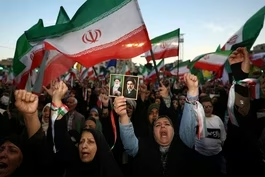
David Ignatius on the consequences of the Iran war
Video has Closed Captions
David Ignatius on the consequences of the Iran war (11m 16s)
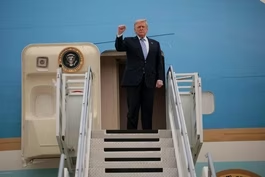
Trump’s revolutionary approach to global leadership
Video has Closed Captions
Trump’s revolutionary approach to global leadership (9m 45s)
Providing Support for PBS.org
Learn Moreabout PBS online sponsorship New Episode
- News and Public Affairs

Top journalists deliver compelling original analysis of the hour's headlines.
 New Episode
- News and Public Affairs

FRONTLINE is investigative journalism that questions, explains and changes our world.

 New Episode
 New Episode
 New Episode
 New Episode
 New Episode
 New Episode


Support for PBS provided by:
Major funding for “Washington Week with The Atlantic” is provided by Consumer Cellular, Otsuka, Kaiser Permanente, the Yuen Foundation, and the Corporation for Public Broadcasting.