
Gina Hessburg
Clip: Season 17 Episode 10 | 9m 20sVideo has Closed Captions
Patient advocacy artist Gina Hessburg uses art to show those living with an invisible disease.
In Minneapolis, patient advocacy artist Gina Hessburg uses art to illustrate what it’s like to live as an undiagnosed patient with an invisible disability.
Problems playing video? | Closed Captioning Feedback
Problems playing video? | Closed Captioning Feedback
Postcards is a local public television program presented by Pioneer PBS
Production sponsorship is provided by contributions from the voters of Minnesota through a legislative appropriation from the Arts and Cultural Heritage Fund, Explore Alexandria Tourism, Shalom Hill Farm, West Central...
Support provided by:


Gina Hessburg
Clip: Season 17 Episode 10 | 9m 20sVideo has Closed Captions
In Minneapolis, patient advocacy artist Gina Hessburg uses art to illustrate what it’s like to live as an undiagnosed patient with an invisible disability.
Problems playing video? | Closed Captioning Feedback
Where to Watch Postcards
Postcards is available to stream on pbs.org and the PBS app.
Providing Support for PBS.org
Learn Moreabout PBS online sponsorship(bright music) - I really got reinspired to make art in 2020 in the beginning of the pandemic in isolation.
And that was converging with the murder of George Floyd and my home city of Minneapolis while I was having a health crisis.
(bright music) I started playing with a blowup doll in a nonsexual way, but just putting him in different parts of my house and writing about my experiences and what I was processing in the pandemic.
And I was posting it on Instagram and people looked for it daily.
And that sort of blossomed into a book project to create awareness and fundraise for patients like me.
And so I self-published a book along with the support of my industry and by crowdfunding.
And that has sort of been a catalyst for me to continuing to make art.
(bright music) That evolved more in 2024 when I decided to do a self-funded and self-driven show to illustrate what it's like to live with a unique visual impairment and an invisible disability and an undiagnosed disease.
And just to hopefully inspire more empathy in people and understanding that we can't always see what's going on the surface of people, and that there's millions of people out there having unique experiences that can be quite challenging.
(pleasant music) The first time I had an optic neuritis attack, I was traveling alone on a small island called Little Corn in Nicaragua.
And I checked into a hostel and I played some card games with some foreigners that I met and drank some rum.
And we went out dancing.
And the next day I woke up and it was like literally looking through almost like plastic horizontal blinds on my right eye.
And I've always had 20-20 vision, so I knew something was wrong.
And then it was like planes, trains, and automobiles, trying to get back to mainland to see an ophthalmologist.
And the first ophthalmologist told me that I was just getting older and I needed some readers.
And luckily there was a woman there who encouraged me to see a second doctor.
And that doctor did a scan and she said, "This isn't your eye, this is your brain and you need to go to the hospital now."
And so I was sent in a car to a hospital and the first thing they did was a spinal tap.
And that just started the whole cascade of hospitalizations and harsh testing for the next few years.
(serene music) In my show that I entitled "Welcome to the Party," I use mixed media to display what my unique vision experience is like and how it impacts me.
So I altered photos that I drew on to show the experience as best I'm having it.
So at my last, at my show, the first piece that sold was a photo and drawing much like this.
And it seemed to be really popular with people.
And I think it's because it's really impactful when you're looking at yourself and you see this visual impairment.
And also for me, like when I wake up in the morning, my right eye, because the visual field is most damaged, it kind of wanders and I always kind of have to like talk it back to looking at me.
But like I'll never, I'll never look in the mirror and see my face clearly again.
And the reason why I entitled it Welcome to the Party is because my visual impairment is almost like a little disco ball moving in my visual.
But it was, the show itself was bringing my community together to celebrate.
Like, although this journey has been incredibly difficult, we've come to this place together where I've been able to create something beautiful outta something that's been really difficult.
(pleasant music) I feel like art is medicine.
I feel like any sort of creative play or creative outlet is naturally therapeutic.
And it's something that we probably dismiss.
(calm music) Living with a visual impairment, I am literally looking at it every waking moment of my life.
It is always there with me.
It's always staring me in the face.
It impacts everything I do and everybody I look at.
I'm gonna note that very few people ever detect that I have it.
They don't notice that it's impacting me because I appear to be functioning very normally.
And I keep up, but it's there.
This is the same.
This is drive from the same photo that I did the painting portrait of my niece.
But this is more of how I actually see the world with my eyes as they are now.
(calm music) I did have one friend say after coming to my show was like, her response was, "God, that must really suck."
And sometimes it does.
And then other times it's just, it's a part of who I am now.
But I do often have dreams where in my dream I wake up and my vision is clear again in both my eyes In the dream I'm always searching for that thing, like what was the thing that cleared my vision?
And I always sort of wake up before I find it.
And then I wake up and remember that this is life is it as you know, this is life as it is now.
It's not ever gonna go back to the way it was.
(gentle music) Which can be really difficult.
(gentle music) The journey I have with art in my life is very back and forth.
There are days where it's easy for me to sit down and make something.
And there are other days where I have a battle in my brain about what I should make and is it gonna be any good and is it gonna be useful?
But it's always there and every time I pick back up with it, it feels good.
It feels good to get lost in it.
(gentle music)
Video has Closed Captions
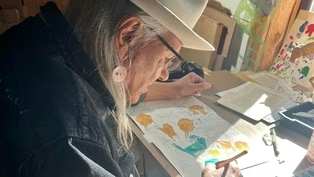
Clip: S17 Ep10 | 18m 49s | Michael Horse is an indigenous artist that creates ledger art and jewelry. He is also an actor. (18m 49s)
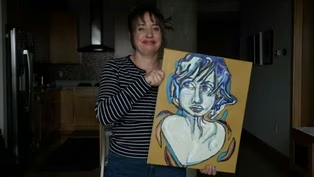
Michael Horse and Gina Hessburg
Preview: S17 Ep10 | 30s | Actor Michael Horse creates ledger art and Gina Hessburg depicts invisible illness through art. (30s)
Providing Support for PBS.org
Learn Moreabout PBS online sponsorship
- Arts and Music

Innovative musicians from every genre perform live in the longest-running music series.










 New Episode

Support for PBS provided by:
Postcards is a local public television program presented by Pioneer PBS
Production sponsorship is provided by contributions from the voters of Minnesota through a legislative appropriation from the Arts and Cultural Heritage Fund, Explore Alexandria Tourism, Shalom Hill Farm, West Central...