
Michael Horse
Clip: Season 17 Episode 10 | 18m 49sVideo has Closed Captions
Michael Horse is an indigenous artist that creates ledger art and jewelry. He is also an actor.
Indigenous artist Michael Horse is well-known for his portrayal of Deputy Hawk on the iconic television series, Twin Peaks. He’s also an award-winning ledger artist and jewelry maker. Michael takes inspiration from the nature surrounding him in his new home in Two Harbors, Minnesota with Pennie Opal Plant – lifelong protector and defender of the sacred system – at his side.
Problems playing video? | Closed Captioning Feedback
Problems playing video? | Closed Captioning Feedback
Postcards is a local public television program presented by Pioneer PBS
Production sponsorship is provided by contributions from the voters of Minnesota through a legislative appropriation from the Arts and Cultural Heritage Fund, Explore Alexandria Tourism, Shalom Hill Farm, West Central...
Support provided by:


Michael Horse
Clip: Season 17 Episode 10 | 18m 49sVideo has Closed Captions
Indigenous artist Michael Horse is well-known for his portrayal of Deputy Hawk on the iconic television series, Twin Peaks. He’s also an award-winning ledger artist and jewelry maker. Michael takes inspiration from the nature surrounding him in his new home in Two Harbors, Minnesota with Pennie Opal Plant – lifelong protector and defender of the sacred system – at his side.
Problems playing video? | Closed Captioning Feedback
Where to Watch Postcards
Postcards is available to stream on pbs.org and the PBS app.
Providing Support for PBS.org
Learn Moreabout PBS online sponsorship(serene music) - I am an indigenous artist.
What I do is a lot of different things.
The older I get, I don't do a lot of things, which I kinda like too, you know, just to slow down a little bit and think about who I am, and what is my place upon Mother Earth.
You know, there's a lot of native cultures that I've asked and there's not even a word for art.
It's not separate from the human condition.
(gentle music) This is my wife Pennie.
It's an honor to be her husband.
She's one of the smartest people I've ever known and she keeps me around 'cause I make her laugh.
- That's true.
This is my husband, Michael Horse.
He is hilarious.
He kept asking me to marry him and I kept saying no.
And finally he said, "I promise to make you laugh every day."
And I went, "That's a pretty good deal."
So I grew up in California and while I really felt blessed and lucky to have grown up in California, I also didn't feel like it was the place for us anymore.
And then I started three times a day looking for where we were gonna live.
And my criteria was water.
Looking at the UN climate reports and seeing what the projections were for different parts of the United States and looking at mineral extraction sites, including fossil fuels.
And we decided that this would be the place for us.
So we bought this place sight unseen, and it has been so much more beautiful and fulfilling here than we'd ever imagined.
It's like the best place either of us have ever lived.
And we've both lived in these amazing places before we even met.
And yeah, we just got really lucky, huh?
- Yeah, Pennie goes "Well we're moving to Minnesota."
You know, both of us thought we'd retire in Mexico.
- I had never been to the Midwest.
I had absolutely no desire to go- - Pennie, wouldn't go east of the Rockies.
- I hated snow.
- A snowflake fell on her when she screamed.
(both laughing) - But when we were driving here, when we came over that hill in Duluth and saw the lake, my heart just started beating so fast.
I had no idea how big it was in real life.
And it was so beautiful.
It took our breath away.
And I had never imagined in my entire life that I would fall in love with the Midwest.
(water sloshing) (pleasant music) - I'm so happy to be here.
We're still amazed here.
We go out every day and, you know, watching the changing of the seasons and the people in Minnesota are the nicest people I've ever met.
You know, you hear about Minnesota, truly nice people.
Everybody smiles at you and you go in a hardware store and you go got one of these, the guy takes you over and finds it for you.
And I never knew my birth father.
I'm part Swedish, so you know, I'm getting into my Nordic roots, you know.
Look Swedish meatballs, food of my people.
And Pennie goes, "No, I don't think that's the..." - That's not true.
You made a delicious Swedish meatball and noodle dish a couple of weeks ago.
It was really good.
- We went up to the Powwow in Grand Marais and on the way back we went to the Finnish Powwow, we called it.
- It was cultural days, Finnish cultural days, and so- - And some Finnish food.
- [Pennie] And I love snow now.
- Yeah, she does.
She loves snow.
It's home to me now.
I can't imagine living any other place.
I'm part Yaki, part Swedish.
I grew up in what's called an intertribal culture in Los Angeles.
I grew up with a lot of the Diné Navajo people and Lakota people and Cheyenne people.
And I was a traditional dancer when I was younger.
And there were big, big powwows and, you know, it was wonderful place to grow up.
And, you know, I wasn't really separated from my culture and also got to learn about a lot of other native cultures.
You know, I got to, to hang out with some of the real traditional people that were from Los Angeles area.
Some of the Gabrielino and Shumush people were friends of mine.
And got to learn some about the history of California.
You know, all my family are artists.
My mom's a traditional painter.
My uncles are jewelers, my aunts are painters.
And some of the really famous native jewelers took me in and I got to apprentice with them.
Never went to school with it.
But it's my favorite thing to do.
Of all the things I do, people say, what's your favorite thing to do?
Cut rocks.
(machine whirring) Sometimes it'll come to me before and sometimes I'll just sit down.
Sometimes the stone will dictate what I'm gonna do.
You know, my dad was most proud of all the things that I did, he was most proud of me doing the jewelry 'cause I did that with my hands.
(machine whirring) It's a very organic process and good for my soul.
Basically I start with just a sheet of metal and a raw stone.
The tools that I use that make the marks in my jewelry, they're my tools.
They're all made from old pieces of drill rod or rebar or old files.
So somebody wants to duplicate my work, they'd have to duplicate all my tools.
To see people wear my jewelry, I mean, I'm flattered by it.
I'm flattered by anybody that gets a piece of my art or you know, watches one of my films.
It's, you know, I mean it's, as a human, it's really nice for people to go, I really like that.
And we used to paint on heights.
That was our history book, our calendar.
It would remind the oral storytellers.
There were little pictures remind the oral storytellers of things that would happen.
Migrations, battles, things in the heavens.
We could roll it up and take it with us.
Well, on the reservation we weren't allowed to have weapons or hunt.
And so hides are not that available.
And we start getting a hold of pieces of scrap paper, mostly out of ledger books.
But any piece of scrap paper, old love letters, bibles, maps, we would draw on these things.
And it was done 1860s up to about 1940.
A lot of it was done in Fort Marion where, you know, after the Battle of Little Bighorn, they put everybody on trains and took 'em there very repressive time.
So a lot of 'em are pictures of things that happened long time ago or things that would actually repressing them, like being on the reservation.
Also, social things.
A lot of pictures of people cheating on their husbands and wives and spying on each other, you know, which is people like kind of our soap opera.
And there was only about, there was just a handful of us that actually brought this art form back then.
Now there's lots of people do wonderful, wonderful ledger artists, all kinds of, some of 'em, they're really, really detailed artists.
I mean, they can just draw like a photograph.
And then there's other people that, there's this kind of almost cartoonish, but mine are very similar to the old ones 'cause I copied them.
I've had 'em in my hands, you know, I've had 'em in the museums in my hands.
So I just started copying 'em.
But it's a really interesting art form.
I've learned so much about history doing this.
And even people that know a lot about native art have never seen ledger art.
You know, the last 20 years or so, it's had, you know, it's had a big renaissance.
There's a lot of people that do it now, but people still they haven't seen it 'cause most of us archived in museums and there's a few books that have come out on it.
But yeah, people are still discovering it.
Wherever you repress people, this exists.
It's in Manzanar where they turn the Japanese, it's from the concentration camps.
It's in there and you know, wherever you do this to people, they get a hold of a piece of a scrap paper and you know, and they draw, you know, most of these were done in colored pencil, like what they called crayon back then 'cause that was the most accessible.
But I paint like in the Comanche and Kiowa style, which is like pen and ink when it was available.
And basically kids' watercolor.
Then I was running my art studio from an agent in 1980 and she says, you wanna be Tonto in the "Lone Ranger," you know?
And I went, no, I'm an American Indian movement member.
I don't wanna be to, and we knew Jay, we loved him.
I knew him, I knew his daughter.
Even with that stereotypical role, he was the real deal.
We just loved him and went, "No, I don't wanna be Tonto."
She kept asking me, I went, no.
And she told me how much they were gonna pay me.
And I went, "Kemosabe."
So went down and talked to Mr.
Fraker and I said, you gonna do this different?
He went, yeah and I'd done a couple of small things, but my first experience was this huge film and not a very good film and didn't take me long to realize it's only gonna be as good as it's written.
(dramatic music) Working with David Lynch is one of the most amazing experience of my whole entire life and a true gift.
I cherish every time we ever had together.
He was a very funny man too.
And he would direct me, go, "Okay a hawk this time, only good."
I knew exactly what he meant.
You know, he trusted us all very much.
And same with him.
I got to see him a couple of months before he passed.
And I live up here in wonderful Minnesota now and he didn't wanna talk about film.
He goes, "What kind of trees do you have?"
And I go, "I have this kind of pine and this kind of pine."
And he was just fascinated by it.
But the opportunity to work with that man, you know, we knew we were doing something special the first time, but 25 years later to realize the impact that we made on film and television.
I mean, everything's got Twin Peaks' DNA all over it.
I mean, David had called me, I heard rumors he was coming back and he called me and said, "Hey buddy, we're getting the gang back together."
And I said, "Well, wonderful.
Just gimme a cameo.
I'll do it for nothing for you."
He goes, "No, we got something for you."
You don't get a chance to work, especially in television to do art.
And if I never worked again on anything, just to have that opportunity to work with David, you know, people said, well, what's your big take from him?
I go, just to be a small dot of color on that man's artistic palette is enough for me.
And he was a wonderful, he was everything you think he is and more and as a native actor, you know, a lot of this stuff is just so freaking stupid.
And we had a chance to actually hold some mirrors up to some stereotypes.
Just a wonderful experience.
I'm a very lucky person.
(gentle music) When I go out and I meet these fans, sometimes I don't do a lot of these events 'cause I'm still working a lot.
And I tell my wife, it's not about fame, it's about sharing David's heart.
And they say, "I'm a big fan."
I go, "I'm a fan just like you are."
(audience applauding) The thing that most impressed me about David, he did not compromise.
I mean, he was, they pushed and pushed and pushed on him.
He would go, "Well I'm not doing it."
You know, I mean, he would not compromise on his art.
There's a great love for this character.
A lot of times my wife will go, "Why aren't you as cool as the Hawk?"
I go, "Nobody's as cool as the Hawk."
And I base this character on a lot of these traditional elders that I grew up with that I hoped I would be someday when I got older.
David understands the human condition.
You know, a lot of my native artist friends and contemporaries, big fans of David's work because like us, he understands that the dream world is just as real as the awake world.
And he understands that the forest is a living entity.
You know, it's a scientific fact that the forest communicates with each other and the myceliums communicate with the forest.
And forest talks to the animal.
(gentle music) (dramatic music) Things that I think I should get and I don't get.
And then things come out of the blue.
Did a wonderful series about a nail salon and the mob called "Claws" with Niecy Nash.
And I just did "Motherland: Fort Salem" about these, you know, my agent goes, "They want you to be on this thing about these witches and work with the government."
I go, "That sounds stupid."
And she goes, "No, you better look at it."
Really wonderful character actors and actresses.
And I've been given a lot of gifts.
A friend of mine, I've done a couple of films for him.
He wanted to do something.
He says, I really wanted to do something of some great substance.
And he says, "I know you do before you retire."
And it's a story of five homeless people that meet on a bench every day.
And they're pretty messed up.
But there's a backstory to all of them how they got that way.
So when you see homeless people, don't look at them like they're invisible.
It's a wonderful film.
I'm really proud of it.
I'm a real fan of animation.
I wanted to do cartoon voices for years, so hard to get into.
And I speak a little bit of my language.
So I started doing a couple of those and people would hire me.
And you know, I did do "Captain Planet" and "Superman" and "Batman" and "Spirit," which was my favorite.
The Mississippi River occupies a unique space in America's consciousness, especially in Minnesota.
I have a real affinity for the Mississippi River, but I didn't know anything about the northern part of it.
So I was asked to do it.
And I'm so pleased and honored and so excited to see it 'cause the water is so important.
You know, my wife is a big water activist and without clean water, we're all gonna be in in a lot of trouble.
Her story is as complicated as it is captivating, filled with heartbreak and triumph.
And it begins here.
(water gurgling) (pleasant music) Nature has an effect upon people.
You know, we are all connected to it.
You can't be a healthy person without music and art and nature.
But now, I mean, this is family to me.
These trees and the ferns.
I mean, that's all part of my family now.
(gentle music) It's interesting, of all the tribal ceremonies I've seen, all around the world, most of them deal with gratitude.
It's thank you and you're a grateful person.
You're less apt to be a jerk.
- I would like to invite people, which I do all the time anyway, invite people to start imagining and envisioning the beautiful future that humanity can create for the entire sacred system of life 'cause everything that we see around us, everything that's human made was first imagined.
And we can imagine something much better than what we have right now.
(gentle music) (waves lapping) (pleasant music) (pleasant music continues) (pleasant music continues)
Video has Closed Captions
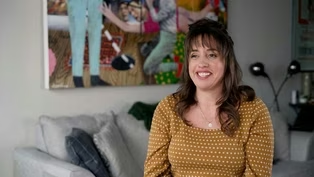
Clip: S17 Ep10 | 9m 20s | Patient advocacy artist Gina Hessburg uses art to show those living with an invisible disease. (9m 20s)
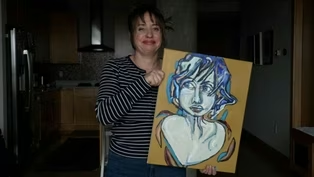
Michael Horse and Gina Hessburg
Preview: S17 Ep10 | 30s | Actor Michael Horse creates ledger art and Gina Hessburg depicts invisible illness through art. (30s)
Providing Support for PBS.org
Learn Moreabout PBS online sponsorship
- Arts and Music

Innovative musicians from every genre perform live in the longest-running music series.










 New Episode

Support for PBS provided by:
Postcards is a local public television program presented by Pioneer PBS
Production sponsorship is provided by contributions from the voters of Minnesota through a legislative appropriation from the Arts and Cultural Heritage Fund, Explore Alexandria Tourism, Shalom Hill Farm, West Central...