
Natchez
Season 27 Episode 10 | 1h 25m 40sVideo has Audio Description
Natchez, Mississippi, is famous for its antebellum homes, but what’s left out of the tours?
Antebellum homes draw visitors to Natchez, Mississippi, but not everyone agrees on the stories being told. As tour guides, homeowners, and activists navigate competing histories, the town confronts the tension between preservation and truth, offering a glimpse into a Southern community wrestling with race, memory, and identity.
See all videos with Audio DescriptionADProblems playing video? | Closed Captioning Feedback
Problems playing video? | Closed Captioning Feedback
Natchez
Season 27 Episode 10 | 1h 25m 40sVideo has Audio Description
Antebellum homes draw visitors to Natchez, Mississippi, but not everyone agrees on the stories being told. As tour guides, homeowners, and activists navigate competing histories, the town confronts the tension between preservation and truth, offering a glimpse into a Southern community wrestling with race, memory, and identity.
See all videos with Audio DescriptionADProblems playing video? | Closed Captioning Feedback
Where to Watch Independent Lens
Independent Lens is available to stream on pbs.org and the PBS app.

Aesthetics and Unraveling the AI Hype
Ghost in the Machine seeks to unravel the AI hype to find the untold origins of “artificial intelligence.”Providing Support for PBS.org
Learn Moreabout PBS online sponsorshipMore from This Collection
The faces, places, and experiences that shape our local communities.

Video has Audio Description
A filmmaker confronts injustice in his hometown as he reconnects with his conservative father. (1h 26m)
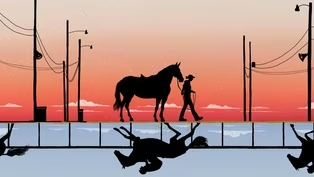
BACKSIDE: The Unseen Hands of Horse Racing
Video has Audio Description
Behind the Kentucky Derby's glamour, unseen workers keep racing’s biggest stage running. (55m 40s)

Video has Audio Description
An Amish sexual assault survivor breaks her silence, sparking a movement for justice and reform. (1h 25m 11s)

Video has Audio Description
Librarians across the U.S. examine how restrictions on library content are shaping communities. (1h 25m 43s)

Free For All: The Public Library
Video has Audio Description
How public libraries shaped a nation and remain a beloved sanctuary for Americans today. (1h 24m 21s)

Video has Audio Description
Unravel the complexities of the Electoral College through four 2020 presidential electors. (1h 16m 37s)

Video has Audio Description
Women and LGBTQ+ journalists launch startup The 19th* to buck a broken news media system. (1h 24m 13s)

Video has Audio Description
A public housing community in Miami becomes ground zero for climate gentrification. (1h 23m 30s)
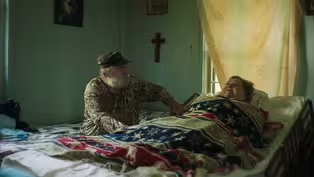
If Dreams Were Lightning: Rural Healthcare Crisis
Video has Audio Description
With rural hospitals closing, meet the people trying to get help in healthcare deserts. (25m 43s)
Providing Support for PBS.org
Learn Moreabout PBS online sponsorship♪ [Horn blowing] [calliope plays "Ol' Man River" by Kern and Hammerstein II] ♪ ♪ [Engine roaring] [Indistinct conversation, dog barking] Woman 1: Ladies.
[Glass tinkling] I need everybody's attention for just a minute because you have a very, very special guest here today, mayor of this grand city of Natchez, Dan Gibson.
How are y'all doing?
Great!
It is so good to be with you.
It's awesome.
And I always love being with the Garden Club because it always means a lot of... a lot of fun conversation, a lot of good food, and also, occasionally, some good planting tips.
[Laughter] Woman 2: OK, if I could get everyone's attention again.
Hello, everybody.
[Glass tinkling] By the way, guys, this is my brother from another mother.
[Laughter] Elaine and I go way back.
[Laughter] I'm excited that Natchez is a new Natchez.
It is a Natchez that appreciates and loves our history, all of it, even the bad.
But it is our history.
It is also a city that believes in coming together in love.
And if we ever needed it in America, we need it today.
We need love.
You know, give me your hand.
Give me your hand.
Woman 3: I love it.
You know, this is what Natchez is right here.
Woman 3: Yeah.
Thank you.
[Applause] ♪ I hear babies cry ♪ ♪ I watch them grow ♪ ♪ They'll never... They'll... ♪ [Chuckles] Woman 3: ♪ We'll never... ♪ ♪ Than we'll never know ♪ [Laughing] All: ♪ And I think to myself ♪ ♪ What a wonderful world ♪ ♪ I think to myself ♪ ♪ What a wonderful world ♪ ♪ Rev: What y'all doing?
We're visiting.
You're visiting?
Mm-hmm.
Well, I'm the guy you need to see.
OK.
I am Rev from Rev's Country Tours.
I am the best tour guide in America.
OK.
And I do a comprehensive historical tour of this place.
You know, there're more millionaires here than anywhere else in the world.
I heard.
Yeah, there's more money here than... We was gonna see if they would drop us some.
Ain't no money here now.
It's all gone.
No, it's gone.
Yeah.
But it was.
And so, you can't talk about cotton without talking about slaves, so I'm going to get you that history.
Umm... Some of the downtown businesses.
We're from Alabama.
So, y'all... Yeah, yeah, yeah.
So, y'all know the Southern history.
We're from Alabama.
I should have known by the hat, too.
Women: [Laugh] Some Southern belles.
That's right.
I would love to do that.
I would love to do that.
You got 3 ladies who wanna join.
Hot diggity.
And we're gonna take some pictures, I'm gonna send 'em to Brenda, She gonna cook for two weeks.
Oh, wow!
When she sees me with these pretty women, she's gon' say, "I got to get "something on the stove."
Yeah, she know how to keep old fat Tracy at home.
[Laughter] Rev: Welcome to Rev's Country Tours.
Welcome to Natchez, Mississippi.
I'm Tracy.
Everybody calls me Rev.
I'm a local pastor.
I've been in the same church for 17 years.
And a former county supervisor who realized that he didn't know anything about what he represented.
So I started a little pilgrimage to learn history.
I thought it was gonna be a couple of weeks and a couple of books.
Ladies, that was in 2015.
And I'm still on the same journey today.
So I went on and combined the love for history and the love for people, and that's how this was born.
What church do you pastor?
East Mount Olive Missionary Baptist Church in Red Lick, Mississippi.
Red Neck?
Red Lick, Red Lick, Mississippi.
I got 200 members, 70 of them come to church, 30 of them pay money, and two of them do what I tell them.
All: [Laugh] [Clip-clopping] Rev: There are only 14,000 people here.
So, it's a small town.
But it's got a very old, rich, deep, peculiar, and I do mean peculiar history.
I'm gonna share with y'all just a little bit later.
Tour Guide 1: They settled Natchez in 1716, and that makes us the oldest settlement on the Mississippi River.
We've got New Orleans beat by two years.
Tour Guide 2: We have homes from every period in American history, Antebellums, Victorians, even colonials.
♪ ♪ Tracy: I'm Tracy McCartney.
I'm very much a country girl.
I grew up poor.
We grew up literally at the end of a dirt road.
[Chuckles] My hoop skirt has 5 steel hoops.
Seeing movies of the South and of the antebellum times, and of course, Scarlet... Everybody always thinks of Scarlet O'Hara.
The ladies have someone who dresses them and someone who does their hair, and I always thought, you know, how spoiled!
That just seems like a little over the top.
Until I first tried to put this dress on.
[Laughs] And I tried and I tried, and I thought, "Surely I can do this.
"I've been dressing myself for quite a number of years."
Filmmaker: OK, cool.
Tracy: Cannot.
Absolutely impossible to do.
I'm getting ready for Spring Pilgrimage, and a Pilgrimage, for those of you who don't know, it's held twice a year when our pilgrims, as we lovingly call them, come from all over the world to see these beautiful homes and to experience the culture of Natchez.
Welcome to Choctaw Hall.
Come on in.
Tourist: Is that your normal attire?
Welcome.
This old thing?
We're at the home of David Garner and Lee Glover.
Hey, ladies.
How are y'all?
Would y'all like to take a tour of Choctaw Hall?
Yes, we would.
Well, let me tell you how Pilgrimage began.
[Bell tolls] In the 1800s, cotton was king.
It was a very, very wealthy city.
Thus, all of the beautiful homes you see, all the beautiful architecture.
But in the early 1930s, when the boll weevil came through and destroyed all of the cotton crops, this city fell to its knees.
I mean, it really, really devastated the economy.
So the Garden Clubs went on a mission to save Natchez.
They decided to do garden tours.
And so all of the ladies worked for months and months and months preparing their gardens, planting, cleaning.
The azaleas were in full bloom.
All of the gardens here were pristine.
And as fate would have it... [Thunder] ...it rained and rained.
All of the blooms were laying on the ground.
The yards were a mess.
It was just a mud hole.
They're thinking, "Oh, my goodness, "what do we do?"
But like any strong, little, resilient Southern lady, they thought, "We're gonna do this.
"Ladies, clean your houses.
"Make some tea cakes, some punch.
"Spike it if you need... [Chuckles] "or whatever you need to do."
It became the tour homes.
You know, they say, "The little old society ladies "got together and saved the city."
And they say it in jest, but in a way, it's true.
And it has been in existence nonstop ever since.
Let me check and see if they're ready for the next tour and you can come in.
[Door creaking] David: Good morning, girls.
Good morning.
Good to have y'all.
Good to have y'all.
But we didn't get started.
We're gossiping.
But anyway, we'll quit gossiping, y'all.
Where are you girls from?
Santa Celemente, California.
Way out yonder.
I'm David Garner.
The other owner, Mr.
Glover, and I maintain Choctaw as our private home.
Let me tell you what.
This old house is a home.
My bulldog ran and jumped up on that yellow Scalamandré sofa.
And the lady said, "Mr.
Garner, Mr.
Garner, "your bulldog's up on that gorgeous fabric."
I said, "She does it all the time.
"Doesn't she have good taste?"
[Laughing] David: My grandmother was one of the first families in the state of Mississippi.
She definitely believed, and I totally agree, my great-grandfather and I were reincarnated.
We looked exactly alike.
Wild, hateful, arrogant, overbearing.
Totally out of control.
I played it up, y'all, and it paid off.
Don't you think?
[Chuckling] My grandmother said that the dining rooms of Natchez, Mississippi, were the battlegrounds of the aristocrats.
The more silver, the more porcelain you could pile up, the more affluent you appeared.
We even have turtle forks.
Have you ever seen a turtle fork?
You don't see them hardly at all.
They look like a terrapin turtle.
People get them confused with ice cream forks.
They are similar.
The ice cream forks are larger.
But aren't they the cutest thing?
[Giggling] [Calliope playing] ♪ Natchez is a little blue speck in a sea of red.
Natchez had the first Black openly gay mayor in the state of Mississippi.
Now, Natchez don't really need a mayor as long as you got the president of the Garden Club.
And the Garden Club runs the city.
I call them the blue-haired mafia.
[Giggling] Woman 4: Most people don't understand what our Garden Clubs really are.
They're preservation organizations.
And we own Stanton Hall and Longwood and maintain those houses.
And we own Natchez Pilgrimage Tours, which is a tour agency.
So, it is really a big business that we're responsible for.
Woman 5: The people that own these homes, you know, we're invested in them 100%.
They're part of our personalities.
And we spend time talking about the history to the point that it feels like it's still alive.
[Hinges creak] Hello, hello.
Thank you for coming to Glenfield.
My great-grandfather bought this house.
Bought it in... 1865?
Daughter: No, he didn't.
When did he buy it?
Excuse me.
1840?
Mother, 1880.
Are you OK?
Woman 6: Oh, it was fabulous.
Famous people.
Cecil DeMille was here.
He came, and we had a fit over it.
Now, the governor would come every Pilgrimage.
Oh, it was so exciting because, see, I was in the fourth grade when all that was going on and just thought it was wonderful.
[Birds tweeting] Woman 7: Welcome to Green Leaves.
This is our family home.
Oh, nice.
And Hazel and I are the sixth and seventh generation.
Every little girl in Natchez grew up, including myself, wearing hoop skirts.
Look at the teeny-tiny hoop skirts.
Isn't that cute?
They made these for us when we were, like, 2 and 3.
And so everybody has worn these.
Riding my tricycle when I was 5 years old out at the home Arlington.
And then going in the house and making up stories as to why this dangled and that looked blue because I didn't know what in the world I was talking about.
Woman 4: I felt very close to the Civil War growing up because my great-aunt and my grandfather grew up in this house with their grandparents who lived through the Civil War.
She'd be wearing this dress, and she'd be in the dining room.
That was her room.
And she would tell how Union soldiers broke into the house and knocked her grandmother down because her grandmother wouldn't turn over the keys to the soldiers.
So, that particular war was very real to me.
[Birds tweeting] I've never seen such a collection of Confederate uniforms and dresses.
Right.
It's wonderful.
Man 1: The members of our Garden Club select from our youth a king and queen of Pilgrimage.
These were actually worn by queens of Pilgrimage, over the years, so they're just a beautiful assortment.
For many years, the young men wore the Confederate uniform, and there's been a move against... [mumbling to self] Let me see, how I can say this right?
Um... [mumbling] How do I say this?
For many years, the young men wore the costume or the... I'm sorry, wore the uniform of their ancestors, the Confederate uniform.
There's been a movement in the past 3 or 4 years to kind of reduce the, um... I'm going to get in trouble here.
Um... There's been a movement within the past 5 years to... to take away... um... No.
Ugh!
[echoes from distant room] There's been a movement for young men to go away from... ♪ Debbie: There's one thing, though, that I wanted to take to my grave, but I'm outed.
The city knows it.
And I was like, whew!
I'm the first African-American woman in this city to become a member of a Garden Club.
Garden Clubs in this town are slaps in the face to the African-American community.
Yeah.
Debbie: They put on the hoop skirts, and they sashay around.
I was working for Monmouth Historic Inn, so I'm finishing up a tour on a particular afternoon, and I say to my guest, "Oh, and that is "an original slave dwelling."
And then I started to talk about the enslaved woman, Dicey, and how she loved her tobacco, just telling the story.
Then they called me in, and they said, "Stick to the script."
[Giggling] "Stick to the script."
Today, I wrote my own script.
This is my own slave dwelling, and this slave dwelling sits on the grounds of Old Concord.
The big house burned in 1901.
I know that oftentimes people come to Natchez to see our big, beautiful homes, but you come here to see the kitchen.
You come here to see the quarters.
You're coming here to see my mother's collection of China from the A&P grocery store.
There is no old Sevres and old Paris and that sort of thing in here.
The enslaved worked in here, and they slept above.
Rev: Behind the big house is the rest of the story.
[birds chirping] Rev: Tourism is a lifeline to this city, but that's waning 30% in 7 years or so.
It turns out that millennials and Generation Z folks, them 20-something, 30-something year olds, they're not as interested in the antebellum stories.
8I call them the "Gone With the Wind" stories that are being told here, as the baby boomers are.
And Natchez has been really reluctant to expand the narrative, even in the face of lost revenue.
OK.
Rev: Which is where I come in.
I'm about to violate some Southern Pride narratives with truths and facts.
All: [Laugh] Rev: So hold your hat on.
So, when you're looking at these houses as you're going through Natchez, understand that they were built by slaves.
that you don't get in the antebellum houses.
that you don't get in the Antebellum houses.
They use the word "servant" or "help," you know, but these were slaves.
Guide: OK, this was Dr.
Duncan's servant.
That was their favorite servant.
He became the overseer of this house.
They taught him to read and write.
Those are his actual writings right here.
Woman 8: Oh, yeah.
And back then it was against the law.
Yes, that's what I wanted to know.
Guide: So, Dr.
Duncan, he was good to his people.
[Phone ringing] Gwyn: Good afternoon, this is Auburn, this is Gwyn.
Yes, this will be our last day to stay open.
[Register cha-chings] I've been a member here 40 years.
For years we made really, really, you know, good, and we could pay our bills.
But when you get to where you can't pay your bills, duh.
[Chuckles] We're all gonna miss doing this, but it's just gotten to the point where we're all... I hate to say this, we're getting all too old.
I guess these aren't politically correct anymore.
I'm guessing.
What can you say?
Gwyn: You know, older people sometimes want it to remain the same.
But regardless of what you want, you know, you can't live in the past.
This is it.
This is it.
This is it.
It's tragic.
I hope somebody keeps it open to the public so that we can see the history.
Instead of rewriting history, we continue the history.
From the back, where we from?
Woman 9: We're from Little Rock.
Hot Springs.
This is Hamburg, Arkansas.
Rev: Arkansas, Arkansas.
Woman 10: I think we're all from Arkansas.
Rev: Ohhhh!
Sooie Pig!
Sweet-pea!
[Laughs] Wonderful, wonderful.
I ain't got no damn Yankees on here.
This gonna be a good tour... All: [Laugh] Woman 11: Hey, how did they make their money?
Oh, I'm gonna tell you, baby.
When I get through with you, you gonna be able to buy a van and be my competition.
There you go.
Rev: Yes, sir.
So, if I forget something, well, just ask away.
By 1815, the textile mills in Manchester, England, are producing 90% of the cloth for the entire continent.
I said the continent of Europe.
And the number one raw material for the cloth is... Women: Cotton.
Grown in the Southern states.
The demand for cotton becomes insatiable.
Newspaper ads in Natchez say, "Buy more slaves to grow more cotton," to buy more slaves to grow more cotton, to buy more slaves to grow more cotton.
And the cotton kingdom, my dear friends, is born.
First of all, I want to thank you for coming to Melrose.
My name is Barney, and I'll be your tour guide.
Kathleen: Any time you're open for public tours, you're gonna have the whole world come in.
And they're all gonna have their own education, and their own experiences, and their own expectations.
We can never be everything to everybody.
I mean, I will speak as a Southerner and as a Mississippian.
Natchez is a complicated little town.
Because of tourism, Natchez swallowed a master narrative about the Old South.
We all want to be rich, and we want to be princesses and live in palaces.
If it's a fairy tale, that's one thing.
But if it's what you then decide is truth, then that can be much more dangerous.
♪ Hello!
Beautiful!
Thank you!
Oh, I got her skirt.
That was it.
Tracy: The first time I put this dress on, as an older woman, I probably felt the most beautiful and ladylike that I've ever felt in my life.
Tracy: Hello.
Man 2: How you doing?
Beautiful.
Tracy: It changes the way people look at me and it changes the way, you know, I feel about myself.
I grew up always knowing that I was adopted.
I didn't know any specifics because it was a very taboo subject back then.
So, I've struggled with a lot of things about myself.
♪ So, when I put on this dress, I felt like I belonged, like I did fit in.
♪ [Cicadas buzzing] David: Natchez, Mississippi, was built upon ambition.
This lady up North, she said, "Why is it that all of you Southern... "little Southern Gentlemen, "why are y'all always so arrogant?"
I said, "Honey, we're not arrogant.
"You're totally misconstrued.
"We're just proud of what we accomplished."
And that's the truth.
There is a great deal of difference, because let me tell you, look around.
We worked our butts off for what you see, for 7 generations, and still working them off to keep it above water.
[David speaking offscreen] [Laughter] Woman 12: Thank you for having us.
Al: [Laughing] We better not stay too long.
Yeah, yeah!
All: [Laughing] [Water running] Rev: David Garner at Choctaw, they throw me good pieces of business from time to time.
You know, every effort is made to be civil and sweet.
But my interactions with the Garden Club folks are surface level.
OK.
OK.
Thank you.
Thank you.
Enjoy.
Alrighty.
Thank you, my friends.
I don't live in Natchez.
Natchez is in Adams County, 32 miles from where I live, in Jefferson County.
All right, doc.
What's happening?
[Indistinct] You still there?
Yes, sir.
It's been a long time, ain't it?
So, Jesus, he say, "Who do men say that I, "the Son of man, am?"
Because he knew who he was.
Yes, sir.
Listen, let me help you out with a little history.
You know, I'm a big time history buff.
One of the master's main tactics was to get us to hate one another.
The light skinned slave better than the dark skinned slave.
The house slave better than the field slave.
The old better than the young.
The female better than the male.
And resentments would arise.
But it really wasn't about hating one another, it was about hating ourselves.
See, it don't matter what the world call Christ.
In fact, let me help you, it don't matter what they call you.
[Applause] And you can't let other people's opinion determine your outlook on who you are.
[Applause] Huh?
♪ Mmm ♪ ♪ Something ♪ ♪ Got a hold on me ♪ ♪ Trouble in my way ♪ All: ♪ Trouble in my way ♪ Rev: ♪ I gotta cry sometimes ♪ All: ♪ I gotta cry sometimes ♪ Rev: ♪ There's so much trouble ♪ All: ♪ Trouble in my way ♪ Man 3: Our Father, God, bless this food and let it nourish our body entire soul.
In Jesus' name, Amen.
Everyone: Amen.
[Laughing] [Overlapping conversations] ♪ But that's alright ♪ ♪ I know that my Jesus ♪ ♪ Jesus, he will fix it ♪ ♪ I know my savior will fix it ♪ ♪ Jesus, he will fix it ♪ ♪ After a while ♪ Pastor: Now and here I pray.
Are you ready?
Both: [Imitate growling] Did you all enjoy your tour?
Woman 13: We did.
Thank you so much for coming.
Thank you.
[Door closes] Um, as I said before, I grew up in a very small town.
At the time that I met my husband, he was much older than me and was in the oil and gas business.
When we married, we visited Natchez very, very often and was looking for a place.
And one of the ladies from the Garden Club, a past president, invited me to join the Pilgrimage Garden Club.
[Laughing] No.
Tracy: And so we bought the condo here in Natchez.
17 years we've been married.
And, you know, we're having some really hard times, but neither one of us have drawn a line in the sand.
♪ We'll see what happens.
♪ Rev: Franklin, Armfield and Ballard, they could buy a slave in Virginia for $600 and sell the same slave in Mississippi for $2,000.
They could almost triple their money.
So the cheapest way and the most common way to get slaves in the Deep South was to make them walk.
One million and one-half million people walked 800 plus miles barefoot and in chains into the cotton fields and the sugar cane plantations of the Deep South.
And it's going to take 9 weeks.
The second largest domestic slave market in the history of America was right here in Natchez.
And it was called the Forks of the Road.
We're right in the middle of it now.
And this is the market itself.
Please, guys, do not allow the size of this place to betray the magnitude of what happened here.
The total number is 750,000.
That's three-quarters of a million human beings, men and women, boys and girls, who are bought and sold at this very site on their way to servile labor until they die.
The slaves came here bound at 5 points, both ankles, both wrists, and around their necks.
And then a chain between us and one going back 50 people deep.
The neck collars and ankle braces are riveted on by a blacksmith.
By the time the slaves get to Natchez, this iron is seasoned with flesh and with blood.
And people ask, you know, "Why would you harm "a product you're trying to sell?"
Well, how do you control 10,000 people for 30 years?
You control them with violence and fear.
This is a Park Service site.
They already started buying properties around it to make this the premier slave market museum in the country.
They're trying to buy these businesses, but, you know, the people are going to try to hold out for more money.
From this point here, every plot of land that you can see with your eyes, all of these are slave-trading companies.
Franklin, Armfield, and Ballard's Southern Office Is where that red muffler shop is, across the street.
[Hammering] [Crackling, phone ringing] Gene: Hello, Natchez Exhaust.
OK, that'd be cool.
All right, Barbara, thank you, baby.
I'm Gene Williams.
I own Natchez Exhaust, across the street from the slave market.
The state park, they made some offers on our property, and it was a joke.
[Hammering] Kathleen: I have been working with the Forks of the Road for 18 years now.
Land acquisition is a slow and complicated process.
And so the challenge is always to find sellers who are willing, and to have an appraised market value, which is what we can pay, that meets their expectations.
Gene: Well, I mean, I've made a living here, all of my adult life.
You can't just up and move a business.
You know, you've got to rebuild your business again.
And at 64, I don't feel like rebuilding anything, you know?
They're coming here and try to buy me out for this much money, and then they'll spend this much money redoing everything that's here.
And I told the guys, I said, "What do I look like?
"Some poor old dumb country guy with my bib overalls on "and a chew of tobacco running down my lip, going, "'Well, I'll take that for it if you just give me that.'"
I'm going, "No, I don't want that."
It'll never happen.
Kathleen: The National Park Service is in the forever business.
And every parcel has its own stories and its own complications.
Across the road is where Franklin, Armfield, and Ballard were located.
And Franklin and Armfield were the largest slave traders in the United States.
They became millionaires off of human trafficking.
Gene: I don't know what that Forks of the Road is supposed to prove.
I think it's just like everything else they say, they're promoting memory of something that was bad.
It's over and done with.
And I hate it.
I wasn't here.
None of us was here.
You know?
Had I been here, I wouldn't have done it.
You just have to keep reminding people of what happened 100 years ago.
And if it's a bad, bad thought, don't remind them of it.
If you're going to take down all the statues, take down all the statues.
You're going to go build something there to promote what they're taking the statues down about.
Why would they do that?
That's kind of what... my thoughts about it.
I'm not trying to be a racist.
I'm not trying to be anything like that.
I'm just saying.
I thought about maybe just opening up my own Forks of the Road over here.
It'd be different than that.
[Laughs] Barney: I hope I'm around when they finish the Forks of the Road project, when it's developed.
Because, man, that's going to be... that's going to be mind boggling.
That land literally has our blood in it.
Literally.
Literally has our blood in it.
That story may still be lost to time.
Boxley: The enslaved ancestors here asked the question, "Who is going to tell their story?"
And I said I would.
And from that time on, I'm waging a protracted struggle to bring the Forks of the Road from forgotten to a National Park Service park.
From here on out, for as long as your generation and your generation's generation exists, they're going to have to tell our story here.
Boxley fought for that.
He fought hard for that.
Kathleen: And he has been working with politicians.
He has worked with non-profit groups tirelessly for more than 30 years to call attention to this forgotten site.
Boxley: However, Natchez City itself was an enslavement selling market up until the Franklin and Armfield people brought in enslaved persons with cholera.
That led to banning the selling of enslaved Africans within the city limits.
So there were enslaved persons sold all over the whole city.
This is my spot, so to speak, and it's been a long time that I've sat here avenging the ancestors.
Kathleen: I'm a Christian woman, and I see him as a biblical prophet because that's what the prophets did.
They were all about pointing out to the status quo that they were not fulfilling their mission of justice.
OK, slaves came here bound at 5 points, both wrists, both ankles, and around their neck.
Tell them about the custom preacher?
[Chuckles] No, I haven't... I know him.
He's a good guy.
He seems to be doing well with this.
[Continues explaining] You can hear him hollering over here.
A lot of folks come there to stand and listen to Ol' Rev's story.
[Distant explanation] Rev: So there's a common misconception that everybody white in the South had a slave.
Only 5% of Southerners ever owned slaves.
Now, everybody white in America benefited from the institution of slavery then, and today.
America's status as the richest nation on Earth.
The first big pot of money that existed on this continent, or in America, was cotton.
And cotton can't exist without...?
Hmm?
Say it.
All: Slaves.
Rev: Slaves.
So it is right, fair, true, just, equitable to say that America's wealth was built upon the backs of the enslaved.
[Engine whirring] ♪ Debbie: I always loved the antebellum homes.
Because as a matter of fact, my mother spent some time working in one of the antebellum homes.
She worked there for more than 30 years.
And I would go to work with her and I thought, "Wow," you know, "I'd like to own one of these one day."
And then several years ago, we were driving around, and I saw the top of the columns here.
You couldn't see anything else because it was just covered in vines.
And we crept in and I thought, "Oh my God."
And I called my husband right away.
I said, "Oh, Gregory, you should see this place.
"We could bless a bride."
Plantation style weddings were really big And he says, "We aren't blessing anybody.
"Get in the car and come home."
[Chuckles] You know, when we bought the place, I was so proud.
And then I start to ask questions about the property.
We find then that it is a slave dwelling.
And then we find an inventory of 124 enslaved African-American men, women, and children.
I didn't know what to do with that when I found that it was a slave dwelling.
I don't know how to handle that because I've gotten a lot of pushback from my people.
My grandfather, he was born in slavery.
He didn't talk about it.
And I'd ask him even, "Papa, what was your dad's name?"
Totally embarrassed, the gentleman was.
And he'd say, "Oh, Master Jones, gal.
"Now get away from here."
Here I was living in history.
And so my emotions are all over the place.
I was in tears, I was sitting there crying.
I go to Walmart and there's this colorful gentleman at Walmart.
And he says, "I heard what you were doing."
It was Ser Boxley.
Boxley says to me, "These buildings are worthy of preservation."
"Still, people don't understand it until they come."
♪ ♪ [Cheering] Tracy: You know, and some people would be offended by this, but this just smells like home to me.
[Laughing] [Cheering] Rev: Welcome to the Tiger Den.
It's homecoming!
[Trumpets] [Indistinct conversation] [Cheerful music playing] 5, 4, 3, 2, 1, hey!
[Explosions and cheering] [Laughs] Yeah, yeah, yeah.
[Playing the piano] [David speaking off-screen] [David speaking off-screen] [Chuckles] [Playing the piano] [David speaking off-screen] ♪ [Distant music playing] Man 4: I can tell you [Indistinct].
[Indistinct] kill themselves.
And you ought to humble yourself instead of being proud of your perversion.
[Pop music playing] Host: Welcome, ladies and gentlemen.
How are y'all doing this evening?
[Cheering] Thank y'all so much for supporting the LGBTQ plus community.
We're here to have a good time.
We're here to raise a lot of money for Y'all Means All Natchez, ladies and gentlemen.
Choctaw Hall is one of our sponsors this evening.
First of all, you two kids, if you have not been to see this, oh my God, stand up.
I don't know how long it takes you to run up that platform to get to him.
That is a mountain worth climbing right there.
I swear.
[Music playing - "Can't Take My Eyes Off of You"] ♪ Man 4: I'm not going to tell you how things are, God.
If you made me a man, then I'm a man.
And if you made me a woman, I'm a woman.
Tracy: I love to receive.
I love the beautiful homes, the beautiful dress, and I love Pilgrimage.
I do miss it, but I have gone through a recent divorce.
We had a prenup.
I'm at a financial point where I need to make a living.
Wouldn't all fit on the truck.
Everything that would go on the truck is there, but I have one more trip.
I'm downsizing my life.
You know, I don't have to have a lake house and a boat.
What I do have to have is peace.
Tracy: I'm going to sort through and keep the things that really are special to me, and then the things that are not, I'm just going to sell them at Kress.
It's a consignment store.
I'll just turn it into cash.
Some days I do really well, some days not, but I'm going to be all right.
Yep.
[Hip hop music playing] Rev: By the time the war starts, half of Natchez is already Union.
A little blue speck and a sea of red today.
By 1862, the secessionists here have to make a choice.
My Southern pride or my million dollar bank account?
I'm going to give you 5 seconds to figure that one out.
Ray Charles can see who's going to win the war.
Stevie Wonder wouldn't wonder who's going to win the war.
One more time in war, poor people die, so rich people can stay rich.
1865, the Civil War ends.
That ushers us into a period called Reconstruction.
During Reconstruction, Natchez, I told you it was peculiar.
Natchez get a Black mayor, a Black sheriff, a Black tax assessor, a Black chancery clerk, the higher-up levels.
First Black man in the U.S.
Senate, Natchez.
John R. Lynch.
First Black man in the U.S.
House of Representatives, Natchez, J.B.
Banks.
First Black physician, uh, Natchez.
Schools, haberdasheries, grocery stores, apothecaries, blacksmith shops, lawyers, banks, and doctors.
"Pump your brakes, Rev!
"Slow down!"
[Chuckling] How you move from being a slave to having economic and political power in the richest city in the world?
Now, that does not happen anywhere else in the South like it does in Natchez.
Upper mobility for newly freed slaves throughout the South was evident, but a mayor, a congressman, a sheriff?
Hell no.
Hell no, I say!
I'm going to require a bit of brutal honesty from you for just a moment.
Who do you think wants what's happening in Natchez to spread throughout the rest of the country?
N... Nobody.
Nobody.
If it happened today, who do you think would want it to spread?
And I fear the answer would be the same.
And so, the aristocracy, they have to stop it.
[Playing the piano] Woman 14: You come here and you get away from the current year.
Current events.
You go back.
I feel like I have stepped out of the current mess and muddle and I have gone back in this lovely way... To a lovely world.
And I can pick and choose what I want to think about.
That's right!
Nowhere, nowhere in America is everything beautiful.
But Natchez.
I mean, you think about the lives we've learned about here.
Although they lived in amazing beauty, their lives were turned upside down by current events.
We have the luxury of removing ourselves from our unsightly current events, and going back and enjoying just the beauty of their time.
Man 5: Cheers.
[Chuckling] ♪ Kathleen: The history that they learned and the history that they believe is now being yanked out from under them.
That's how people experience it.
This change that they feel is being forced on them.
And it's hard work to come to a point where you're able to say, "The history I learned was a mythological construct "that was used to sell tickets."
♪ Welcome to the family dining room here at Magnolia Hall.
There would have been 12 bells in the house, one for each room of the house.
Filmmaker: The bell's for what?
Oh, I'm sorry, to call servants.
Call the servants, yes.
Sorry about that.
Yes, indeed.
[Bells ringing] I think ours sound better than the "Downton Abbey" chime that they had.
That's the tea closet.
At the time, it would have been locked because, y'all, tea and sugar were so expensive during that time that you couldn't afford for even a little bit of it to get pilfered by the servants.
So the lady of the house would have worn that key around her neck, as I do today.
Woman 15: Do you know what a punkah is?
Some of the homes here have a punkah to shoo away the flies.
Man 6: These originated in India.
So a servant would have sit in one side of the room and pulled on the rope.
The punkah goes back and forth.
It would, number one, cool the guests, but it was also to keep the flies and keep the air fanned.
Barney: Ladies and gentlemen, this punkah fan, Mary McMurran wrote this, and she says, "You know when the slave is doing it right?
"When they don't blow the candles out.
"That's the trick."
This was a job, and his job title was called the punkah wallah.
Punkah's fan, wallah's work, operate, punkah wallah.
That was the name of the job.
It was a child.
How do we know it?
She wrote it.
Think about this.
Why a child?
Why a child?
First of all, it's a slave, all right?
It's a child.
Small, look at that corner, inconspicuous, out the way.
Illiterate, can't read or write.
Not a person.
Harmless.
Newsflash.
Ladies and gentlemen, I ain't never met a harmless child in my life.
I don't care if he is a slave.
He's a child.
Children are intuitively inquisitive.
We're loose at dinner.
Things are coming out.
This child can't read or write, but words have meanings that cause an action.
I repeat, words have meanings that cause an action.
That's how children learn.
They're products of not only their environment, but the culture and their language of their environment.
8That's how they learn.
This kid is no different.
He's a slave, but he's no different.
What do you think is going to happen when that kid goes back to the quarters at night?
Man, this kid... "Man, y'all not going to believe what happened last night."
Information is power.
Information is power.
Information is power.
Information is power.
Information is power.
Especially to a race of people that can't read or write, and it's against the law to teach 'em.
It's power.
How do I know this?
Why is this park ranger saying all this?
Simple.
Read John Roy Lynch.
What was John Roy Lynch's job as a child, as a slave?
What was John Roy Lynch's job?
He was at a house called Dunleith on Homochitto.
What did John Roy Lynch do?
He was a punkah wallah.
He operated the fan.
What did John Lynch do?
Freed himself from slavery, joined the Union Army.
What did John Lynch do?
Became a postmaster general during the war in Natchez.
What did John Lynch do?
He became a U.S.
congressman, legislator out of Reconstruction.
What did John Lynch do?
He later left Reconstruction, left politics, became an attorney, moved to Chicago, and practiced law for 38 years in Chicago.
What was his job as a child?
A punkah wallah.
A slave punkah wallah.
Woman 16: Wow, Jesus.
Kathleen: One of our goals is to try to raise the bar, to talk about slavery as a part of every tour.
And I think that some of the other museum houses in town move in that direction.
Well, you know, with mixed results.
This painting of a Black man, there's only 3 in the state of Mississippi.
And by the way, that white is, I think, a reflection on his lip, not necessarily his teeth.
Woman 17: I was very resistant to talking about enslavement because I had so few facts, but we've gotten braver over the years.
All of us who are from the South and who come from families who were plantation owners in the 19th century have to deal with the issue of slavery, chattel slavery.
It's obviously not a nice system.
Woman 4: Lansdowne was my great-great-grandparents' house.
He had a lot of plantations, owned a huge, horrible number of slaves.
And, and, yeah, that's my history.
That's part of my history, and I have to tell it as much as I hate it.
Woman 18: And the other part of our story is about the African-Americans who lived here, at Green Leaves with the family.
Unfortunately, one of them we know was not happy because this is Matilda, who ran away in 1850, and this is an advertisement for her return.
All right, this is what I ring when I want someone to bring me a Diet Coke.
[Bell chimes] Welcome to the summer kitchen.
This is an original dependency, as we say in Natchez, or outbuilding, of Gloucester.
In National Geographic, 1949, check out this gorgeous picture.
There is an actress portraying the shucking of all these vegetables right by the fire during Pilgrimage one time.
Isn't that lovely?
Debbie: Here I am with this slave dwelling.
So I said, "Oh, you know, "I'm going to invite the Garden Club ladies "out here to see this house."
And I did.
Now, I love how Debbie has gone through, because the unique history of this property here, I would say the majority of us that have these other homes don't really have that type of opportunity to focus on what she can focus on.
But we have the responsibility of doing what we've got at our places as well.
Elizabeth: Anyway, you know the thing I like about Debbie is the one thing we have in common, is that we both seem to just have our own ideas and our own research, and then we just do whatever we want.
[Nods] I find that very fun about you.
Thank you.
[Laughs] Thank you.
I am fun, fun, fun.
I'm fun Debbie.
That's just who I am.
I went over to her house to visit it, but I didn't even get to meet her then.
Debbie: When you're telling a story about, say, a kitchen, a Black woman's kitchen, for me, you bring a Black person in to talk about the kitchen, and you say to me, "Well, you come and you do it."
I don't have time to tell the story for your kitchen, but I'm almost certain your guest would most probably be more receptive of a Black person, woman, in that kitchen telling your story.
That's all.
We probably have two different kinds of people coming, some who just want to look at pretty things, and some who want to learn more about it.
Debbie: I don't know.
I beg to differ there now.
Elizabeth: I know who comes to my house now.
Yeah, well, I know who comes here, and I know, you know what I'm saying.
I'm not being argumentative.
I don't want to do that.
Elizabeth: Oh, no.
Okay.
No, what I want to say is that a lot of people come to Natchez and they see the pictures.
They're not even oftentimes reading anything about it.
They see that mansion.
So they come here to find, "Oh, it's a slave quarter."
I have people who stay with me who have no idea.
Yes, because it's... Yes, because it's concealed by design.
What's frustrating to me is reading the stories of the enslaved people.
We're at least getting to learn some names, but we don't have... It frustrates me to know we don't know what they look like.
We don't have a portrait of any of them, or... And it's the way it was, but I'm like, what do you do?
Do you have a silhouette created?
Is there something to... to symbolize someone without it?
I'll never have something real, or do you just honor the name or what little bit you know?
Debbie: You certainly do.
You answered your own question.
That is exactly what you do.
I don't know how y'all feel about it, but I like how Helen Smith, I thought she said it well.
She said there's clearly examples of there being great affection, you know, between people in the home, but she says affection will never be a substitute for freedom.
I thought that was a nice way to say it, but you at least have to hope there's affection.
It makes you feel a little like, okay, they weren't... Gloucester was built in 1803, and the Emancipation Proclamation was in 1863, so it did have slavery for 60 years.
But then, from then on, from 1863 to 1920, when they built an indoor kitchen finally, they had, you know, paid servants out there working in that very primitive kitchen.
Some stayed on and just, you know, got paid, I'm sure.
Surely not much, but got paid and stayed on with the family long after the war.
We pay our housekeeper.
She doesn't come for free.
Mmm.
OK.
Debbie: It was like a nightmare today.
By the time you got here, I wanted to just burst into tears.
I did.
Anita: Poor baby.
Oof.
And I mean, because this [beep] is hard.
You have to sit in here and listen to all that old Karen stuff.
[Nods] So she bought a house, and she doesn't know.
That's it.
She knows the history of her house, but she knows, and that is so it.
The lingo, it's not proper.
The things... She needs to... She needs to go get some help with that, because it's offensive.
It truly is, and I was trying not to be so offended in my home, as well as, not to offend her.
That woman made me so... [Laughs] I don't usually get that rattled.
But that is so, that's it.
Bless her heart.
And I'm going to send her some candy, some cookies.
Don't send her no candy and cookies.
Send her a book, so she need to be educated.
Oh!
♪ This way.
♪ Perfect.
[Indistinct chatter] ♪ [Laughs] ♪ ♪ Live from Mississippi, yo ♪ ♪ Go ahead and walk out the door ♪ ♪ One thing that you gotta remember ♪ ♪ Is one monkey don't stop no show ♪ ♪ If you wanna go, baby ♪ ♪ Go ahead and walk out the door ♪ ♪ One thing that you gotta remember... ♪ Rev: Take your time as you exit.
The old aristocracy, they went from have to have not.
75 years of absolute wealth and power ended in 4 years of war.
At Melrose, they're planting tomatoes after the war to pay taxes.
What you think the first thing was on the aristocracy's mind?
"How do I get it back?"
By 1890, all 13 Ex-Confederate states pass the Mississippi Plan, and it becomes the law of land in the South.
These new constitutions in the South will forbid Black representation on a state, federal and local level.
Just like that, all those elected officials sit down.
It's going to create voter suppression laws like literacy tests and poll taxes, no more Black voting, white-only and color-only bathrooms, limited access to public facilities.
A Black man can't wear a white shirt on Sunday morning.
If you were walking down the sidewalk, and I approached you, I had to step into the street, bow my head and call you miss.
If I looked in your eyes, the constitutional law, called that simple assault.
You told, I went to jail, hello Karen.
[Laughing] She born right here in Natchez.
The most insidious thing it did was to rewrite criminal justice codes called Black Codes for Black People.
This will elevate misdemeanors to felonies and create inmate lease programs so that state prisons, county jails, and local jails can rent inmates to farmers.
That set of laws had a name, and it was not the name of a human.
It was the name of a minstrel act, where an actor put on blackface and pasted feathers on his arms, danced around as a buffoon, and it was called Jim Crow.
Jim Crow.
Jim Crow.
All: Mmm.
So Jim Crow was not some spotty municipal ordinance, social norm, or custom.
Jim Crow was constitutional law in the whole Deep South, from 1890 to 1965.
65.
Yeah, I was born in 1964.
It was not until LBJ signed the Voting Rights Act in '64 and Civil Rights Act in '65 that Jim Crow got wiped off the books.
It was too late.
It was a scar.
It was a wound on the soul of America.
75 years of government-sanctioned, institutionalized, systemic racism and white supremacy had done its dastardly deed.
America is still segregated.
There are Black schools, white schools, Black churches, white churches, Black neighborhoods, white neighborhoods to this very day in Natchez.
Rev: Well, it's got to be on purpose.
You know, I mean, like... Woman 19: I mean, are there, you know, new developments that actual white and Black people are living?
I mean, there are exceptions.
-Are there signs?
-No, there's no signs.
But Jim Crow was ingrained into America's psyche, culture, heart, mind, and it's still there.
♪ Rev: Y'all got any questions, comments, anything?
You ain't gonna get a whole lot of opportunities to talk to an articulate Black man about this kind of stuff, so go ahead.
Man 7: How do you turn that around?
Oh, baby, if I knew, I'd be rich.
Oh, I know that.
But I mean, it starts with sitting down and talking, just like you said.
It does... But then you have to focus more on, you feel, like, education.
I always felt like education... was the key.
Was the key.
Yeah, I think so.
The whole family idea, women having numerous children and with no father.
Yeah.
You know what I mean?
Well, they got fathers.
Well, yeah, yeah.
They all got, yeah, yeah, yeah, yeah, yeah.
They're not... In the home.
They're absent.
Right, right, right, right.
And that's designed.
You see, if you want to kill a snake, do you cut the tail off or the head?
You cut the head off.
And so the cradle to the prison pipeline, the injection of drugs and poverty, and the gentrification in communities, and the redlining, all that stuff works just fine.
I get thousands of people.
I've done these tours in the last 8 years or so, and I get this comment a bit repetitively where folks say, "Well, "what Black people need to do "is this or this or this to solve this problem."
But y'all understand that Black people didn't create the problem.
White people created the problem.
And so if it's going to be solved, white folks are going to have to solve it.
Plus, let me finish.
Let me finish.
Black people don't have enough money or power to solve the problem.
And so the inequities that exist in our culture will require something that I think is going to be difficult, and that's white folks are going to have to give up something.
Yeah, yeah, yeah.
Opportunity, wealth, all those things.
And who wants to give up anything that they feel like they've worked for?
You know what I'm saying?
And so, how you fix it, man, that's real tough.
Rev: I welcome those conversations.
And sometimes after the tours, I'm a little sad because I feel like we've made a connection, and now it has to end.
You got to analyze as you're talking to people, and it's almost an art, what they're able to bear.
You know, you get more from nonverbal cues than you do verbal cues.
So, you know, I'm really in tune to them while I'm talking.
That's how I know when to shut up.
Man 8: You ever pick cotton, Rev?
Rev: No, sir.
Man 8: I Have.
Woman 20: My grandmother did.
OK.
Uh... I took you to the highest point on the bluff, and this is the lowest point.
Woman 20: Oh.
Did you ever do Choctaw Hall?
Filmmaker: Yeah, we did it yesterday.
Have you taken the tour?
Oh, me?
I've been in the house many, many times.
Many times.
I don't think David does the same thing with me there as he does without me, because I've had people come back and say, you know, "He made some blatantly racist comments."
Uh... I always picture him as just trying to portray what a Southern aristocratic gentleman-- how they would talk, as opposed to it being him.
I mean, he gay in America still.
Y'all'll get to know him a little bit more, and maybe you can see if there's a real him or if that is the real him.
Jacques Petit loved monkeys.
He owned 3.
He made scent bottles with rose oil in the shape of monkeys.
Look at her, she's dressed in royal clothes.
Her top comes off.
Pour rose oil.
Look, she's got a flask in her hand.
She's smashed.
You can tell by looking.
And look how beautifully signed she is.
Don't you love...?
Look at her face.
Isn't she hysterical?
I mean, this girl is blitzed.
[Laughter] And what's so interesting, it's cracked and crazed, you can still smell rose oil.
Isn't that... Isn't that great?
I feel like I'm doing communion.
[Laughter] Woman 21: Oh, wow.
Wouldn't I have made a good priest?
I'd love it.
[Visitors laugh] Have you been in Choctaw, too?
Yes.
Did you see David?
Oh, yes.
Biggest characters you'll ever meet.
He's a nice guy.
Yeah, he is.
And believe it or not, he took a bunch of stuff out.
Yeah?
He did.
Especially at Christmas.
He said the hoop skirt mafia made him take a lot of things out.
[Laughter] They got on to him all the time about inappropriate words that he might use, and he didn't like that at all.
So, he was reprimanded numerous times over his tours, but everybody loves his tours.
He just says it like it is.
He's entertaining.
Bye-bye.
Thank you.
Y'all come back now, you hear?
[Laughs] Mayor Dan: In recognition and appreciation for their many contributions to our city... Listen, don't start doing that.
You know, you'll make me... [Chuckling] We honor Deborah Cosey with this key to the city.
[Applause] Debbie: Wow, I'm so overwhelmed.
Natchez is a place of healing of the ugly past.
And yes, I am the first African-American woman to be a member of the Pilgrimage Garden Club.
And then, when they're surly, my friend here, he'll tell you, I do this for them, and then I break 'em down if they wanna be ugly.
[Chuckles] ♪ Oh, freedom ♪ ♪ Oh, freedom ♪ ♪ Oh, freedom ♪ ♪ Over me and before I'd be a slave ♪ ♪ Said I'd be buried in my grave ♪ ♪ And go home ♪ ♪ Home to my Lord ♪ ♪ And I'd be free ♪ [Applause] I have really bad days sometimes when I think I'm gonna just be this little wimpy girl or woman or whatever, and it's like, "I'm tired and I can't do this anymore, "and I can't go."
I think of them, the enslaved people here.
Flora Upshaw, Hester Williams, George and Charity Martin.
I give honor to them.
I say their names.
I ask for their guidance.
[Chuckles] You know?
These were handmade.
They made these bricks, you know?
[Birds chirping] ♪ Tracy: One day I was out here, as I am every morning, and a van drove up.
I introduced myself, and... as it turns out, I'm Tracy, he's Tracy, so we chatted for a little while, and, you know, I've wanted to do his tours since then.
I love learning about all of the beautiful architecture that's here, and the culture of our city.
Rev: Well, y'all know my... My name is Tracy Collins, and I'm a local pastor here, and a bit of a historian.
♪ The fastest-growing cash crop in the state is the Southern Pines.
My very first job was in the pulpwood's.
Rev: Shut up, you ain't been in no woods, girl.
You were a Beverly Hillbilly!
Tracy: My dad loaded the truck, and then my mom drove the truck to the mill the next morning and unloaded it.
I hauled wood for one day.
The next day I went and got in college.
Woman 22: [Chuckles] Tracy: Oh, right?
By the time slavery moves from the East to the South, the chains aren't on their arms anymore.
The chains are on their minds.
Rev: You been in Melrose?
I have not.
It's so sad that people can be so... You know, so cruel.
He said some things that made me think about it a little differently than what I had before.
♪ Woman 23: You grew up next to the governor's mansion?
[Laughs] Tracy: You know, I just can't imagine the slaves.
I mean, how do you walk 900 miles?
I don't think I could have... I mean, I just feel sure I would have died.
And no one would have cared.
No.
And I would have been glad of it.
I mean, I would have rather died than... Rev: I'm sure some of them felt that way.
Slaves couldn't read and write, so where did the education come from?
Well, some of them are the bastard children of the aristocracy.
See, the rich white male planter get to have sex with whoever he wanted to.
And these men are raping women like 55 going south.
You understand?
Your husband is gonna come tell you at 9 o'clock, "Baby, I'm going to check the chickens."
He ain't gon' check no chickens.
He's going down to the slave quarters.
And he's gon' do that every night.
And the only time he'll even come to your bed is to make an heir.
And the same women that he having sex with, raping, to put it the way it is, they're washing your clothes, cooking, cleaning, helping you put your clothes... She's pouring your coffee in the morning.
And he got that, "I'm going to have sex with you" look "tonight" in his eyes.
But he ain't looking at you.
He's looking at her.
And guess what you get to say about it?
Nothing.
You can't say a word.
Now, do you think you can't say anything because you won't say anything or you can't say anything?
What do you think?
I mean, what do you think?
If you're the wife?
If you're the wife, why can't you say anything?
You ain't going to be wrong, I promise you.
You know, where would she go?
Well, right.
And because they're supporting your lifestyle.
Right.
There you go.
[Metal cutting, grinding] Jim Crow was constitutional law in the whole Deep South.
Now, get this.
From 1890 to 1965.
I was born in 1964.
Me too.
We the same age.
Same name, same age.
You my sister, man.
You my sister.
Yeah, you got to come to church with me.
Yeah, yeah, yeah.
That was, uh, a drastic turn.
All: [Laughing] Rev: I'm hip, right?
[Chuckles] Hey, Doc!
[Gene speaking off camera] Oh, man.
And you the worst doggone muffler man in Mississippi!
Get a job!
Ass.
Woman 22: What did...?
What did Gene say?
Rev: The muffler guy?
"Oh, that Black boy's lying."
[Chuckles] One of his little friends was over there.
And every time it's 3 or more of them together, their ignorance just boils over.
I'll get him straight in the morning, though.
♪ ♪ [Water running] ♪ [Laughter] ♪ Woman 24: [Speaks off-screen] Both: [Laugh] [Chuckles] Yeah, yeah, yeah.
♪ ♪ [Indistinct singing] ♪ ...stretch my hand to Thee ♪ ♪ Be ♪ ♪ The only help I know ♪ ♪ If Thou withdraw thyself from me ♪ ♪ Where shall I go?
♪ 5, 4, 3, 2, 1.
You're not here.
♪ Jesus, my God, I know Your name ♪ ♪ The only help I know ♪ [Random piano notes playing] ♪ If Thou withdraw thyself from me ♪ ♪ Where shall I ♪ ♪ I go?
♪ ♪ Hi, pops.
This is my youngest son.
This is... Yeah, Bobby.
This the boy you've been talking about?
[Laughing] He's the Director of Interpretation.
♪ Barney: Melrose here today commemorates over 700 slaves that John McMurran owned over a 33-year period, paying homage to the enslaved people that were considered less than human, but yet built a country.
Mayor Dan: This is the history of Americans.
Are we really not going to tell that story?
♪ [Laughs] Rev: My barber says, this place is never gonna change.
"This place is never gonna change."
[Laughter] Tracy: A couple of Tracys.
Rev: I know.
When I believe that, then I'll sell everything and move.
This is home.
♪ [Crickets] ♪ ♪ Announcer: Independent Lens is made possible by the Action Circle for Independent Lens with major funding from the John D. and Catherine T. MacArthur Foundation, Acton Family Giving, The Ford Foundation, The Jonathan Logan Family Foundation and contributions from the following: Additional support for this series has been provided by the Corporation for Public Broadcasting and by contributions to your PBS station from Viewers Like You.
Thank you.
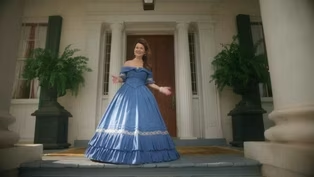
Video has Closed Captions
Preview: S27 Ep10 | 30s | A Mississippi tourist town examines its antebellum history and the stories being told. (30s)
Providing Support for PBS.org
Learn Moreabout PBS online sponsorship












Support for PBS provided by: