Prairie Yard & Garden
The Perennial Paradise
Season 39 Episode 2 | 28m 45sVideo has Closed Captions
Rita and Jim Erickson have a breathtaking landscape featuring hundreds of vibrant perennials.
Before retiring, Rita and Jim Erickson ran "The Hosta Shed" near Paynesville. While it started simply as Rita’s hosta collection, the garden has since exploded into a breathtaking landscape featuring hundreds of perennials, creating an unparalleled display of color and beauty. Host Mary Holm gets an exclusive, grand tour from Rita, who shares her secrets in the hopes of inspiring fellow gardeners
Problems playing video? | Closed Captioning Feedback
Problems playing video? | Closed Captioning Feedback
Prairie Yard & Garden is a local public television program presented by Pioneer PBS
Production sponsorship is provided by Shalom Hill Farm, Heartland Motor Company, North Dakota State University, Friends of Prairie Yard & Garden, and viewers like you.
Support provided by:


Prairie Yard & Garden
The Perennial Paradise
Season 39 Episode 2 | 28m 45sVideo has Closed Captions
Before retiring, Rita and Jim Erickson ran "The Hosta Shed" near Paynesville. While it started simply as Rita’s hosta collection, the garden has since exploded into a breathtaking landscape featuring hundreds of perennials, creating an unparalleled display of color and beauty. Host Mary Holm gets an exclusive, grand tour from Rita, who shares her secrets in the hopes of inspiring fellow gardeners
Problems playing video? | Closed Captioning Feedback
How to Watch Prairie Yard & Garden
Prairie Yard & Garden is available to stream on pbs.org and the free PBS App, available on iPhone, Apple TV, Android TV, Android smartphones, Amazon Fire TV, Amazon Fire Tablet, Roku, Samsung Smart TV, and Vizio.

Visit the Prairie Yard & Garden Website
Do you love gardening? Consider becoming a friend of Prairie Yard & Garden to support this show and receive gifts with your contribution. Visit the link below to do so or visit pioneer.org/donate.Providing Support for PBS.org
Learn Moreabout PBS online sponsorship(gentle music) - During the last year of my mother-in-law's life, she had lots of health issues.
We made the three-hour drive from Morris to St.
James quite often.
One of my gardening friends asked if we had ever stopped at the Hosta Shed at Paynesville, since it was right on our way back and forth.
Well, we had a few extra minutes one day, so we pulled in, and admired the many hostas they had for sale.
I wandered off, came around a corner, and saw a sight to behold, and to share with you.
(gentle music) - [Narrator] Funding for Prairie Yard and Garden is provided by Heartland Motor Company, providing service to Minnesota and the Dakotas for over 30 years, in the heart of Truck Country.
Heartland Motor Company, we have your best interest at Heart.
(gentle music) North Dakota State University, through its Field to Fork Educational Program, providing research-based information on growing, preparing, and preserving fruits and vegetables.
(gentle music) Mark and Margaret Yackel-Juleen in honor of Shalom Hill Farm, a non-profit rural education retreat center in a beautiful prairie setting near Wyndham, Minnesota, (gentle music) and by Friends of Prairie Yard and Garden, a community of supporters like you, who engage in the long-term growth of the series.
To become a friend of Prairie Yard and Garden, visit pioneer.org/pyg.
(gentle music ending) (gentle music) - [Mary] My garden club goes on a tour each summer.
Last year, one of the places we visited were the Gardens of Rita and Jim Erickson at Paynesville.
Rita and Jim have retired from owning the Hosta Shed, but their gardens are a perennial paradise.
After getting to enjoy this beautiful area, I asked Rita if we could come and do a show for Prairie Yard and Garden, so all of our viewers can share the beauty too, and she said yes.
Thanks Rita for letting us come.
- You're welcome.
I'm glad you could come.
- Now tell me, how did you get started?
- Well, I've started gardening small.
My father was a gardener, mostly vegetables, but I just love flowers, and so I got into flowers, my friends started collecting hostas, and so I got started collecting hostas too, and that's just grown from there.
There was just one small, little, like four by four patch of garden, and then along a fence line, a two foot section, and then just back where the picket fence is, there was a few flowers there too, so ... - [Mary] So where did you start planting?
- [Rita] I started along the fence line, and then in this back bed, so I just mostly, it was all sunflowers.
So I started with daylilies.
I also have a passion for daylilies, so that's, most of my flowers at that time were daylilies.
- [Mary] Would it be possible for us to go and see some of your sun plants?
- Sure, let's go take a look.
(gentle music) Mary, this is part of my sun gardens, and daylilies are part of my passion.
This one I think is Desperado.
There's one back here, it's a peach with a pink tint to it, I really like that one.
- [Mary] How in the world do you keep up with all of the weeding here?
- [Rita] Mulch.
I get lots of mulch.
I have big piles, I have people that, tree trimmers that dump up on top, a lot of they'll just ask me, you know, "Do you have a place for 'em?"
And I said, "Just dump 'em up on top."
And so we mulch fairly heavily.
- [Mary] How did you get the stepping stones in your paths here?
- [Rita] Well, my husband made some of the concrete ones, and these other ones I've just bought on sale.
And then I just decide to try and find a focal point, the bird bath, of course, it's being hidden by the sedum right now, but that was a focal point.
- [Mary] How do you manage to mix the textures and the colors so beautifully?
- [Mary] Well, thank you, I just, it just happens.
I mean, I like the variegation, I love the variegation.
- [Mary] Have you intentionally planted the different daylilies to get a longer season of bloom?
- Yes, yes, that was, one of my concerns was that I wouldn't have enough color, but I do plant them, and as with all perennials, you plant different ones to extend your bloom time.
So Mary, this is another one of the sun gardens, and it's right on our patio, and I have many different seasonal plants in here.
I have, well there's naturally, there's tulips in, and there's sedum for the fall, and there's asters down here, there's peonies, I have annuals, I have marigolds on the patio, and they seeded themselves this year, just like that.
It's like I didn't plant any of those.
They're all from seed.
- [Mary] What are the beautiful blue and white flowers in the middle there?
- [Rita] Yeah, those are balloon flowers.
They take deadheading to make 'em look nice.
They tend to flop once in a while, I have a couple of cages around them, but they're beautiful.
And here's a Jacob's ladder, that's another spring, early summer bloomer, and I also have it in a variegated variety, which is really nice, I like it a lot.
Over here, there's allium, also a spring bloomer, and it has a very interesting head when it's done blooming.
Some people have taken them and spray painted them, and like for the 4th of July, they have them sold, they're like sparklers, on some of these, I've cut the stock off, and I've just let 'em sit there for just, you know, looks, texture, and then when they start to form the seeds, they're outta here.
And Mary, this plant, when I bought it, the lady told me it was called a hard-leafed lamb's ear.
Well, I've since found out that I believe it's called betony, and I had it just in the purple color, and it has started seeding, it will seed itself, and I have pink now too, and so I really like the pink.
So I'll take and put the pink ones, different places for more color and more texture.
- [Mary] Then for fall, are there specific plants that you like for fall color in here too?
- I also have some asters over here, and there's actually some asters buried in here, which I cut some of these plants back, so that you can see the asters when they start to bloom.
And, of course, the sedum has seeded itself so much here too, so it's gonna have to partially go too.
But it's very, very pretty in the fall.
- [Mary] Do you deadhead your daylilies after they're done?
- [Rita] Every day.
I take the spent blooms off every day.
They just, when they're on there, they just distract from the beauty of the plant.
So yes.
- [Mary] And then how far down do you cut the stalks?
- [Rita] Depending on how much time I have, if I ... I'll go clear to the bottom if I have a lot of time.
If I'm just trying to tidy up, I'll just snip 'em below the green.
- How did this come to be?
- The gazing ball?
- Yes.
- My husband makes all the gazing balls.
They're from a bowling ball, and he just sits and glues all the little beads, throughout the garden, you'll find lots of gazing balls.
He was actually selling them when we had the Hosta Shed.
He would sell them, so that was how they came about.
- [Mary] How do you keep up with the watering?
- [Rita] Our watering system is out of the lake, which I think provides a lot of nutrients, why a lot of my plants look pretty good is from the lake water, and when we moved here, a plumber owned the property, and he had run, he had a row of pine trees up the hill, and he had run water all the way up the hill.
So we have a big pump across the lake, and it pumps water all the way up the hill.
- [Mary] Wow.
Well this is so gorgeous, but now can I see your shade area too?
- [Rita] You sure can.
(gentle music) - You like dried apple slices or fruit leather?
You can make these quite easily at home.
Early on, earlier generations made use of the Sun and wind to dehydrate foods, or in other words, lower the water activity.
Today, we're food scientists when we're drying foods, or doing any kind of food preservation.
If you decide to use a food dehydrator, you're gonna look for some specific things.
You want trays that have a lip on them, you want a dial that shows you the temperature, and by the way, if your oven goes low enough, you can dehydrate in your oven, if it goes down to 140 degrees.
And you also want a grounded plug.
Here's the recipe for homemade fruit leather.
I have a cup of applesauce, a cup of pureed berries, a tablespoon of honey, and we mix these together in a food processor or a blender, (blender whirring) and then we're going to spray our tray with a non-stick cooking spray, and then spread it out evenly, and let it dehydrate for about six hours.
We want the temperature to be about 140 degrees in your food dehydrator or oven.
Now it's time to enjoy our delicious snacks.
This is Dr.
Julie taking you from field to fork.
Until next time.
(gentle music) - Well Mary, this is one of my shade gardens.
This is probably the most maintained, because it's the closest to the house.
And I have many different varieties of plants in here, besides the hostas, I have companion plants, like the coral bells, I have many different coral bells, and astilbi, and here's a purple one that's in bloom over here now.
I have bleeding hearts, I have probably, I think five different varieties of bleeding heart, I have the chartreuse, I have the plain pink one, I have a dark red with a dark stem, I have the white, these are all white that are back here.
I also have jack-in-the-pulpit, and jack-in-the-pulpit showed up one day, and it's a nice plant, and it's fun to have, also seeds itself, and I will find it in many different places, so yeah, it's like the good and the bad.
(Mary and Rita laughing) - [Mary] How many hosta varieties do you have?
- The varieties I used to have, I have to keep track of all of them in a log.
And I had 950 at one point, but the winter was so bad, I lost several varieties over the winter.
I'm probably at about 930, 940 now.
Somewhere in that variety.
- [Mary] And then you even label your plants too, don't you?
- [Rita] I do, especially, I do the daylilies, and I do the hosta.
Some of the other stuff I don't label, but I find that these are the best markers.
They're stainless steel, and then I use a Brother waterproof label on it, and most of these labels have been in for like 10, 12 years or more.
- And they don't fade?
- No, they stay just like that.
The only thing that happens to 'em is the deer will stomp on 'em sometimes and bend them.
I can bend them right back, so ... - Now do you have some ferns in here too?
- I have Japanese painted fern, and I really, I love the color of the Japanese painted fern.
And I do have the big ostrich, or the fern that's out in the woods fern, I have it along the side of the shed, where I keep it contained as much as possible.
(Rita laughing) Otherwise it goes everywhere.
I'm always having to cut it back.
- [Mary] What is that really pretty ground cover that you have over on the hillside there?
- [Rita] That's geranium.
That's the perennial geranium, and I think I have probably four, maybe five varieties of that.
But this is the easiest to maintain.
And this is in the center here, there's some ground cover, it's called lamium, and there's some along the edge over here too that's used for filler, you know, and a lot of times, you have to be careful with it, it will get away from you, and it'll find, I'll find it in a lot of different places, and it's like, "Yep, I don't want you there.
You've gotta come out of here."
(Rita laughing) So that's, you know, that's the beauty of ground cover.
I've tried several different ground covers.
They don't always work for me, and I also find that slugs like the ground covers.
I'll find, I'm always having to try and kill slugs out of the ground cover.
Yeah.
- So do you have trouble with slugs with all of your beautiful hostas?
- [Rita] Yes, of course, you have hostas, you're gonna have slugs.
I do the ammonia drench, that's early in the spring, and you drench around when they're just coming up, and that helps keep the population down, and also Sluggo is a good bait for the slugs, but we've had so much rain, I haven't been able to use it.
If you come out, and with your spray bottle, and you get right down in there, you can find 'em right down in the crown, and I just spray, spray that ammonia drench on 'em, it doesn't hurt the hosta at all, but it'll get rid of the slugs.
- [Mary] Do you have to worry about the leaves burning if it's hot when you're spraying?
- [Rita] Not really, because most of 'em are in the shade.
And then Mary, I wanted to show you, there're some of my favorites, there's spilt milk is right there, fragrant bouquet, I have one called Fire and Ice, that's just a small one down here, and wheee, I love wheee, it's just such a fun name, and it's got the real rippled edges, and it just goes all over everywhere.
And one of my favorites is Rainbow's End, and it's just, it has such a beautiful color combination.
And I also have big hostas, Sunpower, my Sunpower is like huge.
I have the Empress Wu, she hasn't reached proportions like everybody says it's going to, but I do have some that are really big.
Key West, that's a beautiful gold that's really tall and real cascading leaves on it, that's very pretty.
And it also puts out several seedlings.
I do have a lot of seedlings off of it, and they're gold and green, but most of them are gold, and they're really pretty.
- [Mary] What do you do with the seedlings when they come out?
- [Rita] Try to find a place for 'em usually, I have, my sister came up one year, and she took seedlings from all, and named all her grandchildren.
So she has a garden of my seedlings that just have her grandchildren's names on them.
It's kind of fun.
- Okay, now here's a question for you.
Are there any hostas that are maybe your least favorite?
- My least favorite?
Well, that would be possibly this one, although it's a beautiful one, it is a slug magnet.
Miracle lemony I think is the name of it, is a small one that was hybridized to have a yellow flower, and it's kind of a hard grower, and it's an okay little plant, but the slugs really like it too, so ... Anything that really attracts the slugs I'm not as crazy about.
- So do you ever come out here, and sit in this area?
I see that you've got kind of a seating area?
(Rita laughing) - Are you're looking at my bench?
We brought this bench back from South Carolina, several, several years ago, and I put it there and that tree was much smaller, and I never, I garden, I don't always look, and I don't pay attention, and I came out one day, and I looked, and it's like uh-oh ... (Rita laughing) I tried to move the bench, the tree has grown around it, there is no moving that bench.
It's there permanently.
(Rita laughing) - Well, would it be possible to see a couple of the other features here in the yard and to have you show us some of your favorite things up in the upper area?
- Sure, Mary, let's go do that.
(gentle music) - I have a question.
When is the right time to pick apples?
- Well, the first thing you need to know is what variety do you have.
And once you know that, you can look up an extension bulletin to get a rough idea of what time of year you should be picking, apples in Minnesota can be picked anywhere from beginning of August, all the way to the beginning of November, for example, honey crisp, right about middle of September is when we start picking honey crisp, and then you need to take a look at your actual apple tree, and there's the first thing that you're going to be looking at is what we call background colors.
So most apples are what we call bicolor, so red on top of some other color, like yellow, and as an apple matures, that background color goes from green to yellow.
And what we can see behind me right here is that yes indeed, that background color has gone from green to yellow.
The next thing we wanna do is actually pick a piece of fruit off the tree, and then cut it open, so that we can see the seeds.
And what we can see here is that the seeds are indeed brown and not white.
If they were white, that fruit is not ready to pick, it's not mature.
And the final thing that you need to do is to bite into that piece of fruit.
(gentle music) (apple crunching) What we're looking for is that it doesn't have a dry mouth feel, like an astringency.
So if it's got a dry mouth feel, that means a lot of starch is in it, like if you bit into a potato.
If you bite it into a potato, not what you want, leave it on the tree for a little bit while longer.
If it's sweeter, and it tastes like an apple, you're ready to pick.
(gentle music) - So Mary, this is another part of my sun garden, and with it, I have my creak, (Mary and Rita laughing) and the creak came about, because my husband thought he should have a water feature.
And I told him my water feature is out there.
But he insisted on doing this, and my friend has a pond, and so she came and kind of helped us, we had to find the liner, and my other friend was a farmer, and so she had the field stone.
And so we made many, many trailer trips to get the fieldstone, and she helped us lay it out, and design it, so you could have enough hearing, you could hear it good enough when it hits in the different sections, and so that it's just another feature of the gardens.
- [Mary] Well, when we were down below, I saw that balloon flower, but there's another color here.
- [Rita] Yeah, I have a lavender and it's, I actually have, it's a double lavender, and it was the only one that I had here at one time, but as time goes on, they gather, and I get more.
(Rita chuckling) And I don't know if you noticed, but there's some mums up in here, those are all Minnesota mums.
And so I have found that with the Minnesota mums, you kind of get what you get.
You buy a color, and then it seems to decide to be whatever color it wants to be.
So you can start out planting something here or there, and then you go, "Hmm, that color's not gonna work there", and then I have to move it.
So I have some yellow ones that are combined, like with some of daylilies that have some yellow, and some real pretty purple edging, and they work really nice together.
- [Mary] Well, and I see you've got a clematis here on the little arbor.
- I do have a clematis.
My clematis, everybody has trouble growing clematis, and I have clematis grows wild everywhere.
In fact, I'm always digging it out, and it's like, "Somebody take the clematis."
(Mary and Rita laughing) - [Mary] Well, I see you've got even a bigger arbor.
Tell me about this.
- [Rita] Yeah, and if you go up more into the shade gardens, you're gonna find that you'll walk past this arbor my husband and I built, it's an old satellite dish, and it's a mesh one, and so it's airy, and it's really nice, and I grow an Engleman Ivy on it, which I have to make sure I watch it, because it will spread and run, so I have to keep it trimmed back.
But otherwise I really like it.
It's a nice place to sit and listen to the water.
- [Mary] To me it looks like the hostas and these beds go on forever.
Can we go up and see more?
- We sure can.
So Mary, this is the upper part of our garden and it came about, because of the Hosta Shed, and it was a walkway, I have it planned out with all the paths, so that people could walk through, and see what the mature varieties of the hostas were gonna be looking like.
- [Mary] So how many hostas did you sell at the Hosta Shed?
Was that a regular business?
- [Rita] It was a regular business, and we sold, I think he was selling about 3,000 to 5,000 a year.
- [Mary] Is that where you got a lot of the plants that you have in here?
- [Rita] It is.
A lot of the different varieties came from purchasing plants to sell.
I always got at least one of the plants to put out in the garden, and my husband always wrote it down, "I got one."
(Rita laughing) - [Mary] Were the trees here or have you planted more in order to have the shade?
- [Rita] The trees were all on the property, except for the hydrangeas.
The hydrangeas, we planted those.
- [Mary] Now we are kind of a ways away from your house.
Do you have any trouble with the deer up here, and what do you do?
- [Rita] We do have the deer.
They have, and they were here before we were, they have a path that goes down, and across into the woods.
But I spray deer repellent, liquid fence, I use quite a bit of liquid fence, and I have also used the milorganite, and the milorganite also helps with a little bit of the fertilizing.
But if I'm pretty diligent about spraying, I don't have any problem.
So Mary, I do have some pretty good size hostas up here.
I have one, it's called Chief Sitting Bull.
He's huge.
And I also have, if you can see this gold-colored hosta over here, that is one of my seedlings.
I think it's gonna be spectacular.
But I don't hybridize, I just pick out seedlings, and take care of 'em.
But I do, besides having the great big ones, I do have miniature hostas.
They're in their special bed, it's shaped like a heart, 'cause I love 'em.
Mostly I have a quite a few of the mouse ears series, they're kind of unique because of, oh, and the mouse ears flowers are so pretty.
They're very beautiful.
Started with, I think Blue Mouse Ears is one of the main ones, and then there's like church mouse, and ruffled mouse, there's just all, there's, I think I have probably 10 or more of the different mouse ears varieties.
- [Mary] Are the miniatures as aggressive or as hearty as the regulars?
- [Rita] They are, they just don't get as big, but they're pretty hearty.
- [Mary] Rita, do you do anything with this whole area for the winter?
- [Rita] I trim back the flowers when they start looking bad, but I have to make sure that I disinfect my tools every time I cut a flower, because there is a virus out there called virus X now, hosta virus X, and if you don't disinfect between all the flowers, when you're cutting them back, you will get virus X, and virus X can stay in a plant for 10 or more years.
They don't even know for sure how long it can be.
But you might have had a plant for 15 years, and then one day, it shows up with the virus X. If you're dividing them, disinfect your spade, or your shovel, or whatever you're gonna use, make sure you disinfect between plants.
- If somebody wants to start a bed, what recommendation would you have?
- Well, the first I would say, check with your neighbors that have flowers.
So people are always trying to get rid of plants that they don't wanna just throw away.
They'd like to have.
Now, when I do my dividing, it was really easy when we had the Hosta Shed, so I just put 'em in a container, and set 'em out, and people would take 'em.
But otherwise, you know, you just, you just go call the nurseries around, and find your favorite, and hopefully it all works out for you.
- [Mary] Well, thank you so much for sharing this beautiful place.
- You're so very welcome.
(gentle music) - [Narrator] Funding for Prairie Yard and Garden is provided by Heartland Motor Company, providing service to Minnesota and the Dakotas for over 30 years in the heart of Truck Country.
Heartland Motor Company.
We have your best interest at heart.
(gentle music) North Dakota State University through its Field to Fork Educational Program, providing research-based information on growing, preparing, and preserving fruits and vegetables.
(gentle music) Mark and Margaret Yackel-Juleen in honor of Shalom Hill Farm, a nonprofit rural education retreat center in a beautiful prairie setting near Wyndham, Minnesota.
(gentle music) And by friends of Prairie Yard and Garden, a community of supporters like you who engage in the long-term growth of this series.
To become a friend of Prairie Yard and Garden, visit pioneer.org/pyg.
(gentle music ending) (gentle music)
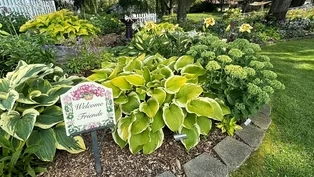
Preview: S39 Ep2 | 30s | Rita and Jim Erickson have a breathtaking landscape featuring hundreds of perennials. (30s)
Providing Support for PBS.org
Learn Moreabout PBS online sponsorship















Support for PBS provided by:
Prairie Yard & Garden is a local public television program presented by Pioneer PBS
Production sponsorship is provided by Shalom Hill Farm, Heartland Motor Company, North Dakota State University, Friends of Prairie Yard & Garden, and viewers like you.